 Blaine Siding
 Custer sits in that stretch of Whatcom County where marine weather off the Strait of Georgia meets the everyday grind of Pacific Northwest rain. It's a quieter corner than downtown Blaine, but the exterior of a house here takes the same beating: salt-laden air drifting in from the water, driving rain that comes in sideways during winter storms, and a moss season that can stretch from October well into spring. If you own a home in or around Custer, you've probably already noticed what that combination does to paint, trim, and siding over the years.
This page is about what that climate actually does to exterior materials, and how we approach siding, roofing, windows, and decks for homes in this area. We're not going to give you a sales pitch dressed up as an article. We'll tell you what we see on houses out here and why we've standardized on one siding product instead of offering everybody's favorite.
What Custer's Climate Does to a House
Whatcom County doesn't get hurricanes or heavy hail, but it makes up for that with sheer persistence. The moisture load here isn't dramatic — it's constant. That's a different kind of stress on a building envelope than a single big storm event, and it shows up in specific, predictable ways.
Salt Air and Coastal Proximity
Custer is close enough to the water that airborne salt is a real factor, especially on the sides of a house that face open exposure. Salt air accelerates corrosion on fasteners, flashing, and any metal trim components. It also breaks down certain paints and coatings faster than they'd wear inland, which is part of why factory-applied, baked-on finishes tend to outperform field-applied paint in this specific environment.
Driving Rain and Wind-Driven Moisture
Rain that falls straight down is manageable for almost any siding product. Rain that gets pushed sideways by wind — which happens regularly here in the fall and winter — finds every seam, lap, and penetration point on an exterior wall. Over years, that wind-driven moisture is what separates siding systems that hold up from siding systems that don't. It's less about total rainfall and more about how often the wall assembly gets wetted at an angle.
The Long Moss Season
Shaded north- and east-facing walls in this area, especially near tree lines, can stay damp for weeks at a stretch during the wet months. That's exactly the environment moss and algae need to take hold. Once organic growth establishes itself on a siding surface, it holds moisture against the material longer, which compounds whatever moisture problem already existed underneath.
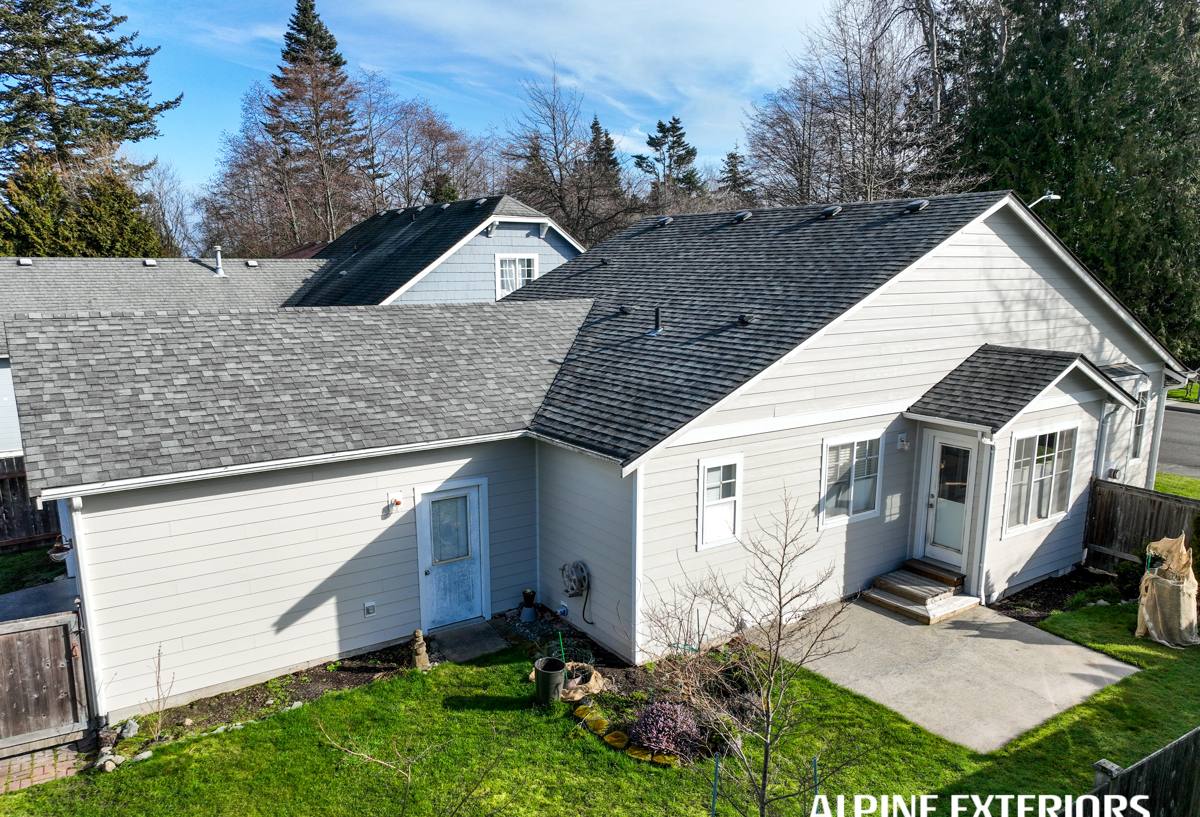
Why Product Choice Matters More Here Than in Drier Climates
In a dry climate, a lot of siding materials perform reasonably well regardless of their moisture tolerance, because they rarely get tested. Whatcom County is not that climate. Here, the difference between a siding product that's rated for moisture exposure and one that just tolerates occasional wetting shows up within a handful of years, not decades.
We install James Hardie fiber cement siding exclusively. We don't offer vinyl, LP SmartSide, Cemplank, Allura, primed spruce, or cedar. That's a deliberate standard, not a limitation of what we're capable of installing. Here's the honest reasoning behind it.
Where Wood-Based and Engineered Wood Products Struggle
Products like primed spruce, cedar, and engineered wood siding (LP SmartSide falls in this category) rely on their outer coating or treatment to keep moisture out of a wood-based core. That works fine as long as the coating stays intact everywhere, all the time — caulk joints, cut ends, fastener penetrations, everything. In a climate with this much sustained dampness and moss growth, any gap in that protection gives moisture a path into wood fiber, and wood fiber that gets wet repeatedly doesn't recover the way fiber cement does. We're not saying these products fail on every house. We're saying the margin for error is thinner here than in a dry climate, and we'd rather not build a customer's siding job around a product that punishes small maintenance lapses.
Where Vinyl Falls Short
Vinyl siding doesn't rot, which sounds like an advantage in a wet climate — and in terms of moisture absorption, it is. But vinyl expands and contracts with temperature swings, can become brittle over time, and its color is baked into the material itself rather than applied as a finish, so it fades unevenly and can't be refreshed without replacement. In coastal air, vinyl also tends to show chalking and discoloration sooner than a factory-finished product. It's a reasonable budget option in a lot of markets. We just don't think it's the right long-term answer for this one.
Why We Standardized on James Hardie
Fiber cement is non-combustible, dimensionally stable, and doesn't feed moss and algae growth the way wood-based products can. James Hardie's ColorPlus finish is baked on in a factory-controlled process rather than field-painted, which matters directly in a salt-air environment where field-applied paint tends to break down faster. Their HZ5 product line is engineered specifically for climates with significant moisture exposure and temperature swings — which describes Whatcom County well. It's not a magic material that never needs maintenance, but it's built for exactly the kind of exposure Custer homes deal with year-round.
How We Approach a Siding Job in Custer
Every house is different, but the sequence of decisions is consistent. We look at wall orientation, existing moisture damage, roofline and gutter performance, and how much shade a given elevation gets before we talk about product selection or color.
Inspection Before Anything Else
Before we quote a siding replacement, we check for soft spots, existing rot at trim and corner boards, and signs of past moisture intrusion around windows and doors. This matters more in a wet climate because siding problems here are rarely isolated — if one wall shows damage, we want to know whether the cause is a siding failure, a flashing failure, or a gutter that's been overflowing onto that wall for years.
Flashing and Water Management
Siding is only as good as the flashing and water management behind it. In a climate with this much wind-driven rain, we pay particular attention to window and door flashing, kick-out flashing at roof-to-wall intersections, and proper drainage planes behind the siding itself. This is the part of a siding job that's invisible once it's done, and it's also the part that determines whether the job lasts fifteen years or fifty.
Ventilation to Fight Moss and Trapped Moisture
On shaded elevations prone to moss, proper rainscreen or drainage gap installation lets a wall assembly dry out between wet periods instead of staying saturated. That drying capacity is a big part of why some houses in this area age well and others develop chronic moss and mildew problems on the same elevation year after year.
Beyond Siding: Roofing, Windows, and Decks
Siding doesn't work in isolation. A roof that's shedding water properly, windows that are flashed and sealed correctly, and a deck that drains instead of trapping water all affect how the rest of the exterior holds up.
Roofing
Roof condition directly affects siding longevity. A roof that's dumping water off a poorly positioned edge, or one with failing flashing at a wall intersection, will wet the siding below it far more than normal rainfall ever would. We look at roof-to-wall details as part of any siding evaluation in this area.
Windows
Window flashing is one of the most common sources of hidden water intrusion we find during siding tear-off. In a driving-rain climate, a window that's caulked instead of properly flashed is a slow leak waiting to happen. Replacing siding is often a good opportunity to correct window flashing issues that would otherwise stay hidden.
Decks
Decks in this climate deal with the same sustained moisture exposure as siding, plus foot traffic and sun exposure on top of it. Proper board spacing, ledger flashing, and drainage underneath matter just as much here as they do on a wall assembly.
Cost Factors for a Custer Siding Project
Every quote depends on the specific house, but these are the variables that move the number most:
| Factor | Why It Matters |
|---|---|
| Existing damage / tear-off | Rot repair and sheathing replacement add labor beyond a straightforward siding swap |
| Home size and wall complexity | More corners, dormers, and trim details increase labor time |
| Siding profile and finish | Lap, shingle, and panel profiles vary in material and installation cost |
| Flashing and water management upgrades | Correcting window and roof-wall flashing during the job adds cost but reduces future risk |
| Access and site conditions | Grade, landscaping, and structure height affect scaffolding and staging needs |
What a Homeowner Can Check Now
- Look at north- and east-facing walls for moss, algae, or persistent dark streaking
- Check caulk joints around windows and trim for cracking or gaps
- Look for soft or spongy siding near ground level or under downspouts
- Confirm gutters are clear and directing water away from the foundation and walls
- Note any areas where paint is peeling or bubbling, which can indicate trapped moisture
Choosing a Contractor for This Climate
A crew that mostly works in drier inland areas can miss the details that matter most here — flashing sequencing, drainage gap installation, and where moss tends to establish itself first. A local crew that works this specific stretch of Whatcom County sees the same failure patterns repeatedly and knows which details actually prevent them, rather than treating every job as generic.
If you're weighing a siding, roofing, window, or deck project on a Custer home, we're happy to take a look and walk you through what we see and what we'd recommend. There's no pressure and no obligation — just a straightforward, no-cost estimate based on your house.