 Blaine Siding
 One Product Line, On Purpose
Walk into most siding contractors' showrooms and you'll see four or five product families competing for your money: vinyl, LP SmartSide, primed wood, a fiber cement option or two, maybe a composite panel system. We don't do that. Every home we side gets James Hardie fiber cement, full stop. That's not a marketing gimmick or an exclusive dealer arrangement — it's a standard we set after years of watching which siding systems actually held up on homes along the Whatcom County coastline and which ones turned into callback jobs five to ten years in.
Blaine sits right on the water, a few miles from the Canadian border, and that location is exactly why material choice matters more here than it does inland. Salt air off Semiahmoo Bay and Drayton Harbor accelerates corrosion on fasteners and trim. Driving rain off the Strait pushes moisture sideways into seams and laps that would stay dry in a calmer climate. And the long, damp shoulder seasons here mean moss and algae have months at a time to get established on anything that holds moisture at the surface. A siding product that performs fine in Spokane or Yakima can struggle on a bluff-front lot in Blaine.
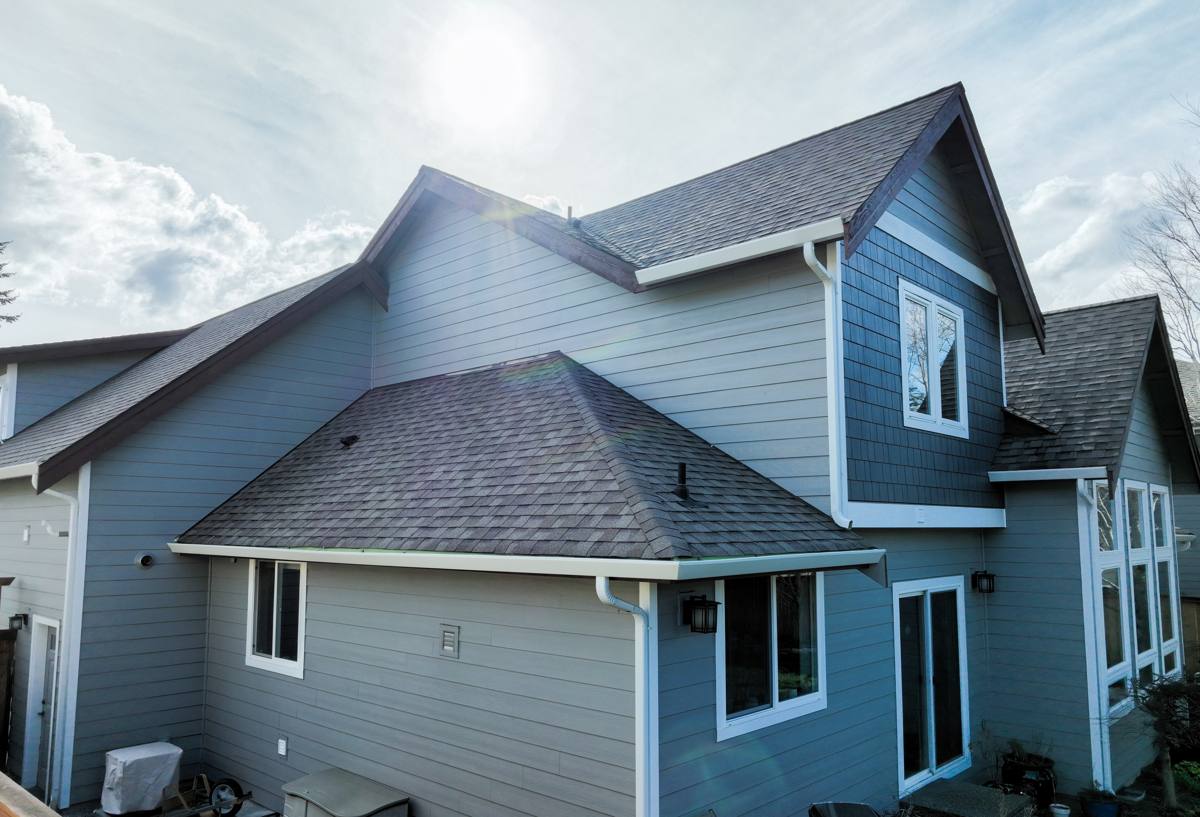
What We Stopped Installing, and Why
We used to offer more options. We narrowed the lineup because we got tired of doing warranty work and repair calls on products that looked fine at installation and failed on their own timeline later.
Vinyl
Vinyl siding is inexpensive and fast to install, and for a lot of the country that's a reasonable trade-off. In a marine climate it has real limits: it expands and contracts more than fiber cement with our temperature swings, seams and J-channels give wind-driven rain a path behind the panel, and the color is molded into the plastic rather than baked onto the surface — so as it ages it doesn't just get dirty, it chalks and fades unevenly, especially on south- and west-facing walls that catch the most sun and salt spray.
LP SmartSide and other engineered wood
Engineered wood siding has come a long way and holds paint well when it's new. The core is still wood strand, which means the number one risk is moisture intrusion at cut edges, fastener penetrations, and butt joints. In a climate with this much annual rainfall and a moss season that runs long, any gap in the factory sealant or field caulking becomes a slow-motion problem — swelling, delamination at the edges, and eventually rot that isn't always visible from the ground.
Primed spruce and cedar
Solid wood siding, primed or not, asks for a maintenance commitment most homeowners don't realize they're signing up for: repainting or restaining on a cycle of a few years, not a couple decades, plus vigilant caulking and moisture management. Cedar looks great and has real fans, but it's a product that rewards an owner who wants to actively maintain it, not one who wants to side the house and move on with life.
Cemplank, Allura, and other fiber cement alternatives
These are legitimate fiber cement products, and the material science is broadly similar to Hardie's. The differences that matter to us are the finish system, the climate-specific engineering of the plank profiles, and the strength of the manufacturer's installed warranty and support network in this region. Hardie has been refining its coastal Pacific Northwest product line and installer program longer than most of the competition, and that shows up in fewer callbacks.
What James Hardie Actually Is
Fiber cement is a mix of Portland cement, sand, and cellulose fiber, formed under pressure and cured. It is not wood, and it is not plastic — that distinction matters for three reasons homeowners care about.
- It's non-combustible. Fiber cement doesn't contribute fuel to a fire the way wood or vinyl siding can, which is a meaningful factor for insurance underwriting in some areas.
- It doesn't rot. There's no organic wood fiber for moisture to break down, so the failure modes that plague wood and engineered wood siding largely don't apply.
- It holds paint and factory finish far longer than wood because the substrate itself is dimensionally stable — it doesn't swell and shrink with humidity the way wood does, so the finish isn't being stressed by the material underneath it.
The HZ5 Product Line and Why Climate Rating Matters
James Hardie engineers its products in different formulations for different climate zones, sold under the HZ (HardieZone) system. HZ5 is the formulation engineered for wetter, more humid, freeze-prone regions — which describes Whatcom County's marine climate well. The HZ5 formulation is built to resist moisture-related damage in exactly the conditions Blaine sees for much of the year: sustained rain, high ambient humidity, and the freeze-thaw cycles that show up in winter cold snaps off the Strait.
This matters because not every fiber cement product on the market is climate-matched. Installing a siding product engineered for a dry inland climate on a saltwater-adjacent home is the kind of mismatch that looks fine for a few years and then doesn't.
ColorPlus Technology
One of the biggest practical differences between Hardie and field-painted siding is the ColorPlus factory finish. Instead of primer and paint applied on site after installation, ColorPlus color is baked onto the plank at the factory in multiple coats under controlled conditions, which produces better adhesion and more even coverage than anything achievable outdoors on a job site.
| Factor | Field-Painted Siding | ColorPlus Factory Finish |
|---|---|---|
| Application environment | Weather-dependent, on site | Controlled factory conditions |
| Typical repaint interval | 5-8 years | 15+ years before touch-up needed |
| Color consistency | Can vary batch to batch | Consistent across the run |
| Touch-up matching | Often visible | Formulated for close touch-up match |
In a climate where UV exposure is moderate but moisture exposure is constant, finish durability ends up mattering more than most homeowners expect when they're comparing bids.
Warranty Structure
James Hardie backs its siding with a limited transferable product warranty, and ColorPlus finishes carry a separate finish warranty covering issues like peeling and fading. The transferability matters for resale — if you sell the home within the warranty window, the coverage carries to the new owner, which is a detail buyers' agents and appraisers increasingly ask about. That said, a manufacturer warranty on the product is only half the equation. Improper installation — wrong nail placement, insufficient clearance from grade or roofline, unsealed butt joints — can void coverage regardless of how good the material is. That's why we're a certified Hardie installer and follow their fastening and flashing specifications to the letter rather than treating them as suggestions.
What Correct Installation Involves
Fiber cement siding is not vinyl. It's heavier, it doesn't flex the same way, and the manufacturer's specs on fastening, clearances, and flashing are not optional if you want the warranty to hold and the siding to perform for decades.
- Minimum clearance from grade, roof lines, decks, and patios to keep the bottom edge of the siding out of standing water and splash-back
- Correct nail type, spacing, and depth — over-driven or under-driven fasteners are one of the most common causes of early failure
- Properly lapped and sealed butt joints, especially critical on a home taking direct, wind-driven rain off the water
- Rainscreen or drainage plane installation behind the siding so any moisture that does get past the cladding has a path to drain and dry
- Correct caulking at penetrations — light fixtures, hose bibs, vents — using sealants rated for the exposure
- Field-cut edges back-primed or sealed per Hardie spec before installation, not left raw
A crew that's fast with vinyl but new to fiber cement will often under-estimate how much this level of detail matters. It's the difference between siding that looks the same in year fifteen and siding that needs trim repair by year seven.
Cost Factors Worth Understanding
Hardie siding costs more up front than vinyl and is generally comparable to or somewhat above engineered wood, depending on the plank profile and finish chosen. The way to think about it isn't sticker price alone — it's cost per year of expected service life, factoring in that Hardie generally doesn't need repainting for 15+ years and doesn't carry the rot risk that turns into structural repair costs on wood-based products.
| Factor | Effect on Project Cost |
|---|---|
| Plank profile (lap width, texture) | Wider reveals and smooth finishes vary in material cost |
| ColorPlus color vs. field-paint | Factory finish costs more up front, less over the ownership period |
| Trim and accessory package | Matching HardieTrim, soffit, and fascia adds cost but keeps the system consistent |
| Tear-off vs. install over existing siding | Full tear-off costs more but allows proper flashing and drainage plane work |
| Home complexity | Dormers, multiple gables, and cut-heavy elevations add labor time |
Is Hardie Right for Every Home?
Almost always, yes, for our climate — but we'll tell you honestly if your project has a wrinkle worth discussing, like a historic-district color restriction or a very tight budget where a phased approach makes more sense than doing the whole exterior at once. What we won't do is install a product on your home that we don't believe will hold up to a Whatcom County winter and the salt air coming off the water, just to win the bid.
If you're weighing a re-side and want a straight answer on what it'll take for your specific home, we're happy to walk the exterior with you and give you a free, no-pressure estimate — no obligation, no pushy follow-up calls.