 Blaine Siding
 Two Different Materials, One Climate to Answer To
If you're re-siding a home in Blaine, you've probably run into both names: James Hardie fiber cement and LP SmartSide engineered wood. They get compared constantly because they occupy similar price territory and both claim to outperform vinyl. But they are fundamentally different materials with different vulnerabilities, and Whatcom County's marine climate is exactly the kind of environment that exposes the difference. Salt-laden air off the Strait of Georgia, wind-driven rain that hits siding sideways for months at a stretch, and a moss and algae season that barely lets up from October through May — this is a tough proving ground, and it's why we made a standardizing decision years ago rather than pitching whichever product a customer had already heard of.
This page lays out how the two products actually differ, where each one is genuinely competitive, and why our crews install James Hardie exclusively. We're not going to tell you LP SmartSide is junk — it isn't. We're going to tell you what it's made of, what it needs from a homeowner to perform long-term, and why that maintenance profile didn't match what we wanted to stand behind in this specific climate.
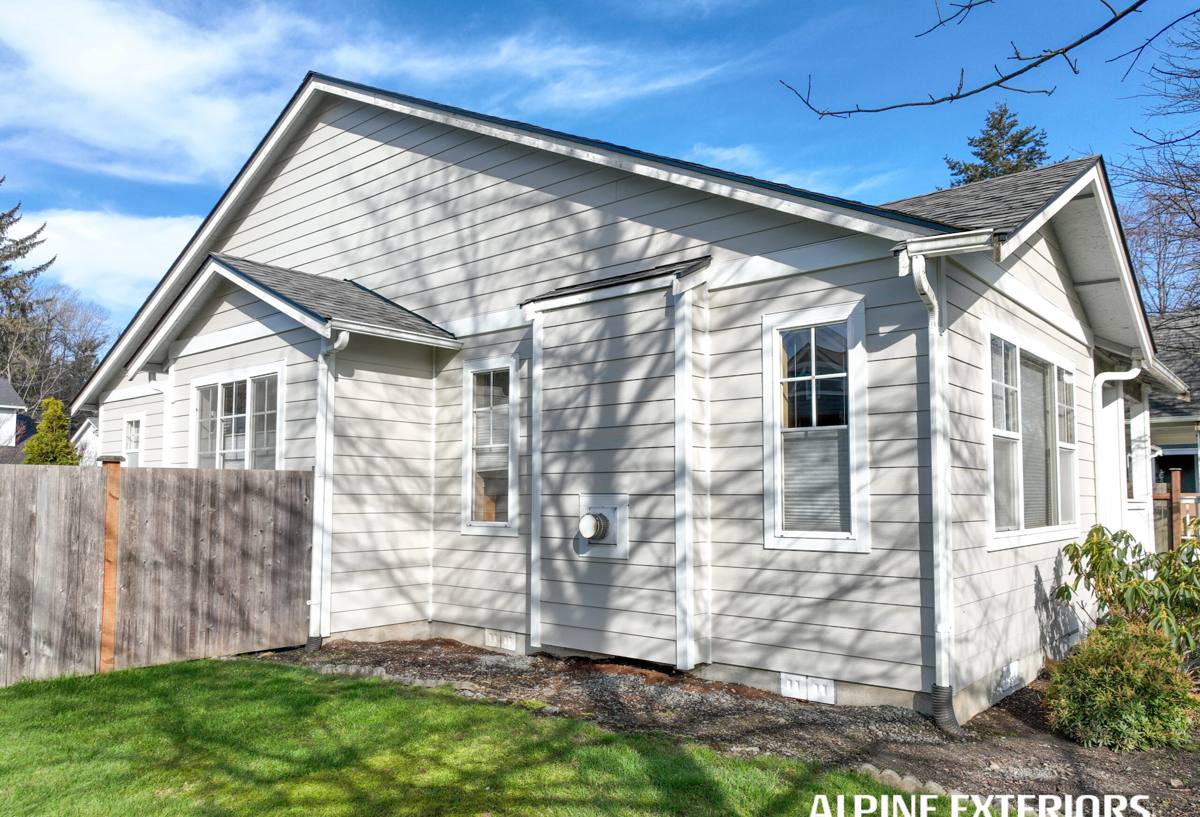
What Each Product Actually Is
James Hardie Fiber Cement
Hardie siding is a mix of Portland cement, sand, and cellulose fibers, cured and pressed into planks or panels. It's an inorganic composite — there's no wood fiber exposed to the weather, which is the core of why it behaves differently in a wet climate. The HZ5 product line, which is what we spec for this region, is engineered specifically for cold, wet, high-moisture climates like ours.
LP SmartSide
LP SmartSide is engineered wood — strand-based, similar in concept to OSB, treated with a zinc borate preservative and coated with a resin-saturated overlay for moisture resistance. It's wood at its core, which means it's lighter and easier to cut and nail than fiber cement, and it holds paint well when new. The preservative treatment is a real engineering improvement over old-school primed spruce or hardboard siding from decades past, and LP backs it with a warranty that's meaningful on paper.
Where the Marine Climate Changes the Calculus
Any siding material can be made to work in a lab. What matters here is what happens over 15, 20, 30 years of actual Blaine weather — salt spray, near-constant humidity, and long stretches where surfaces don't fully dry out between rain events.
Moisture Behavior
Because LP SmartSide is wood-based, its core material can absorb moisture if the protective overlay is ever compromised — at a cut edge, a fastener puncture, a caulk joint that fails, or a corner where installation wasn't precise. Once moisture gets past the treated surface into the strand core, that's the failure mode wood-composite siding is most known for: swelling, edge softening, and eventual rot at those breach points. In a climate with the dry summer stretches of the Midwest, minor breaches get a chance to dry out before they become a real problem. In Whatcom County, they often don't get that chance. Fiber cement doesn't have this failure mode — it isn't organic material, so there's no core to rot even if water reaches it.
Salt Air
Blaine sits close enough to saltwater that airborne salt is a real factor in coating and fastener longevity, not a theoretical one. Salt accelerates the breakdown of some coatings and corrodes unprotected metal fasteners faster than inland environments. Hardie's ColorPlus factory finish is baked on and engineered to resist fading and wear better than field-applied paint, and correct installation specs call for stainless or coated fasteners precisely because of environments like this one.
Moss and Algae
Northwest Washington's long wet season is a moss and algae engine, and any siding surface — fiber cement, engineered wood, vinyl, cedar — will host some biological growth over time if it stays damp and shaded. The difference is what happens underneath that growth. On fiber cement, surface growth is a cosmetic problem you can wash off. On wood-based siding, sustained moisture retention at the surface, combined with any coating wear, raises the odds that moisture works its way toward the core over time.
Side-by-Side Comparison
| Factor | James Hardie (HZ5) | LP SmartSide |
|---|---|---|
| Core material | Fiber cement (cement, sand, cellulose) | Engineered wood strand, resin-treated |
| Moisture failure mode | Non-organic; no core rot | Wood core can swell/rot if overlay is breached |
| Fire rating | Non-combustible | Combustible (treated wood product) |
| Factory finish | ColorPlus baked-on finish available | Primed; field paint typically required/recommended |
| Weight/handling | Heavier, requires more cutting care | Lighter, easier to cut and nail |
| Typical warranty | 30-year limited, transferable | 5-year, prorated after initial period on finish; substrate warranty varies |
| Recoating needs | Rare — factory finish holds long-term | Edges and cut ends need field sealing; repainting eventually needed |
| Upfront material cost | Moderate-to-higher | Generally lower |
Installation Sensitivity — Why the Details Matter More Here
Both products are what installers call "detail-sensitive," but the consequences of a missed detail differ. With LP SmartSide, every cut end, every fastener penetration, and every panel joint is a spot where the manufacturer requires field-applied sealant to maintain the moisture barrier. Skip one, or apply it wrong, and you've created a point where water can reach the wood core — and in a climate that doesn't dry out for months at a time, that point of entry has a long runway to do damage before anyone notices.
Hardie installation has its own strict spec — proper clearances, correct fastener type and placement, caulking at penetrations — and getting it wrong matters too. But because the material itself doesn't rot even when water reaches it, an installation flaw on fiber cement is far less likely to turn into structural siding failure. It's a meaningfully wider margin for error in a region where perfect, never-missed caulk joints over 20+ years are an unrealistic standard to hold any installation to.
What Correct Hardie Installation Involves
- Manufacturer-specified fastener type, spacing, and penetration depth — no shortcuts with the wrong nail gauge
- Proper clearance from grade, roofing, and decks to keep splash-back and standing water away from the bottom edge
- Rain screen or approved drainage plane behind the siding, appropriate for our wet climate
- Correctly lapped and flashed penetrations at windows, doors, and utility penetrations
- Field-cut edges treated per Hardie spec where required
- Caulking only where the manufacturer calls for it — not as a substitute for proper flashing
Fire Consideration
It's not the headline concern for a coastal town like Blaine the way it is in wildfire-exposed regions of the state, but it's still worth stating plainly: fiber cement is non-combustible, and engineered wood products are not, treatment notwithstanding. For homeowners weighing insurance considerations or simply wanting one less combustible material on the exterior of the house, that's a real, factual difference — not a scare tactic.
Cost Over Time, Not Just at Install
LP SmartSide typically costs less at the point of installation, and for a homeowner on a tight budget that's a legitimate factor — we're not going to pretend otherwise. But the honest comparison has to include what happens over the life of the siding: repainting cycles, caulking maintenance at joints and cut ends, and the risk exposure if a breach goes unnoticed in a climate that stays damp most of the year. Hardie's ColorPlus finish is designed to go decades without repainting, and the 30-year transferable warranty reflects the manufacturer's confidence in the non-organic substrate. When we run the numbers with customers over a 20-30 year horizon, the total cost picture narrows considerably, even though the day-one number is higher for Hardie.
Why We Standardized on Hardie
We used to install a broader mix of products. Over time, watching how different sidings actually aged on homes throughout Whatcom County's wet, salty, moss-prone conditions, fiber cement was consistently the material that held its finish, resisted moisture damage at the details that inevitably get missed somewhere on every real installation, and required the least from homeowners to keep looking and performing well. LP SmartSide is a legitimate, engineered product with real advantages — it's just not the one we're willing to warranty our workmanship on in this specific climate. We'd rather install fewer products well than a wider catalog with mixed confidence.
Get a Straight Answer for Your Home
Every house is different — sun exposure, wind exposure, how close you are to the water, what's on the siding now. If you want a straightforward look at what your home actually needs and an honest estimate for James Hardie siding done right, we're happy to come take a look. No pressure, no upsell script — just a clear answer for your specific property. Use the form below to request a free estimate.