 Blaine Siding
 Vinyl siding shows up on more homes in Whatcom County than any other exterior product, and there's a reason for that: it's inexpensive, it goes up fast, and for a lot of builders it's the path of least resistance. We get asked about it constantly, and we want to be upfront about where we stand. This company does not install vinyl siding. Not because it's a scam or a bad product in every application, but because after years of working on homes in Blaine and along the Whatcom County coastline, we've decided it isn't what we're willing to put our name on. This page explains why, honestly, without exaggerating vinyl's problems or pretending it doesn't have real advantages.
What Vinyl Siding Actually Gets Right
Before we get into why we don't install it, it's worth being fair about what vinyl does well, because a lot of the criticism you'll read online is overblown or outdated.
- Low upfront material and labor cost compared to fiber cement or wood
- Never needs painting, and holds its factory color reasonably well for the first several years
- Lightweight, which makes it fast to install and easy to ship
- Resists rot and insect damage because it's plastic, not wood-based
- Widely available in a huge range of colors and profiles
For a homeowner on a tight budget in a mild, dry climate, vinyl can be a reasonable choice. Blaine isn't that climate, and that's really the whole story.
Salt Air Changes the Math
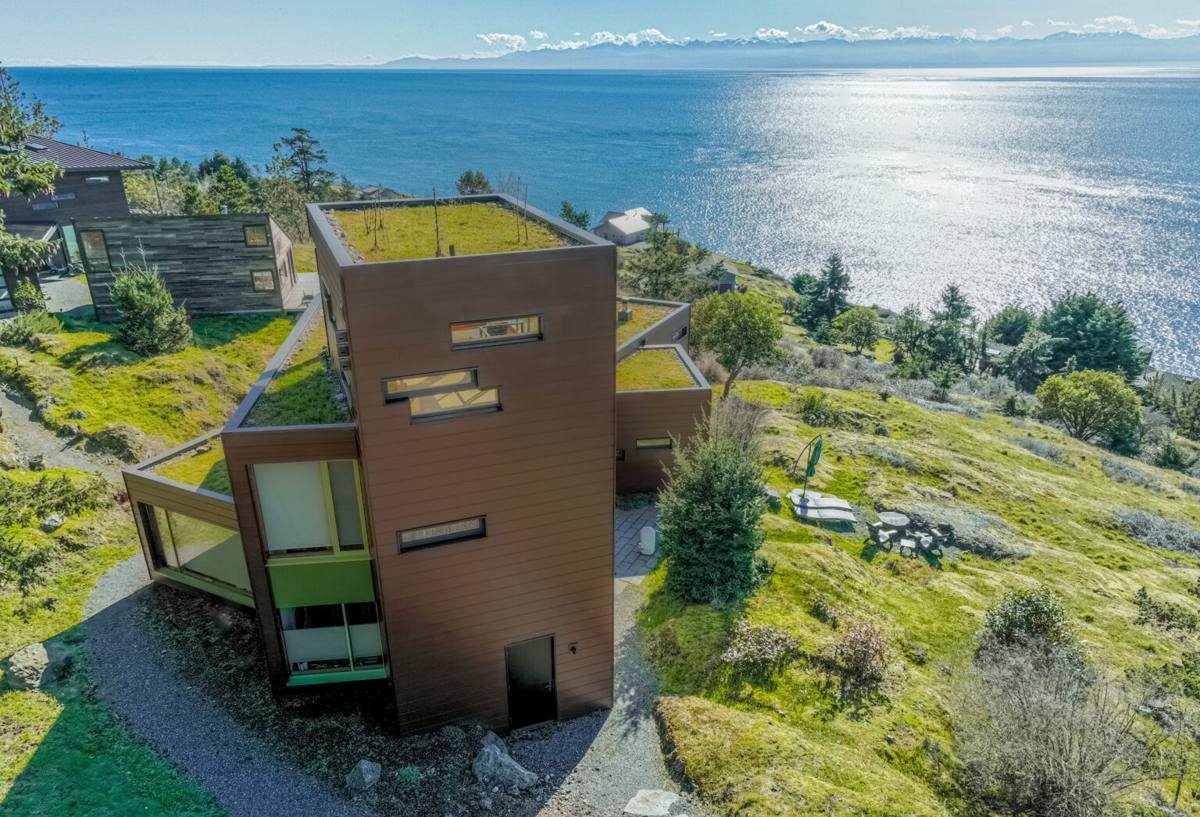
Blaine sits right on the water, and homes here take a different kind of weathering than siding fifty miles inland. Salt-laden air carries fine particulate that settles on exterior surfaces and works into seams, fasteners, and panel laps. Vinyl itself doesn't corrode, but the aluminum trim coil, exposed nail heads, and any metal flashing details that go along with a vinyl installation are all vulnerable to salt exposure over time. We've pulled vinyl panels off homes near the water and found streaking and pitting on trim and fasteners that wouldn't show up nearly as fast on a house set back from the coast.
Vinyl panels also expand and contract more than fiber cement with temperature swings, and that movement is engineered into the panel design through its interlocking track system. Along the water, where salt residue can accumulate in those tracks, panels can start to bind or rattle years before they would inland, and cleaning that residue out without damaging the panel edges is not a simple job.
Driving Rain and Wind-Driven Moisture
Whatcom County storms coming off the Strait of Georgia don't just drop rain straight down — wind pushes it sideways, directly into wall assemblies. Vinyl siding is installed as a loose-fitting rain screen by design; it's not a sealed water barrier, and it was never meant to be one. That's fine when the water hitting it is falling mostly vertically. It's a bigger problem when wind-driven rain is forcing water sideways into the overlaps and gaps that vinyl relies on to breathe and drain.
When that happens repeatedly over years, water finds its way behind the panels and onto the water-resistive barrier and sheathing underneath. If that barrier and the flashing details are done right, the wall still dries out fine. But vinyl siding lives or dies by the quality of what's behind it, and it hides problems well — you often don't know moisture has been getting behind a wall until the sheathing has already started to suffer.
Moss and the Long Wet Season
Blaine's moss season isn't a few weeks — it's most of the year. Anywhere shaded, north-facing, or close to trees stays damp for months at a time, and vinyl's textured, slightly porous surface gives moss, algae, and mildew spores something to grip onto. Vinyl doesn't rot from this, but it does discolor, and that green-black staining is stubborn. Pressure washing works, but done wrong it can force water up under the panels or crack aging vinyl that's gotten brittle from UV exposure, which just recreates the moisture problem described above.
Fiber cement isn't immune to moss and algae staining either — nothing sitting outside in Whatcom County is — but a factory-baked finish sheds and cleans differently than vinyl's surface, and the material itself doesn't become brittle with age and repeated washing the way vinyl can after a decade or two in the sun and salt.
Where Vinyl Tends to Fail First
In our experience working across this region, vinyl siding problems cluster in a few predictable spots rather than happening uniformly across a wall:
- South and west-facing walls, where UV exposure fades color unevenly and can make panels brittle
- Corners and butt joints, where caulking failure lets wind-driven rain behind the panel
- Low areas near grade, where splash-back keeps panels wet longer and accelerates staining
- Around windows and doors, where flashing quality — not the siding itself — determines whether water gets trapped
- Anywhere panels were installed too tight, restricting the expansion vinyl needs and causing buckling
That last point matters more than most homeowners realize. A huge share of vinyl siding failures aren't a material defect — they're an installation error. Vinyl has to be hung loose enough to move with temperature changes, and a crew working fast on a production schedule doesn't always get that detail right. We'd rather not install a product where the margin for installer error is that unforgiving.
Vinyl vs. Fiber Cement: A Straight Comparison
| Factor | Vinyl Siding | James Hardie Fiber Cement |
|---|---|---|
| Upfront cost | Lower | Higher |
| Fire resistance | Combustible plastic | Non-combustible |
| Salt air durability | Panel is fine; trim and fasteners are vulnerable | Engineered coastal formulations available; corrosion-resistant fastening details |
| Moisture behavior | Relies entirely on what's behind it | More dimensionally stable; less prone to trapping water when installed to spec |
| UV / color fade | Fades and can become brittle over time | ColorPlus factory finish is baked-on and warrantied against fade |
| Impact resistance | Can crack in freeze conditions or from impact | Denser material, more impact-resistant |
| Typical lifespan installed well | 20-30 years | 30-50+ years |
| Warranty structure | Prorated after early years, common exclusions for fading/warping | Non-prorated transferable warranty on the product; separate finish warranty |
None of this means vinyl is worthless — plenty of vinyl-clad homes in this area are holding up fine, especially where they're sheltered from direct wind and salt exposure. It means that for the climate we work in, the trade-offs stack up against it more often than they don't, and we'd rather build our reputation on a product with a wider margin for the weather here.
Why We Standardized on James Hardie
We install exclusively James Hardie fiber cement siding, and that's a deliberate business decision, not a marketing angle. Hardie's fiber cement is non-combustible, which matters on a lot of levels beyond wildfire risk — it also resists the kind of heat and impact damage that can crack vinyl. The HZ5 product line is engineered for climates with exactly this kind of moisture exposure, and the ColorPlus factory finish holds color and resists fading in a way that field-applied paint or vinyl's baked-in pigment struggles to match over the same number of years.
Just as importantly, Hardie backs the product with a real transferable warranty, and because we install it to their specifications, that warranty coverage actually holds up if something goes wrong. We're not choosing Hardie because it's trendy — we're choosing it because after years of tearing off failed siding systems on Whatcom County homes, it's the product we trust to still be doing its job in three decades, not just three years.
What This Means If You're Planning a Siding Project
If you already have vinyl siding on your Blaine home and it's performing fine, there's no reason to panic or rush a replacement — plenty of vinyl holds up for its expected lifespan, especially on sheltered walls. This page isn't meant to scare you into a project you don't need. It's meant to explain honestly why, when you're ready to replace siding, we're going to steer you toward fiber cement rather than another round of vinyl, and why we won't quote a vinyl installation even if that's what you originally had in mind.
A few things worth checking before you decide on your next siding project:
- How exposed is your home to prevailing wind and rain off the water
- Are there north-facing or shaded walls that stay damp for long stretches
- Is your current siding trapping moisture behind it, or is it draining and drying properly
- What warranty coverage do you actually have left, and does it cover fading, warping, or cracking
- Are you planning to stay in the home long enough for a lower-cost option's shorter lifespan to matter
If you'd like an honest look at what's going on with your current siding and what your options actually are, we're happy to come take a look. It's a free, no-pressure estimate, and if fiber cement isn't the right call for your situation, we'll tell you that too.