 Blaine Siding
 What Whatcom County Weather Does to Siding
Homes in Bellingham and Blaine sit right where marine air off the Salish Sea meets a wet, mild Pacific Northwest climate. That combination is easier on siding than a freeze-thaw climate in some ways, but it creates its own steady, grinding set of problems. Salt-laden air moves inland from Semiahmoo Bay, Boundary Bay, and the Bellingham waterfront, and it doesn't take a beachfront lot to feel it — homes several miles inland still pick up airborne salt and moisture on a regular basis.
Add to that a rainy season that can stretch from October well into May, with long stretches of low-intensity drizzle punctuated by wind-driven storms, and siding here rarely gets a real chance to dry out fully before the next system rolls through. That's the core issue: it's not one big storm that damages a wall, it's months of siding staying slightly damp, cycling between wet and less-wet, over and over, year after year.
Moss, Algae, and the Shade Problem
Whatcom County's tree cover and cloudy skies mean a lot of homes have north- and east-facing walls that barely see direct sun for weeks at a time. Combine that with high ambient humidity and you get ideal conditions for moss and algae to take hold on siding, trim, and fascia. On absorbent or poorly sealed materials, that growth isn't just cosmetic — it holds moisture against the wall surface and can accelerate rot, paint failure, and substrate breakdown underneath.
Why This Matters When You Choose a Siding Material
The honest answer is that not all siding handles "always a little bit wet" equally well. Wood-based products — including primed spruce, OSB-core siding like LP SmartSide, and real cedar — depend heavily on an intact factory or field-applied coating to keep moisture out of the wood fibers. In a climate where that coating rarely gets a long dry stretch to cure, fully out-gas, or simply rest, any nick, unsealed cut edge, or caulking gap becomes a slow entry point for water. Once moisture gets into wood-based substrate, swelling, edge softening, and eventual rot tend to follow — not overnight, but over years, often starting at the bottom courses, around window trim, and near ground-level splash zones.
Vinyl siding avoids the rot issue since it isn't wood-based, but it has its own trade-offs in this climate: it can fade and become brittle with UV and temperature cycling over time, its seams and panel laps give moss and algae plenty of texture to grip, and it's not offered in the kind of substantial, factory-baked color and texture options that hold up visually decade after decade. It also isn't fire-resistant, which matters more each year as wildfire smoke and ember exposure become a bigger part of the PNW conversation, even this far north.
Why We Only Install James Hardie Fiber Cement
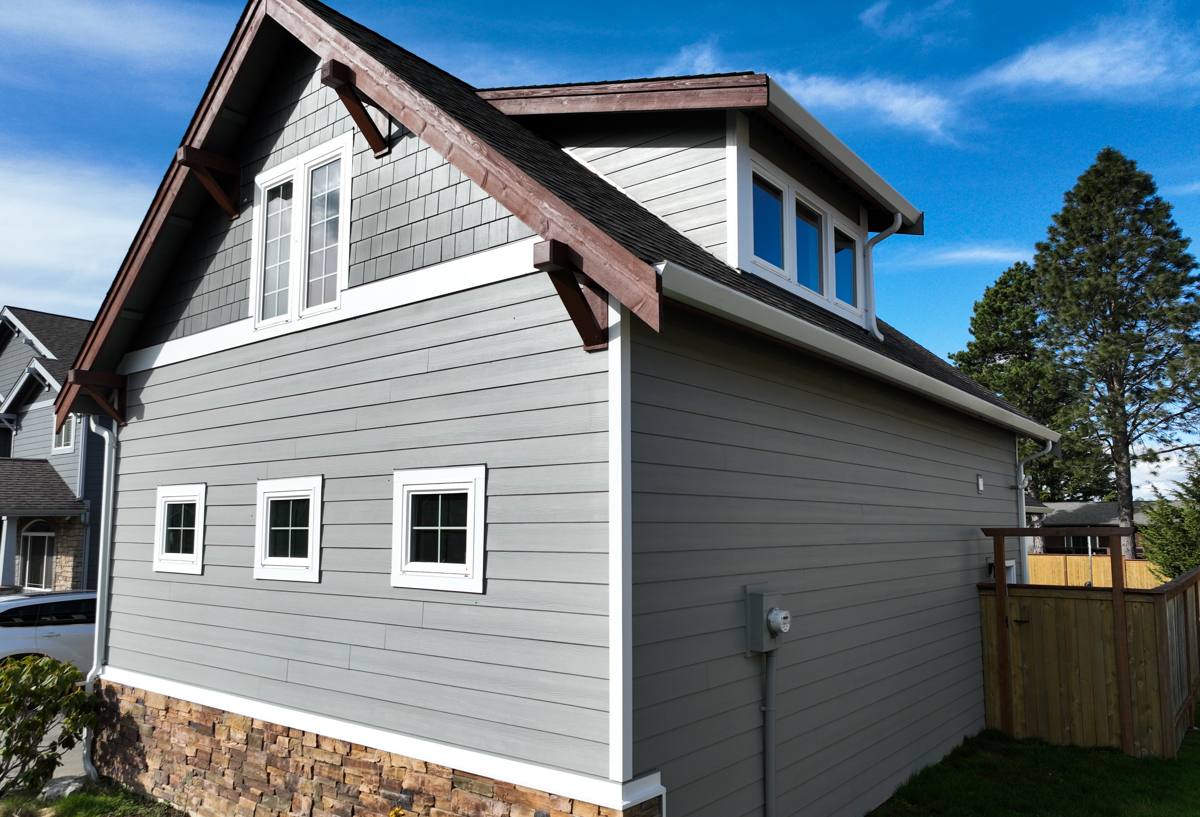
We made a deliberate call as a company: we install James Hardie fiber cement siding, exclusively. We don't install LP SmartSide, vinyl, Cemplank, Allura, primed spruce, or raw cedar. That's not a marketing angle — it's because in a climate like Bellingham and Blaine's, the material itself does most of the work of keeping a home dry and looking good, and Hardie is the product we've seen perform most consistently over the long run.
Fiber cement is made from cement, sand, and cellulose fiber, which means there's no wood substrate to rot and nothing for moisture to swell. It's also non-combustible, which is a real, practical advantage as wildfire risk creeps further into Western Washington's summer conversation. James Hardie backs its siding with a factory-applied ColorPlus finish baked on under controlled conditions — a more durable, consistent bond than most field-applied paint can achieve, especially on a job site where you're fighting rain half the year to get a clean paint window.
HZ5 Engineering for Marine Climates
James Hardie engineers its products by climate zone, and the Pacific Northwest — including Whatcom County — falls into their HZ5 zone, formulated specifically for moisture-heavy, marine-influenced regions. That's a meaningful distinction: it means the product going on a Bellingham or Blaine home isn't a generic national spec, it's built with this exact kind of weather in mind.
What a Correct Hardie Installation Involves
Material choice only gets a homeowner halfway there. Fiber cement siding is installation-sensitive — done right, it performs for decades; done poorly, even the best product can develop problems. A correct install in this region typically includes:
- A proper weather-resistive barrier and rainscreen or drainage gap behind the siding, so any incidental moisture has somewhere to go
- Correct fastener type, spacing, and embedment per Hardie's published installation specs
- Properly flashed and sealed window and door openings, since these are the most common failure points on any siding job
- Factory-cut and factory-primed edges wherever possible, with any field cuts properly sealed
- Adequate clearance between the bottom of the siding and grade, decks, or roof lines to avoid constant splash-back saturation
- Correct caulking and sealant at butt joints and penetrations, using products rated for the material and climate
This is also where a local crew matters more than it might seem. A contractor who works Whatcom County year-round already knows which details to prioritize — where moss tends to build up, which orientations need extra drainage attention, how much clearance to leave near sprinkler zones and low plantings that stay damp. That's knowledge that comes from doing the work here repeatedly, not from a general specification sheet.
Bellingham & Blaine: Site-Specific Considerations
Bellingham's neighborhoods range from close-in, tree-shaded lots to more open, wind-exposed areas near the water — and Blaine, sitting right on Boundary Bay near the Canadian border, gets a steadier dose of direct marine wind and salt air. Homes in both areas benefit from the same core approach, but the details shift with the site:
- Wooded or shaded lots: prioritize drainage and airflow behind the siding to limit moss and slow drying
- Open, wind-exposed lots near the water: prioritize fastener spec and sealant quality at joints, since wind-driven rain finds gaps that calmer conditions wouldn't expose
- Older homes with existing wood siding: expect some hidden moisture damage at trim and sill areas that only shows up once the old siding comes off
- Homes near heavy tree cover: plan for ongoing gutter and roof-line maintenance, since organic debris buildup feeds the same moss and algae issues that affect siding
Comparing Siding Materials for This Climate
| Material | Moisture Behavior in Wet Climate | Fire Resistance | Typical Finish Longevity |
|---|---|---|---|
| James Hardie Fiber Cement | No wood substrate to rot; engineered HZ5 formulation for marine climates | Non-combustible | Factory ColorPlus finish, long-lasting baked-on color |
| LP SmartSide (OSB-based) | Wood-strand core vulnerable if coating is compromised | Combustible, wood-based | Depends on coating integrity over time |
| Vinyl Siding | Won't rot, but seams collect moss/algae; can become brittle with age | Not fire-resistant | Color can fade with UV exposure over years |
| Primed Spruce / Cedar | Natural wood, most exposed to swelling and rot without diligent upkeep | Combustible | Requires regular repainting/resealing |
Beyond Siding: Roofing, Windows, and Decks
Siding rarely fails in isolation — it's usually part of a bigger picture. A roof with degraded flashing or clogged gutters dumps extra water down the wall it's supposed to protect. Old windows with failed seals let moisture track into the wall cavity right at the trim line, one of the most common spots we find hidden damage. And a deck built tight against the house without proper flashing can trap moisture right where siding meets the ledger board.
We handle siding, roofing, windows, and decks, which matters in a climate like this because these systems all interact. When we're on-site for a siding project, we're also looking at how the roof edge, window flashing, and any attached deck are affecting the wall — not just replacing panels and moving on.
What to Expect From a Siding Project Here
Inspection and Scoping
We start by looking at what's actually happening behind the current siding where possible — trim areas, low corners, and anywhere staining or soft spots suggest moisture has already gotten in. This tells us whether it's a straightforward re-side or whether some sheathing repair is needed first.
Prep and Drainage Plane
Before any new siding goes up, we make sure the weather-resistive barrier and drainage plane behind it are correct for the site — this is the layer doing the real work of managing the moisture this climate throws at a wall, and it's not visible once the job is done, which is exactly why it needs to be right the first time.
Installation to Spec
Fastening, flashing, and joint sealing follow James Hardie's published specifications, adjusted for the specific exposure of the home — waterfront wind exposure in Blaine versus shaded, tree-heavy lots common around Bellingham.
Maintenance Checklist for Hardie Siding in This Climate
- Rinse siding periodically to discourage moss and algae buildup, especially on shaded north- and east-facing walls
- Keep gutters clear so overflow doesn't run down and saturate wall sections repeatedly
- Trim back vegetation and tree limbs that keep siding shaded and damp longer than necessary
- Inspect caulking at trim, joints, and penetrations every couple of years and re-seal as needed
- Watch for any staining or soft spots near ground level or under windows, which can signal a flashing or drainage issue worth checking early
Why a Local Crew Matters
Bellingham and Blaine aren't generic Pacific Northwest weather — they're specifically marine-influenced, shaded in places, salt-exposed in others, and wet for a large share of the year. A crew that works this county regularly builds a feel for which homes need extra drainage attention, which need tougher sealant work at wind-exposed corners, and which just need a straightforward, well-executed install. That local judgment, paired with a material engineered for this exact climate zone, is what makes siding last here instead of becoming a recurring maintenance project.
If you're weighing a siding project in Bellingham, Blaine, or elsewhere in Whatcom County, we're happy to take a look and give you a straightforward, no-pressure estimate — just fill out the form below.