 Blaine Siding
 Lynden sits inland from the Salish Sea in the heart of Whatcom County's farmland, but don't let the distance from the water fool you: this is still Pacific Northwest exterior weather, and it is still hard on a house. Between the marine-influenced rain that rolls in off the water, the wind that funnels down out of the Fraser Valley and across the open fields, and a moss and mildew season that can stretch from October well into spring, Lynden homes take a steady beating year after year. We've worked on siding, roofing, windows, and decks throughout this part of the county long enough to know exactly where that damage shows up first, and what actually holds up against it.
What Lynden's Climate Does to a House
Whatcom County's weather pattern is defined by moisture that doesn't let up. Lynden gets a lot of the same low, gray, drizzly stretches that define the whole region, but its open agricultural setting adds a few wrinkles you don't see as much in denser neighborhoods closer to the water. Wind has room to build across open fields before it hits a house, driving rain sideways into wall assemblies that were only ever designed to handle water falling straight down. Add in the salt-laden air that regional weather systems carry inland off the Salish Sea, and you've got a combination that quietly works on caulk joints, fasteners, and paint film even when nothing looks obviously wrong from the curb.
The other constant here is moss. Shaded north walls, areas under mature trees, and anywhere siding stays damp for days at a stretch will grow moss and algae if the material and the paint system aren't built to resist it. Left alone, that growth holds moisture against the wall, which is where the real damage starts — not the green film itself, but what it does to the substrate underneath over months and years.
The Damage Pattern We See Most
- Paint and caulk failure on south- and west-facing walls that take the brunt of wind-driven rain
- Moss and mildew staining on shaded north sides and anywhere tree cover blocks sun and airflow
- Swelling, delamination, or soft spots on wood-based and engineered wood sidings where water has worked past the surface
- Corroded or loosening fasteners on older installations, accelerated by salt-influenced moisture in the air
- Trim and butt joints that have opened up, giving water a direct path behind the siding
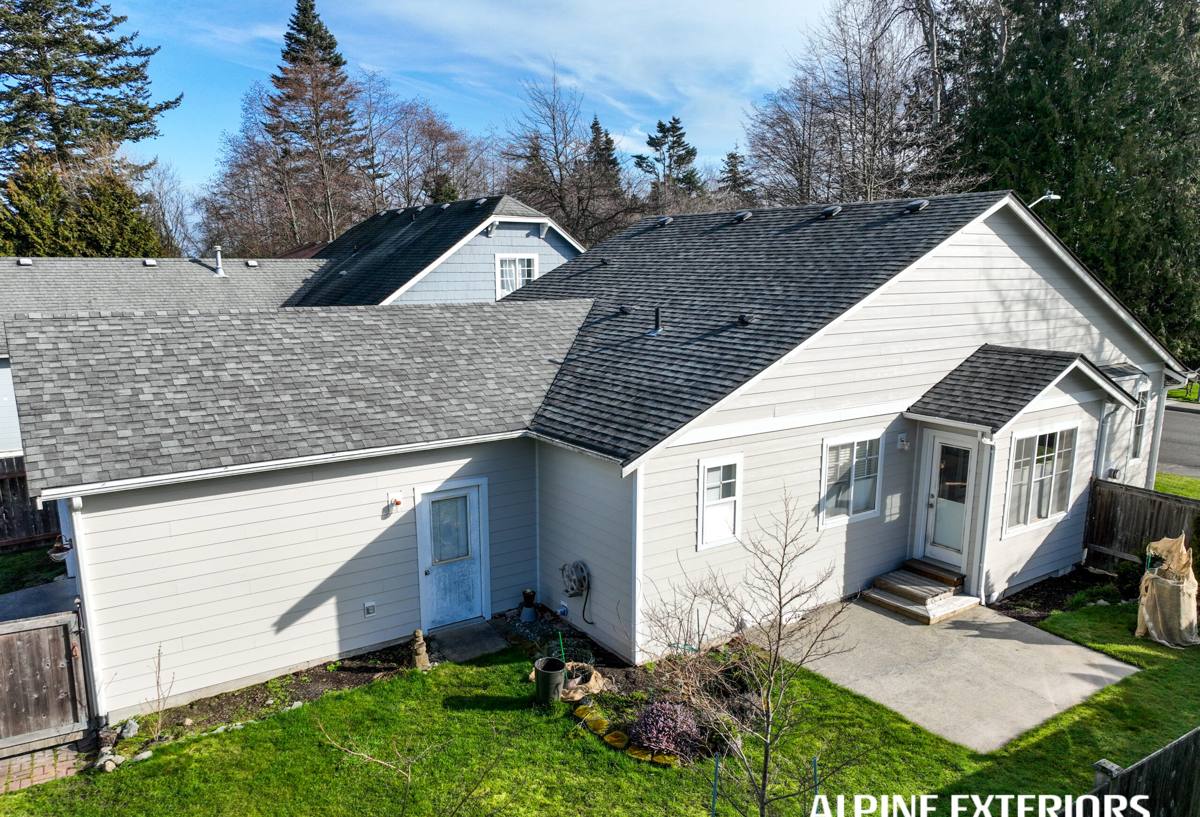
Why We Only Install James Hardie Fiber Cement
Blaine Siding Contractors made a decision a long time ago to stop installing anything other than James Hardie fiber cement siding. We don't carry vinyl, LP SmartSide, Cemplank, Allura, primed spruce, or cedar. That's not a marketing angle — it's a standard we hold ourselves to because we've seen how each of those products actually performs after five, ten, and twenty years in exactly the kind of weather Lynden gets.
Wood-based products, whether that's cedar, primed spruce, or engineered wood siding like LP SmartSide, all share the same basic vulnerability: they're organic material, and organic material swells, checks, and eventually breaks down when it stays wet as often as siding does out here. Engineered wood has come a long way with resin-treated strand and factory coatings, and it can be a reasonable product when installed and maintained exactly to spec — but it still depends on unbroken paint film and diligent caulk maintenance to keep water out of the substrate, and in a climate with this much sustained moisture, that margin for error is thin. Cedar and primed spruce ask even more of the homeowner: regular refinishing, careful attention to end grain and butt joints, and a willingness to stay ahead of moss and mildew before it takes hold.
Vinyl siding avoids the rot problem entirely, but it brings its own trade-offs. It expands and contracts significantly with temperature swings, which stresses seams and fastening over time, and it doesn't offer the same fire resistance or impact durability as fiber cement. Cemplank and Allura are also fiber cement products, and they're not bad materials — but we standardized on one manufacturer's system so every job we do uses matched trim, matched fasteners, and a factory finish we can back with consistent warranty coverage, rather than mixing components across brands.
James Hardie's fiber cement is engineered specifically for climates like ours. It's non-combustible, it doesn't feed moss and mildew the way wood fiber does, and Hardie's ColorPlus factory finish is baked on under controlled conditions rather than field-applied, which means far more consistent coverage and a much longer stretch before repainting is even a conversation. Hardie also builds region-specific HZ product lines engineered for the exact moisture and temperature patterns of the Pacific Northwest, and backs the material with a strong, transferable warranty — something that matters if you ever sell the house.
Siding Product Comparison
| Product | Moisture Resistance | Maintenance Burden | Typical Lifespan Here |
|---|---|---|---|
| James Hardie Fiber Cement | Excellent — inorganic, engineered for wet climates | Low — factory finish, no refinishing for years | 30+ years with proper install |
| Vinyl | Good, but expands/contracts with temperature | Low, but seams and fasteners loosen over time | 15-25 years |
| LP SmartSide / Engineered Wood | Moderate — dependent on intact paint film | Moderate to high — caulk and paint upkeep critical | 15-25 years if well maintained |
| Cedar / Primed Spruce | Fair — natural wood, prone to moisture uptake | High — regular refinishing and moss control | 10-20 years, highly maintenance-dependent |
Siding Installation and Replacement in Lynden
Every siding job we do starts the same way: a careful look at what's underneath the existing exterior. Whatcom County's moisture load means we routinely find water damage to sheathing or framing that isn't visible from outside, and there's no point putting new siding over a wall assembly that's already compromised. We check flashing, house wrap, and window and door transitions before anything new goes up, because those details matter more to long-term performance than the siding product itself.
Once we're confident the wall is sound, installation follows Hardie's specifications closely — correct fastener spacing and type, proper clearances at grade and at roof lines, and joint treatment that keeps water moving out and away from the wall rather than trapping it. That last part is where a lot of siding failures actually start, regardless of the product installed. A well-built house with the wrong details will leak; a correctly detailed house with a durable product like Hardie fiber cement is built to shrug off decades of Lynden's weather.
Roofing, Windows, and Decks — The Rest of the Envelope
Siding doesn't work in isolation. We handle roofing, windows, and decks because a home's exterior is one connected system, and problems in one area almost always show up in another.
Roofing
A roof that's shedding granules, holding onto moss, or leaking at flashing points sends water straight down onto the siding and trim below it. We look at roof condition as part of any siding conversation, because replacing siding under a failing roof just moves the water damage timeline up.
Windows
Old or poorly flashed windows are one of the most common hidden water entry points on Lynden homes. When we tie new siding into window openings, we make sure flashing and sealant details are correct, not just cosmetically finished.
Decks
Decks take the same driving rain and moss exposure as siding, plus direct foot traffic and standing water risk. Ledger board connections and the wall behind them are a common trouble spot we check closely, since a poorly flashed ledger can quietly rot the wall it's attached to.
Why a Local Crew Matters Out Here
Lynden's mix of open farmland, mature tree cover in older neighborhoods, and proximity to both the Nooksack River and the Canadian border creates microclimates that shift block to block. A crew that works this specific area regularly knows which walls take the worst of the wind-driven rain, which yards hold enough shade and moisture to grow moss fast, and how local permitting and inspection processes actually run. That local knowledge shapes real decisions — where we pay extra attention to flashing, which sides of a house get the more moisture-resistant detailing, and how we sequence a project around the wetter months.
What to Ask Before Hiring an Exterior Contractor
- Are they licensed and insured in Washington, and can they show proof without hesitation?
- Do they install to the manufacturer's written specifications, including fastener type and spacing?
- Will they inspect and address sheathing, flashing, and moisture issues before covering them with new siding?
- Is the warranty backed by the manufacturer and transferable if you sell the home?
- Can they explain, in plain terms, why they recommend one product over another for your specific walls and exposure?
Planning a Project in Lynden
Whether you're dealing with siding that's showing its age, a roof that's due for replacement, windows that let in more draft than light, or a deck that needs rebuilding, the same principle applies: address the whole exterior system, not just the visible symptom. A new coat of paint on failing siding, or new siding over an unaddressed leak, is money spent solving the wrong problem.
If you're weighing your options for a home in Lynden, we're happy to take a look and walk you through what we're seeing — no pressure, no sales script, just a straight assessment from a crew that works this weather every day. Reach out for a free estimate using the form below.