 Blaine Siding
 Siding Fails From the Back, Not the Front
Most homeowners judge their siding by what they can see: fading, chalking, a crack here and there. But the damage that actually costs money almost always starts on the inside face of the siding, against the sheathing, where nobody looks until something goes soft underfoot on the deck or a wall starts smelling musty. By the time a stain or a bulge shows up on the outside, the wood framing behind it has often been wet for years.
This matters more in Blaine than in a lot of places. Sitting right on the Strait of Georgia in Whatcom County, homes here take a steady combination of driving rain off the water, salt-laden air, and a moss season that can run half the year. None of that is dramatic on any given day. It's the accumulation that does the damage.
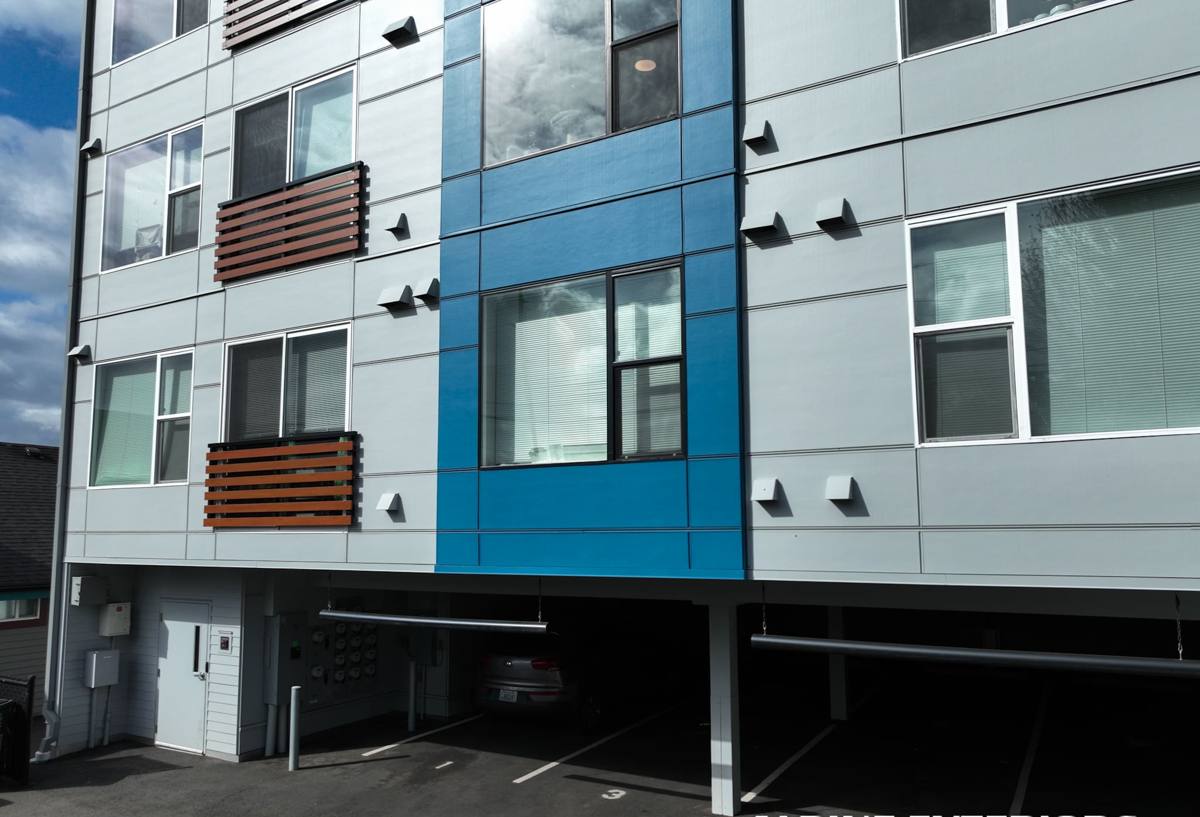
How Water Actually Gets Behind Siding
Siding isn't a waterproof shield in the way people assume. Every siding product, including the best ones, is designed to shed the majority of water while accepting that some moisture will get past face joints, fastener holes, and trim intersections. What determines whether that moisture becomes a problem isn't whether it gets in at all — it's what happens to it next.
- Wind-driven rain — Blaine's exposure to weather coming off the water means rain regularly hits siding at an angle instead of falling straight down, forcing water into laps and seams that would stay dry in a more sheltered location.
- Capillary action — water can wick upward and sideways through tight seams and against fastener shanks, moving well beyond where it first made contact.
- Condensation — warm, moist indoor air migrating outward through the wall cavity can condense against the back of cold siding, adding moisture from the inside with no rain involved at all.
- Splashback and grade contact — siding installed too close to soil, decks, or hardscape stays wet longer after every rain and picks up moisture from the ground itself.
None of these are exotic failure modes. They happen on ordinary houses, on ordinary streets, every wet season.
The System Behind the Siding Matters More Than the Siding Itself
The siding you see is really the last layer of a stack that's supposed to work together:
Weather-Resistive Barrier (WRB)
A house wrap or building paper installed over the sheathing, meant to stop bulk water while still letting the wall assembly dry. Gaps, tears, or improperly lapped seams in this layer are one of the most common hidden causes of rot — and they're invisible once siding goes over them.
Flashing
Metal or membrane flashing at windows, doors, roof-to-wall intersections, and horizontal trim is what directs water back out instead of letting it run down into the wall cavity. Flashing mistakes are quiet failures — they don't cause problems on day one, but they concentrate water in one spot year after year until that spot fails.
Rainscreen / Drainage Gap
A small air gap between the WRB and the back of the siding lets any water that does get through drain out and lets the wall cavity dry through air movement. Without it, siding sits tight against a wet barrier with nowhere for moisture to go.
Fastening and Clearances
Correct nail placement, proper gaps at trim and butt joints, and adequate clearance from roof lines, decks, and grade all affect how much water reaches the wall assembly in the first place and how quickly it leaves.
A siding product can be excellent and still fail early if any one of these layers is done wrong. Just as often, mediocre siding lasts a long time because the system behind it was built correctly. This is why "what brand of siding did they use" is only part of the real question.
Why Blaine and Whatcom County Conditions Push Harder on This System
Coastal exposure changes the math on moisture in a few specific ways:
- Salt air accelerates corrosion of fasteners, flashing, and metal trim — a corroded fastener or flashing seam fails faster here than the same detail would inland.
- Driving rain off the Strait pushes water into laps and joints that would stay dry under a straight-down rain, which is the assumption a lot of older installation practices were built around.
- Long moss and lichen season keeps north-facing and shaded walls damp for extended stretches, since moss and lichen hold moisture against the surface long after a storm has passed.
- Marine humidity slows drying between rain events, so a wall assembly that's slightly compromised gets less recovery time than it would in a drier climate.
None of this means Blaine homes are doomed to rot problems. It means the margin for error in the siding system — flashing, WRB continuity, drainage, product choice — is smaller here than it is in a lot of the country, and cutting corners shows up sooner.
How Different Materials Behave Once Moisture Gets Behind Them
This is where material choice actually matters, separate from the installation system. Some sidings tolerate incidental moisture behind the surface reasonably well. Others don't.
| Material | How it responds to trapped moisture | Practical implication |
|---|---|---|
| Solid wood / cedar | Absorbs water, can swell, cup, and eventually rot if it stays wet | Needs consistent maintenance and finish upkeep to keep water out in the first place |
| Primed spruce / engineered wood (OSB-based) | Wood-fiber core can swell and lose structural integrity if the factory edge seal or field-cut edges are compromised | Edge and cut protection during and after installation becomes critical, especially in wet climates |
| Vinyl | Doesn't absorb water itself, but doesn't stop it either — it can trap moisture against the WRB behind it | Performance depends almost entirely on what's behind it, since the vinyl itself isn't doing much |
| Fiber cement (James Hardie) | Cement-based composition doesn't swell, rot, or support the kind of decay that wood-based products can | More forgiving of incidental moisture exposure, though correct installation still matters for the wall assembly behind it |
That last row is the reason this company standardized on James Hardie fiber cement and stopped installing wood-based and engineered-wood siding products. It's not that those products can't be made to work — with diligent maintenance and a well-executed installation, many perform fine for years. It's that fiber cement removes an entire failure mode from the equation: the material itself doesn't rot, swell, or feed decay the way wood fiber does, which matters more on a coastal wall than it does somewhere dry and sheltered. Hardie's engineered HZ product lines and factory ColorPlus finish are also built with damp, variable climates like this one in mind, and the warranty structure reflects that.
Signs the Assembly Behind Your Siding May Be Compromised
You don't need to remove siding to get useful information. Walk the exterior and check for:
- Soft or spongy spots when you press on siding near the bottom courses, around window sills, or near roof-to-wall intersections
- Dark staining or streaking below butt joints, seams, or fastener heads
- Paint or finish that's peeling, bubbling, or failing in one specific area rather than uniformly across the wall
- Persistent moss, algae, or lichen growth concentrated on one wall or section
- Visible gaps or daylight at trim, corners, or where siding meets the foundation
- A musty smell in an interior room that backs up to an exterior wall
- Baseboards, drywall, or interior trim that feel damp or show staining on an exterior-facing wall
Any one of these is worth a closer look. Several together, especially clustered in the same area, usually mean water has been getting in for a while.
Repair, Patch, or Replace: How to Think About It
Not every moisture issue means a full re-side. The right response depends on how far the damage has spread and what's driving it.
| Situation | Reasonable approach |
|---|---|
| Isolated flashing failure at one window or trim detail, siding itself sound | Targeted flashing and trim repair, no full replacement needed |
| Rot limited to a small section (below a leaky gutter, behind a poorly flashed deck ledger) | Cut back to sound material, repair the sheathing and framing, re-side that section |
| Widespread staining, soft spots, or failures across multiple walls | Full assessment of the WRB and drainage plane — often points to a systemic installation issue that patching won't fix |
| Siding material itself swelling, delaminating, or breaking down (common with aging wood-fiber products) | Full replacement, since the material's ability to shed water going forward is compromised |
A contractor who's honest with you will tell you when a repair is genuinely enough — full replacement isn't always the right answer, and a good inspection should be able to tell the difference.
What a Moisture-Smart Siding Job Looks Like
Whether you're repairing a section or planning a full re-side, the details that actually prevent the next round of rot are consistent:
- Continuous, properly lapped weather-resistive barrier with no gaps at penetrations
- Correctly integrated flashing at every window, door, and horizontal trim board
- A drainage gap behind the siding so incidental moisture can escape instead of pooling
- Proper clearance from roof lines, decks, patios, and grade — typically several inches minimum
- Fasteners installed to the manufacturer's specified pattern and depth, not just "close enough"
- Cut edges of any engineered material properly sealed per manufacturer instructions
These details don't show up in a photo of the finished house, which is exactly why they matter — they're the difference between siding that looks the same in year one and year fifteen, and siding that looks fine in year one and needs work by year six.
Get an Honest Look at What's Going On
If you're seeing staining, soft spots, or just want a second opinion on siding that's starting to show its age, we're happy to take a look and tell you straight whether it's a repair, a partial re-side, or something more. No pressure, no upsell — just a clear read on what's actually happening behind your siding. Reach out through the form below to schedule a free estimate.