 Blaine Siding
 Exterior Work in California Creek
California Creek sits close enough to Semiahmoo Bay and the Strait of Georgia that homes here deal with a different set of pressures than houses further inland in Whatcom County. Salt-laden air moves in off the water, wind-driven rain comes at siding sideways rather than straight down, and the wet season stretches long enough that moss and algae get a real foothold on anything that stays damp. None of that is unusual for the Blaine area — it's just the baseline. The question is whether a home's exterior is built to handle it or is quietly losing ground to it year after year.
We work on homes throughout this stretch of Whatcom County, and California Creek is one of the areas where we see the clearest evidence of what a few decades of marine exposure does to the wrong materials. It's also an area where the right materials, installed correctly, hold up with very little drama.
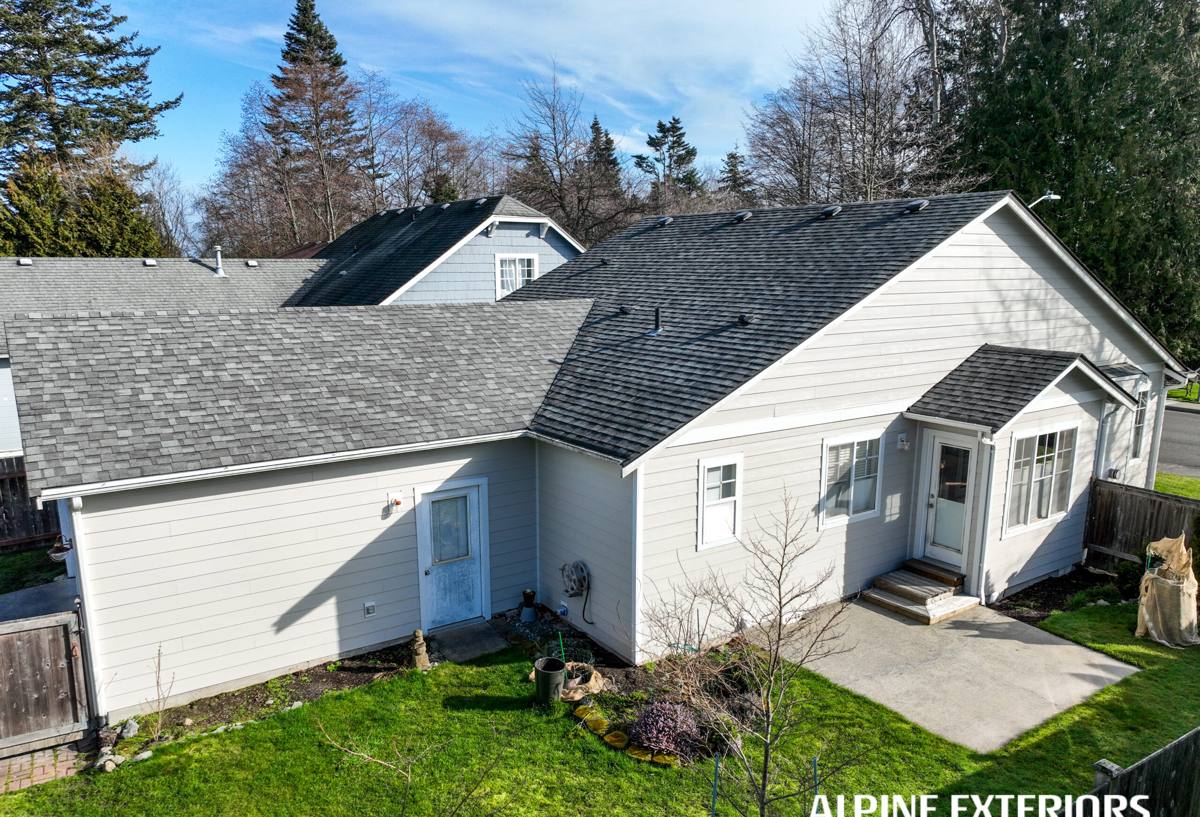
What This Climate Does to a House
Salt Air and Metal Fasteners
Airborne salt accelerates corrosion on anything metal — fasteners, flashing, trim edges. On siding systems where the fasteners are exposed or under-protected, that corrosion shows up as rust streaking and eventually failure points where water gets behind the cladding. It's a slow process, which is exactly why it's easy to ignore until it isn't.
Driving Rain and Wind-Loaded Walls
Blaine's exposure to weather coming off the water means rain doesn't just fall on a roof and run off — it gets pushed horizontally into wall assemblies, especially on the windward sides of a home. Siding seams, window flashing, and butt joints that would be fine in a calmer climate become weak points here if they weren't detailed for wind-driven moisture.
Moss, Algae, and the Long Wet Season
Western Washington's wet months run long, and California Creek's tree cover and proximity to water keep humidity and shade levels high in a lot of yards. Moss and algae don't just look bad — they hold moisture against the siding surface, which is exactly the condition that rots wood-based products and degrades paint film over time.
Why Material Choice Is the Real Decision
A lot of siding failures in this region aren't installation failures — they're material failures. Wood-based composites and traditional wood siding rely on their paint or coating to keep water out, and once that coating is compromised by UV, moisture cycling, or physical damage, the substrate underneath starts absorbing water. In a climate that doesn't give surfaces much time to fully dry out between rain events, that's a slow-motion problem.
This is why we made a standardizing decision a while back: we install James Hardie fiber cement siding, exclusively. We don't install LP SmartSide, vinyl siding, Cemplank, Allura, primed spruce, or cedar. That's not a marketing position — it's a practical one, based on what actually holds up on homes in this part of the country and what we're willing to stand behind with our own labor and warranty.
What We're Not Installing, and Why
Vinyl siding is inexpensive and easy to install, but it's a thin plastic product that expands and contracts significantly with temperature swings, can crack in impacts, and isn't rated to protect against fire the way fiber cement is. Wood-composite products like LP SmartSide use engineered wood strand technology with a factory treatment, which performs reasonably well in a lot of climates, but any wood-based substrate remains dependent on unbroken coatings and sealed edges to resist moisture — a maintenance burden that's harder to stay ahead of in a marine climate with a long wet season. Other fiber cement brands, like Cemplank and Allura, are legitimate competitors to Hardie on paper, but we've standardized on one manufacturer so our crews have deep, repeatable expertise with a single set of installation specs, flashing details, and warranty terms rather than switching systems from job to job. Primed spruce and cedar are traditional, attractive options, but they're natural wood, and natural wood requires the kind of ongoing refinishing and moisture vigilance that most homeowners underestimate until they're a few years in.
Why James Hardie for This Area Specifically
James Hardie fiber cement siding is engineered from cement, sand, and cellulose fiber — it doesn't have the moisture-absorption problems of wood-based products, and it's non-combustible, which matters in a region that has increasingly dealt with wildfire smoke and risk in recent summers even this far north. Hardie also produces climate-specific product lines, including an HZ5 formulation engineered for colder, wetter regions, which is relevant for the Pacific Northwest's freeze-thaw and moisture cycling.
The factory-applied ColorPlus finish is a big part of why we like it for salt-air exposure specifically. Field-applied paint on any siding material is only as good as the prep and the paint job, and it starts degrading from day one under UV and moisture. ColorPlus is baked on in a controlled factory environment with multiple coats and a stronger bond to the substrate, and it carries its own finish warranty separate from the product warranty. For a home a few miles from saltwater, that factory finish is doing real work that field-applied coatings on other products can't consistently match.
| Factor | Fiber Cement (James Hardie) | Wood-Based / Vinyl Alternatives |
|---|---|---|
| Moisture response | Dimensionally stable, doesn't swell/rot | Wood substrates can absorb and swell; vinyl doesn't rot but can warp |
| Salt air / coastal exposure | Factory finish resists fading and chalking | Field-applied finishes degrade faster; vinyl can become brittle |
| Fire performance | Non-combustible | Wood-based products are combustible; vinyl can melt/deform |
| Typical repaint interval | 15 years or longer with ColorPlus | 5–10 years for painted wood products |
| Impact resistance | Strong; resists moss/pest damage | Vinyl can crack; wood is vulnerable to pests and rot |
The Full Exterior: Siding, Roofing, Windows, and Decks
Siding doesn't work in isolation. On a home exposed to driving rain and salt air, the roof, window flashing, siding, and any deck attachment points all have to manage water together, or a weakness in one system undermines the others. That's why we handle roofing, windows, and decks alongside siding rather than treating them as separate trades.
Roofing
Roof drainage, valley flashing, and how the roof edge ties into the siding above the wall line all affect how much water load the siding ever has to deal with. A roof that's shedding water properly takes real pressure off the wall assembly below it.
Windows
Window flashing is one of the most common failure points we find on older homes in wet coastal climates — it's a small detail that gets rushed or done to a lower standard, and it's exactly where wind-driven rain finds its way behind the cladding. When we replace siding, we pay close attention to how new siding integrates with window flashing, and we can replace windows as part of the same project when it makes sense.
Decks
Decks attached to the house create a penetration point in the wall system — the ledger board connection has to be flashed correctly or it becomes a chronic leak source. We build and repair decks with that connection detail as a priority, not an afterthought.
What Installation Looks Like on a California Creek Home
- Assessment of existing siding, sheathing, and any moisture or rot damage found once old material comes off
- Repair of damaged sheathing and installation of a proper weather-resistive barrier
- Correct flashing at windows, doors, and any wall penetrations before siding goes up
- Installation to James Hardie's published fastening and clearance specifications, including ground clearance and proper caulking at joints
- Final inspection of seams, corners, and trim details, since these are the points most exposed to wind-driven rain
Correct installation matters as much as the material itself. Fiber cement siding installed with the wrong fastener spacing, insufficient clearance from grade, or poor flashing detail can still develop problems — which is part of why we keep our crews focused on one product system instead of spreading expertise thin across several.
Cost Factors Homeowners Ask About
| Factor | How It Affects Cost |
|---|---|
| Amount of tear-off and disposal | More layers or damaged sheathing underneath adds labor and material cost |
| Home size and wall complexity | More corners, gables, and trim detail increase labor time |
| Siding profile chosen | Lap siding, shingle-style panels, and board-and-batten vary in material and install time |
| Repairs found underneath | Rotted sheathing or hidden moisture damage adds scope once old siding is removed |
| Combining with windows, roofing, or decks | Bundling trades on one project can reduce total disruption and sometimes overall cost |
We give straightforward, itemized estimates rather than vague ballpark numbers, and we'll tell you upfront if we find something during tear-off that changes the scope — before we proceed, not after.
Keeping Siding in Good Shape in This Climate
- Rinse siding down once or twice a year to keep salt residue and grime from building up
- Trim back trees and shrubs to improve airflow and sun exposure on shaded walls
- Check and clear gutters before the wet season so water isn't overflowing onto siding
- Look at ground clearance periodically — soil, mulch, or landscaping shouldn't creep up against the bottom edge of siding
- Address any moss or algae growth promptly rather than letting it establish
- Have caulking at trim and joints inspected every few years, since caulk is the one component that does wear out over time
Why a Local Crew Matters Here
Whatcom County's coastal microclimates aren't uniform — a home in California Creek faces different wind and moisture exposure than a home a few miles inland, and a crew that works this specific area regularly knows what to look for when siding comes off an older home. We're not learning the region on your project. We know what salt air does to fasteners, what driving rain does to poorly flashed corners, and what a decade of moss growth looks like underneath a wall that was never properly ventilated.
If you're weighing a siding project — or thinking about roofing, windows, or a deck alongside it — we're happy to take a look at your home and walk through what we're seeing, no pressure and no obligation. Reach out for a free estimate using the form below.