 Blaine Siding
 Exterior Work Built for Nooksack's Climate
Nooksack sits inland from Blaine but still lives inside the same wet, marine-influenced weather pattern that defines Whatcom County. Homes here see a long, grey rainy season, high humidity, and enough shade from mature trees and river-bottom terrain that moss and algae get a real foothold on north-facing walls and rooflines. Add in the salt-tinged air that drifts up from the coast on a west wind, and you have a combination that is genuinely hard on exterior building materials over a 20-30 year span. We've built our siding, roofing, window, and deck work around that reality rather than around a generic "Pacific Northwest" checklist.
A lot of what determines whether a home's exterior holds up in Nooksack isn't the first year after installation — it's year twelve, when caulk lines have aged, paint has chalked, and moisture has had a decade of freeze-thaw cycles and wet winters to find any weak point in the assembly. That's the timeline we design and install for.
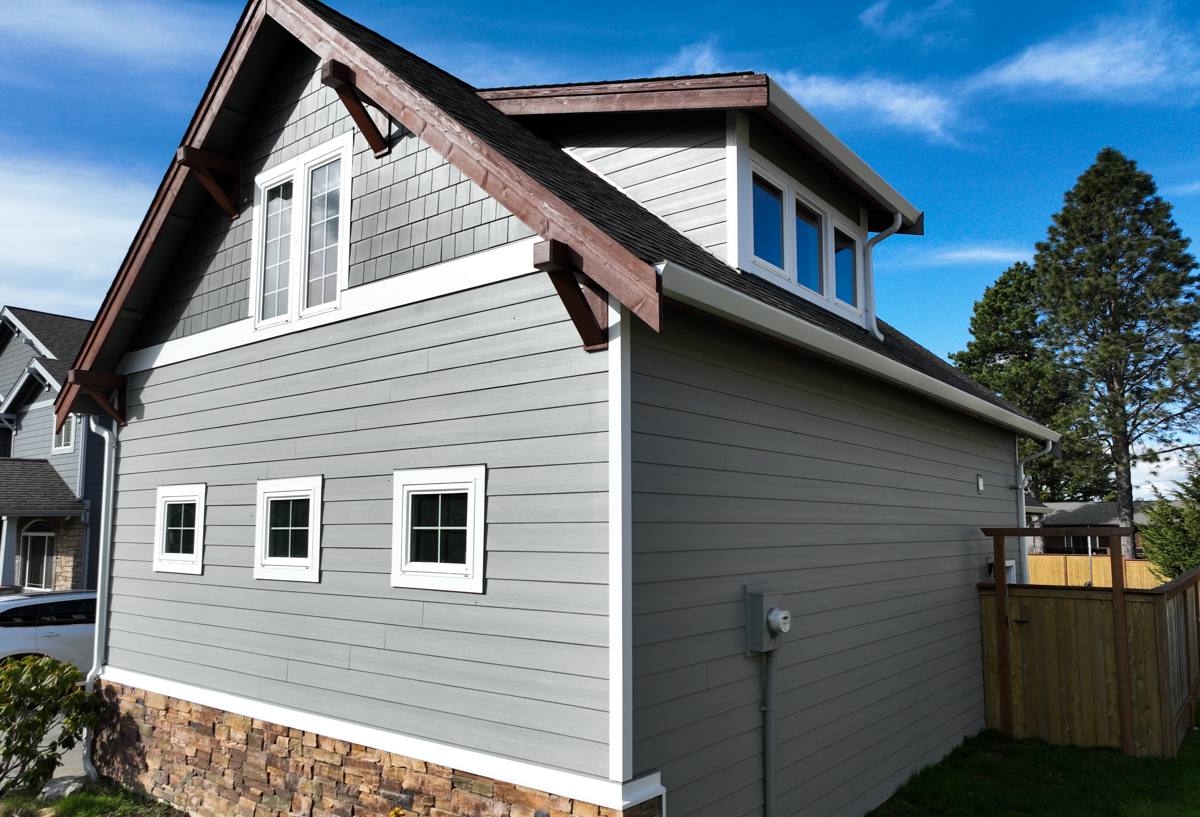
What Nooksack Homes Face Year-Round
Persistent Moisture
Whatcom County's rainy season isn't dramatic — it's just long. Siding and trim spend months at a time damp, which is exactly the condition that lets wood-based products swell, cup, and eventually rot at butt joints and end cuts. Fiber cement doesn't absorb water the way wood-based siding does, which matters enormously in a climate where "dry season" is a relative term.
Moss and Algae
Shaded lots, tree cover, and consistent moisture make Nooksack prime territory for moss and algae growth on siding, trim, and roofing. Beyond the cosmetic issue, moss holds moisture against the surface it's growing on, which shortens the life of anything underneath it that isn't moisture-stable.
Salt-Influenced Air
Blaine and the surrounding communities, Nooksack included, get enough marine air movement off the Strait of Georgia and Boundary Bay to accelerate corrosion on fasteners, flashing, and unprotected metal components. It's a slower effect than what you'd see right on the waterfront, but it adds up over the life of a roof or siding system.
Temperature Swings and UV
Summers bring stretches of real UV exposure even in a generally overcast climate, and winter can still deliver a hard freeze. Materials that don't handle expansion and contraction well — or that fade and chalk under UV — show their age faster here than in a milder, more stable climate.
Why We Install Only James Hardie Fiber Cement Siding
We don't install vinyl, LP SmartSide, Cemplank, Allura, primed spruce, or cedar siding. That's a deliberate standard, not a lack of options, and it's worth explaining honestly rather than just stating it.
Wood-Based Products (Cedar, Primed Spruce, LP SmartSide)
Wood and engineered-wood siding can look excellent and performs fine in the right conditions. The trade-off in a climate like Nooksack's is moisture management: these products rely on intact paint or factory coatings to keep water out, and once that coating is compromised at a scratch, nail hole, or cut edge, wood-based substrates can swell or rot. In a region with a genuinely long wet season, that maintenance margin gets thin.
Vinyl Siding
Vinyl is inexpensive and low-maintenance in a narrow sense, but it's not dimensionally stable across temperature swings, it can crack in impacts, and its appearance — especially color depth and trim detailing — doesn't hold up to close inspection the way a factory-finished fiber cement product does. It also isn't fire-resistant, which matters to some homeowners regardless of region.
Cemplank and Allura
These are also fiber cement products, and fiber cement as a category is the right call for this climate. Our decision to standardize on James Hardie specifically comes down to consistency of manufacturing tolerances, the depth of their ColorPlus factory finish, the climate-specific engineering of their HZ5 product line, and a transferable warranty structure we're comfortable standing behind. Installation crews that know one system inside out, rather than switching between several, also install more consistently.
Why James Hardie
Hardie fiber cement is non-combustible, doesn't swell or rot from moisture the way wood-based products can, and holds its factory-applied ColorPlus finish far longer than field-applied paint on wood or engineered wood. The HZ5 product line is specifically formulated for climates with significant moisture exposure, which describes Whatcom County well. It costs more upfront than vinyl and roughly comparable to quality wood siding installed and maintained properly — but it's a material we can install once and stand behind for decades, not a product we're relying on the homeowner to touch up every few years.
| Material | Moisture Behavior in Wet Climates | Maintenance Over 20 Years | Our Position |
|---|---|---|---|
| Vinyl | Doesn't rot, but warps/cracks with temperature swings | Low, but fades and becomes brittle | Not installed |
| Cedar / Primed Spruce | Absorbs moisture at any coating failure | Repainting/staining every 5-8 years | Not installed |
| LP SmartSide | Engineered wood, still moisture-sensitive at cut edges | Coating maintenance required | Not installed |
| Cemplank / Allura | Fiber cement, moisture-stable | Low, factory or field finish varies | Not our standard brand |
| James Hardie | Fiber cement, engineered for wet climates (HZ5) | Low, factory ColorPlus finish | Our only siding install |
Roofing, Windows, and Decks for the Same Conditions
Siding is only part of a home's defense against Nooksack's weather. Roofing systems here need to shed moss and standing moisture effectively, with flashing details that account for a long wet season rather than occasional rain. Windows need to manage condensation and seal well against the humidity swings between a damp winter and a warmer, drier summer stretch. Decks — especially ones shaded by trees, which is common on Nooksack lots — face the same moss and moisture pressure as siding, and material choice and drainage detailing matter just as much there as they do on the walls of the house.
We treat these as one connected exterior system rather than four separate trades. Flashing at a roof-to-wall intersection, window integration into a siding plane, and deck ledger attachment all depend on getting the water management right at the details, not just the materials.
What a Well-Built Exterior in This Climate Includes
- Fiber cement siding with correctly detailed, caulked, and painted-face joints — not just nailed and left
- Proper rainscreen or drainage plane behind siding to let incidental moisture escape
- Flashing at every window, door, and roof transition, sized for sustained rain rather than isolated storms
- Roofing materials and ventilation that resist moss colonization and shed water efficiently
- Deck structures and ledger connections built to handle repeated wet-dry cycling
- Fasteners and hardware rated for the corrosion exposure of this region
Why a Local Crew Matters in Nooksack
Nooksack isn't a dense urban area, and homes here vary — some are older farmhouses, some are newer builds on larger lots, many with significant tree cover. A crew that works throughout Whatcom County knows the difference between a shaded, moss-prone lot and an open one, understands how local permitting and inspection works for Blaine and the surrounding unincorporated areas, and isn't guessing at how a James Hardie installation needs to be detailed for this specific combination of rain, humidity, and salt-touched air. That local knowledge shows up in the small decisions — how deep to set flashing, where to prioritize ventilation, how to sequence work around the wet season — that a homeowner never sees directly but absolutely benefits from.
What the Process Looks Like
Assessment
We start by looking at the existing siding, roofing, windows, or deck for signs of moisture intrusion, moss buildup, failed caulking, or material fatigue — the things that tell us what's actually happening behind the surface, not just what's visible from the yard.
Scope and Material Selection
For siding, that means James Hardie exclusively, in the HZ5 line for this climate, with a ColorPlus finish selected to match the home's style. For roofing, windows, and decks, we scope materials and details specifically for a wet, shaded, moderately salt-exposed environment rather than a one-size-fits-all spec.
Installation
Correct installation matters as much as the material choice — proper fastening patterns, joint treatment, flashing integration, and drainage detailing are what actually determine whether a James Hardie installation performs for 30+ years or underperforms because of shortcuts.
Warranty
James Hardie's transferable warranty backs the material; our installation work is warrantied separately. Between the two, homeowners have real coverage rather than a vague promise.
Cost Factors Homeowners Should Understand
| Factor | Why It Matters in Nooksack |
|---|---|
| Home size and complexity | More corners, dormers, and transitions mean more flashing detail and labor |
| Existing moisture damage | Rot or hidden water damage found during tear-off adds repair scope before new siding goes on |
| Tree cover and shade | Heavier moss exposure may call for additional ventilation or drainage detailing |
| Access and lot layout | Rural or wooded lots can affect staging and material delivery logistics |
| Scope bundling | Combining siding with roofing, window, or deck work in one project can reduce overall disruption and cost |
If you're weighing a siding, roofing, window, or deck project for a home in Nooksack, we're happy to take a look and give you a straightforward, no-pressure estimate — just fill out the form below.