 Blaine Siding
 Board & Batten Siding in Sumas: Built for This Valley's Weather
Board and batten is one of the oldest siding patterns in the Pacific Northwest for a reason — the vertical lines shed water well when the material and installation are right, and the look fits everything from a working farmhouse to a newer build tucked against the foothills east of Blaine. In Sumas, that weather isn't gentle. Whatcom County sits under a marine-influenced system that pushes driving rain and long stretches of damp, low-light months through the valley, and even this far inland from the Strait, homes pick up the same moisture load that drives moss growth on roofs, fences, and siding across the county. A board and batten installation done wrong here doesn't fail quietly — it fails at the seams, the battens, and the field joints, exactly where water finds its way in.
This page is about board and batten siding specifically for Sumas homes, not a general product overview. We'll walk through what the pattern needs to hold up in this climate, what a correct installation actually involves, how our process works on a Sumas job, and why hiring a crew that already understands this specific corner of Whatcom County matters more than it might seem.
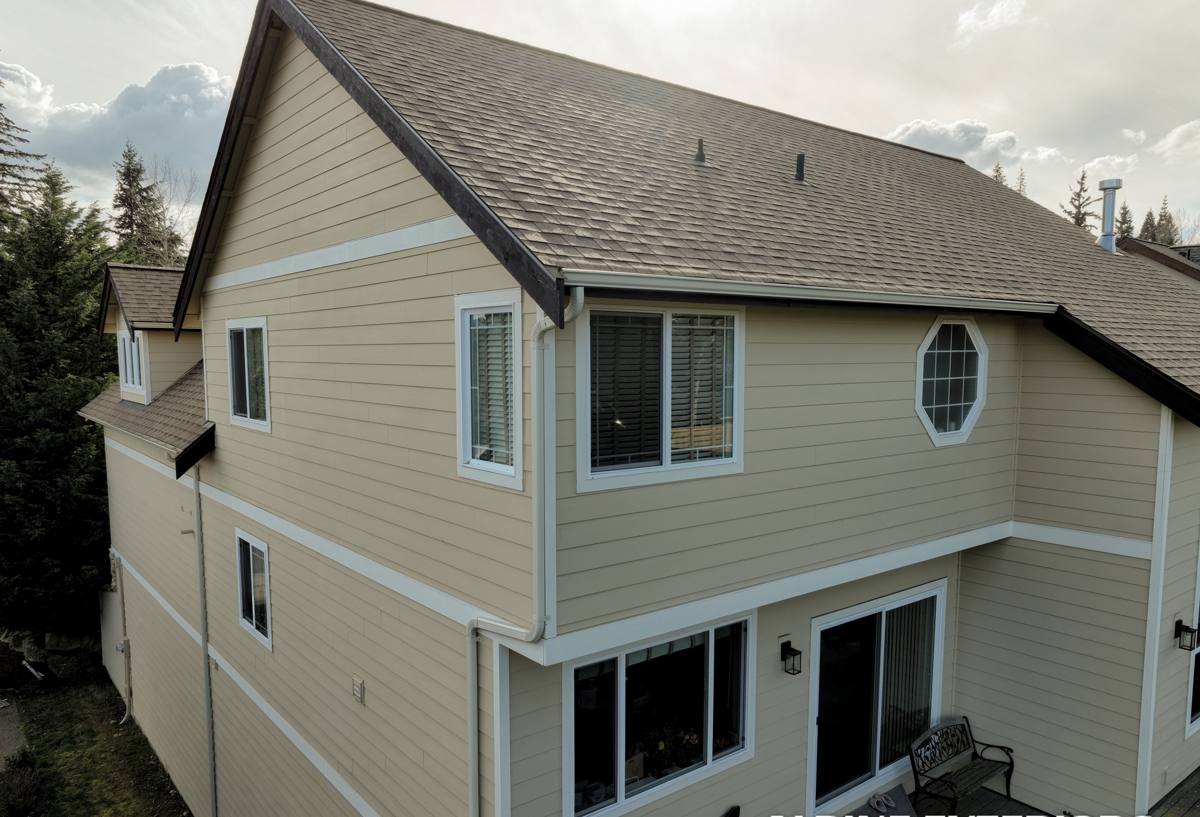
Why Sumas Homes Are Hard on Vertical Siding
Board and batten relies on vertical boards with narrow strips (battens) covering the seams between them. That pattern is more exposed to certain failure modes than lapped horizontal siding, and Sumas's conditions push on all of them:
- Sustained damp seasons. Long stretches of overcast, wet weather mean siding surfaces stay moist for days at a time, which is exactly the condition moss and mildew need to establish.
- Driving rain. Wind-driven rain doesn't just fall straight down — it gets pushed sideways into vertical seams and batten edges, the weak point on any board and batten wall that isn't detailed correctly.
- Temperature and humidity swings. Valley locations like Sumas can see wider daily temperature swings than the immediate coastline, which stresses siding materials that expand and contract with moisture and temperature differently than the wall behind them.
- Shade and slow drying. Tree cover and north-facing walls common on rural and semi-rural Sumas lots slow evaporation after rain, extending the window where moisture can work into a wall assembly.
None of this means board and batten is the wrong choice for a Sumas home — it means the material and the installation both have to be matched to what the pattern is exposed to here, not to a generic spec sheet.
Why We Only Install James Hardie for Board & Batten
We install James Hardie fiber cement exclusively — we don't offer LP SmartSide, vinyl, Cemplank, Allura, primed spruce, or cedar board and batten, even though all of those show up in board and batten applications around the region. That's a deliberate standard, not a lack of options.
Board and batten in particular punishes the wrong material choice. The vertical boards and battens create more cut edges and more seams than a lapped pattern, and every one of those is a place where the material's actual moisture behavior gets tested:
| Material | How it performs in board and batten seams |
|---|---|
| Cedar | Natural rot resistance is real but finite; repeated wetting at seams and battens accelerates checking, cupping, and decay without diligent refinishing |
| Primed spruce / engineered wood panels | Wood-based substrates are vulnerable to swelling and edge failure if paint or caulking at seams isn't maintained on schedule |
| Vinyl | Not a rigid, paintable board-and-batten product in the way homeowners usually picture the style; expands/contracts visibly and can't take true fastening at battens the same way |
| Cemplank / Allura fiber cement | Competing fiber cement products exist, but we've standardized on one system, one factory finish, and one warranty structure so every seam and batten on a job matches |
| James Hardie HZ5 | Engineered for high-moisture, freeze-variable climates; factory-cured fiber cement holds dimension at seams far better than wood-based alternatives |
James Hardie's HZ5 product line is engineered for Pacific Northwest-type climates specifically — the moisture cycling Whatcom County sees is what that engineering targets. The boards don't swell and shrink the way wood-based sidings do, which matters enormously in a pattern where every seam is a potential water path. Add the factory-applied ColorPlus finish — baked on rather than field-painted — and you remove one of the biggest long-term maintenance burdens of a board and batten look: repainting seams and battens every few years to keep water out.
What Correct Board & Batten Installation Involves
The pattern looks simple — vertical boards, battens over the seams — but the details underneath are what determine whether it lasts fifteen years or fifty in a climate like this one. On every Sumas board and batten job, we're paying attention to:
Weather-Resistive Barrier and Drainage Plane
Behind the siding, a continuous weather-resistive barrier and a drainage gap give any water that gets past the surface a path down and out, instead of a path into the wall sheathing. This matters more on vertical siding than horizontal, because vertical boards give water fewer natural stopping points on the way down.
Fastening Pattern
James Hardie specifies exact fastener spacing, type, and placement for board and batten applications, and it differs from lapped siding installation. Over- or under-fastening, or fastening too close to a board edge, creates stress points that show up years later as cracking or fastener pull-through — usually right where water collects.
Batten Placement and Gapping
Battens need consistent reveal and correct gapping over the field boards to allow for material movement without binding, cracking, or trapping moisture behind the batten itself. This is where a lot of amateur or rushed board and batten work fails first.
Flashing at Every Penetration
Windows, doors, hose bibs, light fixtures, vents — every penetration through a board and batten wall needs its own flashing detail. Vertical siding doesn't have the built-in overlap protection of lap siding, so flashing quality has an outsized effect on how the wall performs in driving rain.
Ground Clearance and Bottom Terminations
The bottom edge of any siding system is its most exposed point — splashback, snow load against foundations, and standing moisture near grade all concentrate there. Correct clearance and a properly detailed starter strip keep that edge from becoming the first place the wall fails.
Our Process on a Sumas Board & Batten Job
- On-site assessment. We look at your home's exposure — shade, wind direction, existing moisture or moss patterns, and the condition of the wall assembly underneath any existing siding.
- Product and reveal selection. We confirm board width, batten spacing, and ColorPlus color against your home's style and any HOA or neighborhood conventions in the Sumas area.
- Substrate prep and repair. Any damaged sheathing or framing found during removal gets addressed before new siding goes up — covering rot with new siding just relocates the problem.
- Weather barrier and drainage plane installation. Installed to manufacturer spec, not shortcut, since this layer does the real work if the surface ever gets past.
- Board and batten installation to Hardie spec. Correct fastening, gapping, and flashing at every transition and penetration.
- Final inspection and walkthrough. We review the finished job with you, including care and maintenance expectations specific to a damp valley climate.
What to Check Before Hiring Anyone for Board & Batten in Sumas
- Do they install to the manufacturer's written installation instructions for board and batten specifically, not just general lap siding practice?
- Will they show you the flashing and weather barrier details before the siding goes on, not after?
- Do they have experience with this pattern locally, where driving rain and long damp seasons are the norm rather than the exception?
- Is the fastening schedule and batten spacing documented, or left to on-site judgment call?
- Does the warranty cover both the manufacturer's product and the installer's workmanship, and is it transferable if you sell the home?
- Are they proposing a material actually engineered for this climate, or whatever they have the most margin on?
Maintenance: What Board & Batten Actually Needs Here
One appeal of James Hardie board and batten in a climate like this is how little ongoing maintenance it demands compared to wood alternatives. Realistically, a Sumas homeowner should plan on:
- An annual visual check of caulking at trim, window, and door transitions — not the siding field itself, since ColorPlus doesn't need repainting on the schedule wood does.
- Periodic gentle washing to keep moss and mildew from establishing on north-facing or shaded walls, using a soft brush and low-pressure rinse rather than a pressure washer directly on seams.
- Keeping gutters and downspouts clear so runoff isn't concentrating extra water onto specific wall sections.
- Trimming back vegetation that holds moisture against the siding or blocks airflow and drying after rain.
That's a meaningfully lighter list than what cedar or engineered wood board and batten asks for in this climate, and it's a direct result of the material choice, not just good luck.
Why Local Experience Matters for This Job
A crew that regularly works Sumas and the surrounding Whatcom County communities has already seen how board and batten performs on the specific lot orientations, shade patterns, and rainfall exposure common here — which walls need extra attention, which details get skipped by installers who aren't paying attention, and what a wall assembly looks like after a few damp seasons if it wasn't built right the first time. That's not something you get from a national installation manual alone; it's pattern recognition built from doing this work in this specific weather, on homes like yours.
If you're weighing board and batten for a home in Sumas, we're glad to walk the property with you, talk through James Hardie's HZ5 line and ColorPlus color options, and give you a straight assessment of what your walls actually need. Reach out for a free, no-pressure estimate using the form below.