 Blaine Siding
 Why Metal Roofing Makes Sense for Bellingham and Blaine Homes
More homeowners in Bellingham and Blaine are asking about metal roofing than a few years ago, and it isn't just a style trend. It's a direct response to what living this close to the water does to a roof over time. A house anywhere near Blaine Bay, Semiahmoo, or the Bellingham waterfront sits under salt-carrying air off the Salish Sea, takes months of wind-driven rain every winter, and stays damp long enough that moss finds a foothold on almost anything that doesn't shed water quickly. A correctly installed metal roof handles all three of those conditions better than most other roofing materials, and it keeps doing it for decades.
Metal isn't automatically the right call for every home, and it isn't maintenance-free or immune to bad workmanship. A poorly installed metal roof will leak, corrode early, or loosen up just like a poorly installed asphalt roof — the difference is that mistakes on a metal roof are harder and more expensive to correct after the fact. This page covers what actually matters for a metal roof on a home in Bellingham or Blaine: what the local climate demands, what a correct installation includes, and why the crew you hire needs real experience with this specific stretch of Whatcom County.
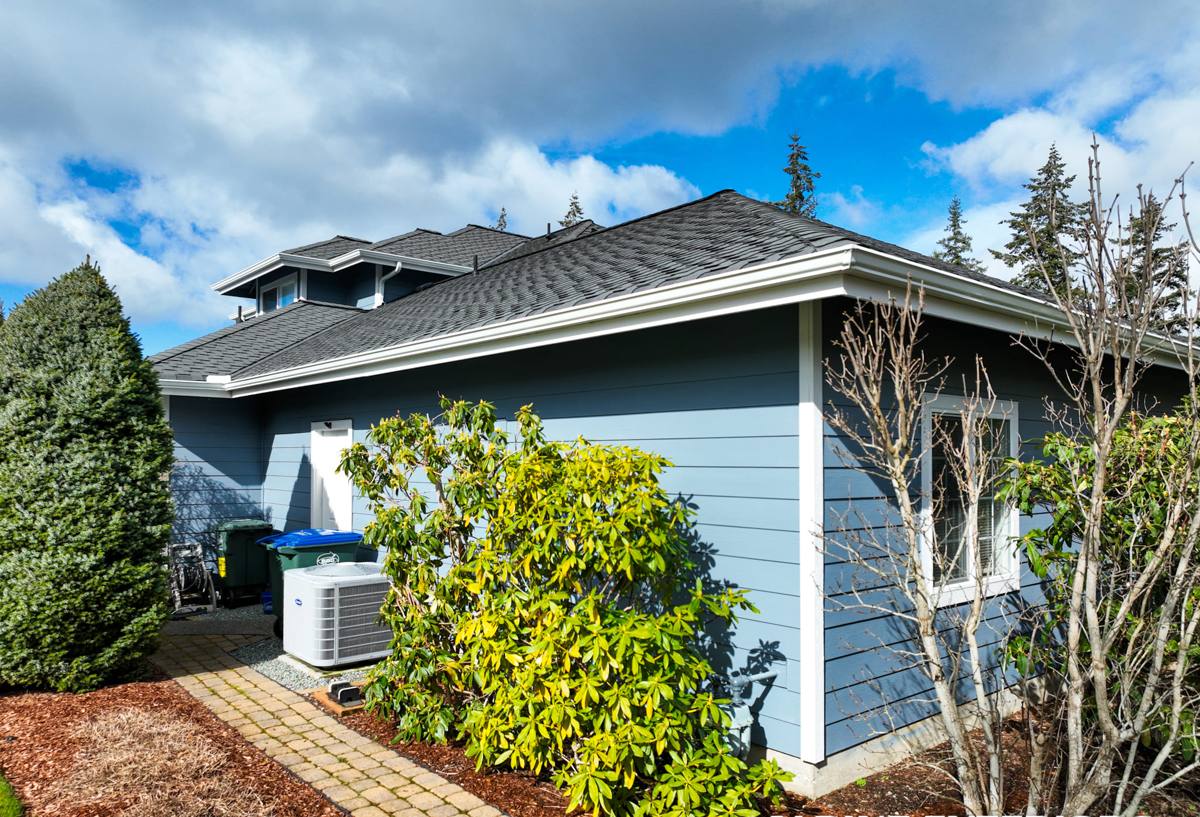
What Whatcom County's Weather Actually Does to a Roof
Salt Air and Corrosion
Any home within a few miles of the water is exposed to salt-bearing air, and that air travels — wind pushes it well inland across Whatcom County, not just along the immediate shoreline. Salt accelerates corrosion on any exposed metal component: fastener heads, flashing seams, panel edges, and cut ends where the factory coating has been broken during installation. That's a big part of why the coating system and the hardware used matter as much as the panel material itself here.
Driving Rain and Wind-Driven Water
Rain in this area rarely just falls straight down. Storms moving in off the water push rain sideways and, on steeper roof lines, effectively uphill under standard flashing details. That's why flashing at valleys, sidewalls, chimneys, and any roof penetration does more real work here than it would on a roof further inland. A roof that looks perfectly dry on a calm day can still take on water during a sideways winter storm if the flashing and underlayment weren't detailed for that condition from the start.
A Long Moss and Moisture Season
Whatcom County stays damp for a large part of the year, which gives moss and algae a long window to establish themselves. On asphalt shingles, moss roots into the granule surface and holds moisture directly against the roof deck. A smooth, properly sloped metal panel gives moss much less to grip, and water moves off the roof faster. Metal isn't moss-proof, but it removes most of what moss needs to get started — which matters in a climate where the moss season barely takes a real break.
Metal Roofing Systems: What's Actually Available
"Metal roofing" covers a few genuinely different systems, and the right one depends on exposure, roof pitch, and budget — not just looks.
| System | How It's Fastened | Best Fit | Trade-Offs |
|---|---|---|---|
| Standing seam | Concealed clips, no exposed fasteners on the field of the roof | Primary homes with full exposure to wind-driven rain and salt air | Higher upfront cost; requires a crew experienced with seaming and panel expansion |
| Exposed-fastener panel (corrugated/ribbed) | Screws through the panel face with gasketed washers | Outbuildings, shops, secondary structures, tighter budgets | Exposed washers and screw heads are a long-term maintenance point in salt air |
| Stone-coated steel (shingle or shake profile) | Concealed or semi-concealed fastening | Homeowners wanting a traditional shingle or shake look with metal's durability | Cost sits between the other two options; profile depth needs correct detailing at valleys |
For a primary residence exposed to wind off the water, standing seam or a concealed-fastener stone-coated system are almost always the better long-term choice — there are no exposed fastener heads sitting out in salt air waiting to corrode. Exposed-fastener panels are a reasonable, budget-friendly option for a detached shop or outbuilding where a slightly shorter service life is an acceptable trade for lower cost.
What a Correct Metal Roof Installation Includes
Deck Prep and Underlayment
The roof deck gets inspected and repaired before anything else happens. A metal roof is meant to be a multi-decade system, so it's never worth locking a soft or damaged deck underneath it. A high-quality synthetic or self-adhered membrane goes down at eaves, valleys, and around every penetration, giving the roof a real second line of defense if wind-driven rain ever gets past the panel seams.
Fasteners, Flashing, and Sealants Built for Salt Air
Hardware matters more here than in a lot of the country. Fasteners and clips need corrosion-resistant coatings or stainless construction, and flashing metal needs to be compatible with the panel metal — mixing dissimilar metals in direct contact can set up galvanic corrosion that eats through hardware years before it should fail. Sealants at penetrations should be a proper butyl or high-grade sealant designed for the joint, not caulk used as the only line of defense.
Ventilation
Proper intake and exhaust ventilation keeps warm, moist attic air from condensing on the underside of the panels. In a climate that stays humid much of the year, skipping or under-sizing ventilation is one of the fastest ways to end up with hidden deck rot under a roof that looks fine from above.
Our Installation Process
- On-site inspection of the existing roof, deck, and attic ventilation
- System recommendation based on exposure, roof pitch, and budget
- Deck repair where needed, followed by underlayment installation
- Panel installation with full flashing details at every valley, wall, and penetration
- Final walk-through covering fastener torque, sealant points, and ventilation
- Full clean-up and haul-away of the old roofing material
Cost Factors to Expect
Metal roofing costs more upfront than asphalt shingles, and the exact number for any given home depends on more than just square footage. Rather than quote a number that won't hold up house to house, here's what actually moves a metal roofing estimate up or down:
- Roof pitch and complexity — more valleys, dormers, and penetrations mean more flashing labor
- Which system you choose — standing seam runs higher than exposed-fastener panel
- Whether the existing roof can be removed down to a sound deck or needs structural repair first
- Number of chimneys, skylights, and vent penetrations to flash
- Roof accessibility — steep pitches or tight lot access add time and equipment cost
Maintenance in a Coastal, Moss-Prone Area
A correctly installed metal roof needs far less attention than asphalt, but "far less" isn't "none" in this climate. A short annual routine keeps small issues from turning into corrosion or leaks:
- Rinse off accumulated salt residue and debris a couple times a year, especially after winter storms
- Keep gutters and valleys clear so water isn't sitting against panel edges or fastener points
- Check exposed fastener washers annually if the roof uses an exposed-fastener system, and replace any that show wear
- Trim back branches or vegetation that hold moisture directly against the roof surface
- Touch up any scratch or chip in the panel coating promptly — a bare spot is where corrosion gets its start
Mistakes We See With Metal Roofs in This Area
Most metal roof problems we get called out to inspect trace back to installation shortcuts rather than the material itself. Standard, non-coastal-rated fasteners used on an exposed-fastener system that then rust out well ahead of schedule. Undersized or missing flashing at valleys that lets wind-driven rain get underneath the panel during a real storm. Panels installed directly over decking that had hidden rot or damage. Dissimilar metals left in direct contact, setting up galvanic corrosion between flashing and panel. And ventilation that was skipped or undersized, leading to condensation damage that isn't visible until it's already serious.
Why Local Experience in Bellingham and Blaine Matters
A metal roof detailed correctly for a dry inland climate isn't automatically detailed correctly for a home taking wind-driven rain off the Salish Sea and salt air year-round. A crew that already works Bellingham and Blaine knows which flashing details actually hold up to sideways winter storms here, which fastener and flashing hardware doesn't give out early in salt air, and how to plan panel layout and ventilation for a roof that stays damp for a big part of the year. That local knowledge is also easy to reach — for a warranty question or a service call, you're not waiting on a crew driving in from somewhere else in the state.
If you're weighing metal roofing for a home in Bellingham or Blaine, we're happy to take a look and walk you through what your specific roof actually needs. Reach out for a free, no-pressure estimate using the form below.