 Blaine Siding
 Why Birch Bay Is a Tougher Test for Board & Batten Than Most Neighborhoods
Board and batten has become one of the most requested looks for homes along the Birch Bay shoreline, and it's easy to see why. The vertical lines, the crisp shadow reveal at every batten, and the clean modern-farmhouse or coastal-cottage feel it gives a house all photograph beautifully. But Birch Bay doesn't just ask a siding style to look good — it asks it to survive salt-laden air blowing off the water, wind-driven rain that hits walls sideways instead of straight down, and a moss season that can stretch for most of the year in the shade pockets around mature trees and north-facing walls. A board and batten installation that would hold up fine twenty miles inland can fail early here if it isn't detailed for this specific environment.
That's the lens we use on every Birch Bay project: not "does this look right," but "does this assembly manage water, salt, and organic growth correctly for this particular lot." The style is the easy part. The performance is where the job is won or lost.
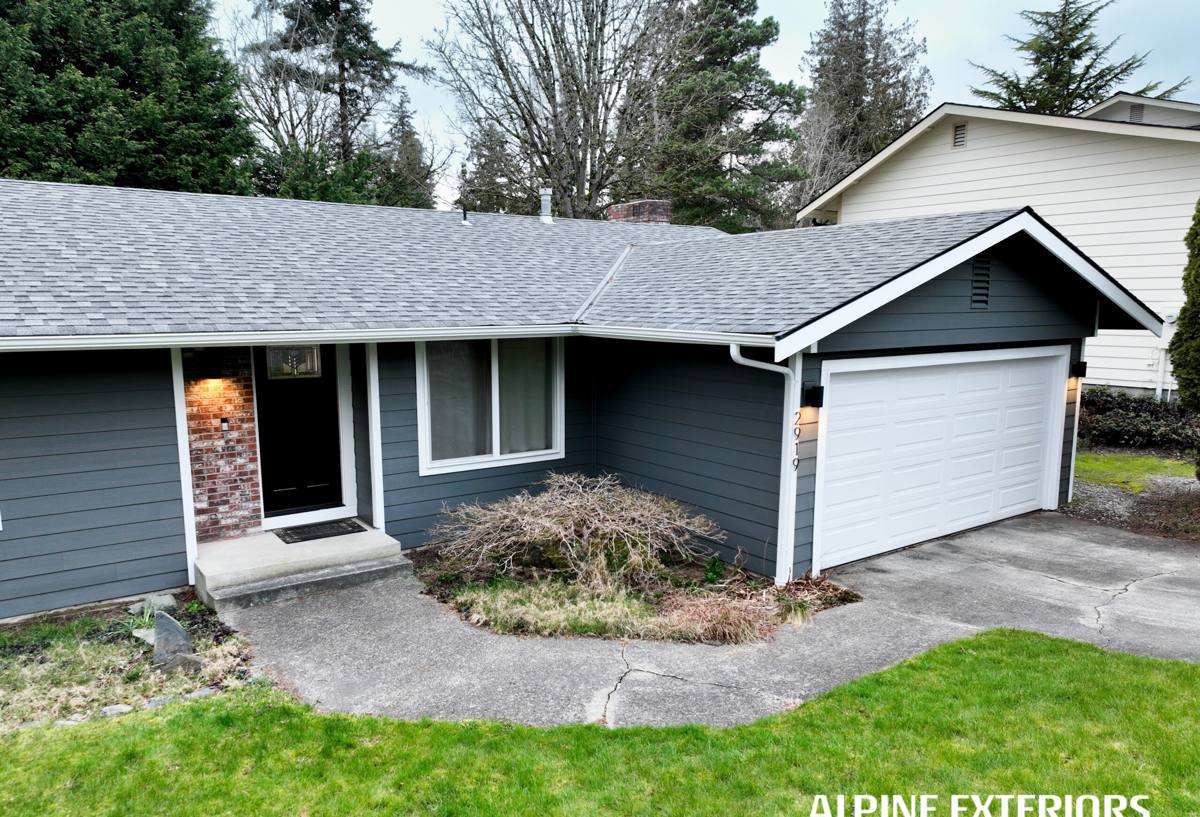
What Board & Batten Actually Has to Do on This Coastline
Salt Air
Airborne salt from Birch Bay accelerates corrosion on anything metal — fasteners, flashing, trim connectors — and it can degrade lower-grade paint finishes faster than inland exposure would. Board and batten has more exposed vertical seams and more fastener points than a plain lap profile, so the fastener and finish quality behind those battens matters more here, not less.
Driving, Wind-Blown Rain
Storms coming off the water don't just fall on a wall, they push into it. Board and batten relies on the battens to shed water off the seam between panels, but that only works if there's a drainage plane and proper flashing behind the assembly doing the real waterproofing. The battens are the visual finish; the water management happens in the layers you don't see.
Moss and Prolonged Dampness
Shaded walls, tree cover, and the general marine humidity around Birch Bay create long stretches where siding simply doesn't dry out fully between rains. Moss and algae take hold on any surface that stays damp and doesn't get airflow. Vertical board and batten with a poorly vented back side traps that moisture right where growth starts.
What a Correct Board & Batten Job Includes
A board and batten installation that's built for this stretch of Whatcom County coastline isn't a different material, it's a different level of attention to the parts of the job that don't show up in a finished photo.
- Weather-resistive barrier, installed shingle-style — every layer overlaps the one below it so water is always directed outward and down, never trapped behind the wall.
- A drainage gap behind the siding — a rain screen or furring space that lets any moisture that gets past the outer layer drain and dry instead of sitting against the sheathing.
- Correct flashing at every horizontal break — window and door heads, roof-to-wall transitions, and any horizontal trim board need step or head flashing, not just caulk.
- Batten fastening into structural framing — battens carry real wind and weather load on a coastal wall; fastening into sheathing alone isn't enough.
- Stainless or coated corrosion-resistant fasteners — standard fasteners can bleed rust streaks or fail early in salt air exposure.
- Factory-finished panels and boards — a factory-cured finish resists moisture and salt exposure far more consistently than field-applied paint, especially on butt joints and cut edges.
- Proper clearance at grade and hard surfaces — siding held above soil, patios, and driveways so it isn't wicking ground moisture during the wet season.
Skip any one of these and the siding can still look like board and batten for a year or two. It just won't perform like it for the next thirty.
Why We Install This in James Hardie Fiber Cement — and Nothing Else
Board and batten can be built out of several different materials, and we get asked about most of them. We install James Hardie exclusively, and on a marine-exposed neighborhood like Birch Bay the reasoning is even more direct than usual.
Fiber cement doesn't absorb water the way wood-based products do, so it doesn't swell, cup, or hold moisture against a fastener the way primed wood composites can when a joint gets compromised by driving rain. It's non-combustible, which matters to insurers and to homeowners thinking long-term about wildfire-adjacent risk even in a coastal county. And James Hardie's ColorPlus factory finish is baked on and warrantied against fading and chipping — a meaningful advantage on a material with as many exposed vertical seams as board and batten has, where a field-painted product depends heavily on how well every cut edge got sealed during install.
We don't install vinyl board and batten, LP SmartSide, primed wood, or cedar battens. Vinyl can look flat and can deform in prolonged heat or impact; wood-based and primed products carry ongoing maintenance and moisture-management burdens that are harder to manage in a salt-air, high-rainfall environment; cedar is a genuinely beautiful natural material but requires a maintenance commitment — refinishing, sealing, and moss control — that most homeowners underestimate until year three or four. James Hardie is the one system in this category where the factory finish, the material's dimensional stability, and the manufacturer's own climate engineering are all aligned with what a Birch Bay wall actually has to survive.
Board & Batten Material Comparison for Coastal Exposure
| Material | Moisture Behavior | Finish Durability in Salt Air | Maintenance Burden |
|---|---|---|---|
| James Hardie fiber cement | Does not absorb/swell; dimensionally stable | Factory ColorPlus finish, warrantied | Occasional wash; repaint not required for years |
| Vinyl board & batten | Sheds water but can warp/deform with heat or impact | Color is molded-in, can fade unevenly over time | Low, but panels are not repairable — only replaceable |
| Primed wood / LP-style composite | Vulnerable at cut edges and joints if seal fails | Field-applied paint wears faster in wind-driven rain | Regular repainting and joint inspection |
| Cedar | Natural material, absorbs and releases moisture | Needs sealing/staining on a recurring cycle | High — refinishing and moss/algae treatment |
Our Process for a Birch Bay Board & Batten Project
1. Site Walk and Exposure Assessment
We look at which walls take direct weather off the water, which stay shaded and damp longer, where moss has already established, and where prior moisture damage might be hiding behind the existing siding before we ever talk product.
2. Tear-Off and Sheathing Check
Old siding comes off and we inspect the sheathing underneath. Any rot, soft spots, or prior water intrusion gets addressed before anything new goes up — covering a problem with new siding just delays it.
3. Weather Barrier and Drainage Plane
We install the water-resistive barrier and drainage gap correctly for the wall's specific exposure, paying particular attention to window and door openings and roof-to-wall transitions.
4. Board & Batten Installation
Panels and battens go up per James Hardie's fastening and clearance specifications, with corrosion-resistant fasteners driven into structural framing.
5. Final Walkthrough
We check flashing details, caulking at penetrations, grade clearance, and finish consistency before calling the job complete.
Ongoing Care in a Marine Climate
- Rinse siding once or twice a year to remove salt residue, pollen, and early moss growth, especially on shaded or north-facing walls.
- Keep gutters clear so overflow isn't running down the wall face during heavy rain events.
- Trim back vegetation and tree cover that keeps a wall section damp and shaded longer than the rest of the house.
- Check caulking at trim joints, window heads, and penetrations every couple of years — caulk is a maintenance item, not a permanent seal.
- Watch for any early moss or algae staining and address it promptly rather than letting it establish.
Why Hiring a Crew That Already Works Birch Bay Matters
Board and batten forgives fewer installation mistakes than plain lap siding — the vertical seams, the batten fastening pattern, and the flashing at every horizontal break all have to be right, and errors show up faster in a climate that's wet as often as Whatcom County's coastline is. A crew that installs regularly around Birch Bay and the greater Blaine area already knows which walls on which lot orientations take the worst weather, where moss tends to establish first, and how the local permitting and inspection process works. That's the difference between a crew executing a spec sheet and a crew that's actually building for the conditions your house will face every winter.
If you're weighing board and batten for a Birch Bay home, we're happy to walk the property, look at your specific exposure, and put together a straightforward, no-pressure estimate — just fill out the form below.