 Blaine Siding
 Why Semiahmoo Siding Wears Differently Than Inland Homes
Semiahmoo sits right up against the water, and that changes what siding has to survive. Homes just a few miles inland in Whatcom County deal with rain and cold. Homes on or near the Semiahmoo Spit and Drayton Harbor deal with rain, cold, wind off the water, and a steady dose of salt air on top of it. Salt-laden moisture works its way into seams, fastener heads, and any spot where the original installation left a gap. Over years, that moisture cycle — wet, dry, wet again — is what actually breaks siding down, more than any single storm.
Add in the long moss season that Whatcom County gets on shaded, north-facing, and tree-lined walls, and you get a second slow-motion problem: organic growth that holds moisture against the siding surface far longer than open sun-exposed walls ever see. A repair that doesn't account for both of these — salt exposure and prolonged damp shade — tends to fail again within a few years. A repair that does account for them can hold up for the life of the siding around it.
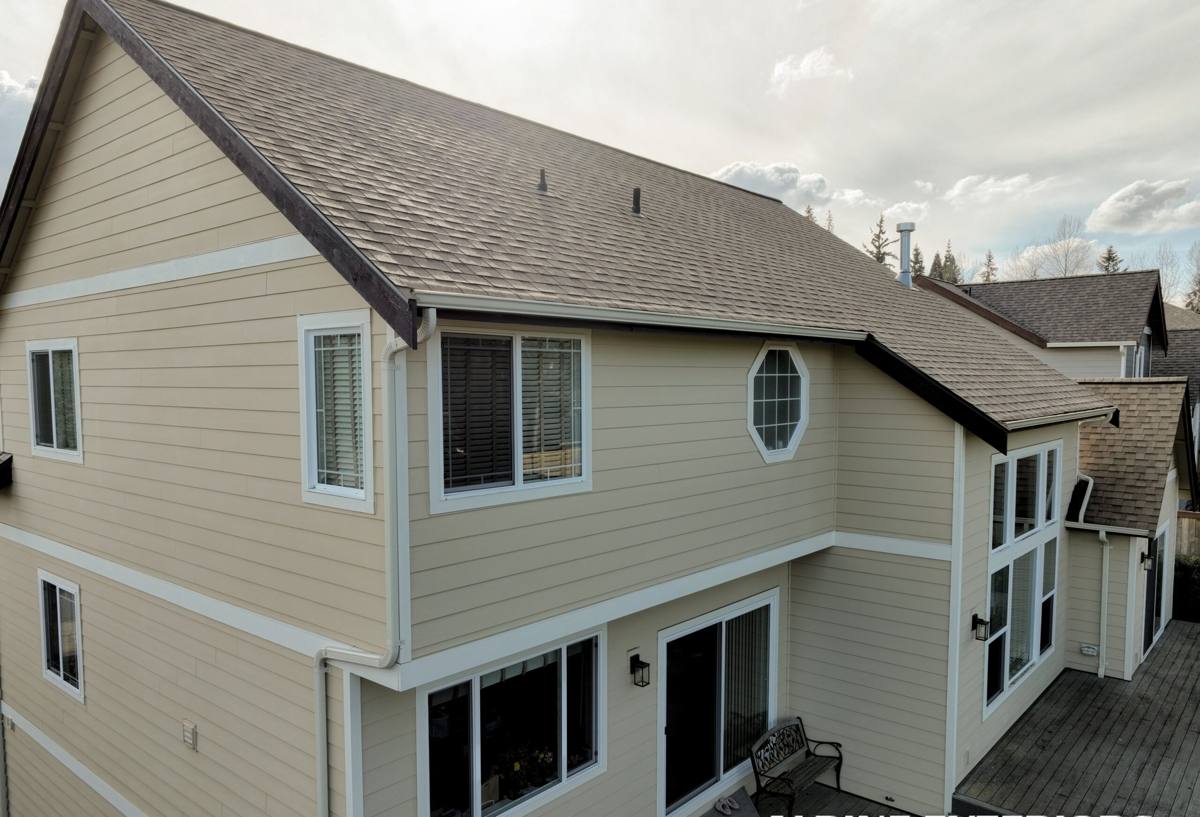
What Salt Air and Driving Rain Actually Do to Siding
It helps to know the specific failure patterns we see on Semiahmoo-area homes, because they're not the same ones you'd find on a dry-side property:
- Fastener corrosion: Nails or screws that aren't rated for coastal exposure can rust, weep stains down the face of the siding, and eventually lose their grip.
- Caulk and sealant breakdown: Salt air and UV exposure age sealants faster than inland conditions, so joints that were sound five years ago may already be open.
- Wind-driven rain intrusion: Storms coming off the water push rain sideways into laps, corners, and trim joints that would stay dry in a straight-down rain.
- Moss and algae staining: Shaded and north-facing walls hold moisture longer, which feeds moss growth that traps even more water against the surface.
- Coating and finish fatigue: Painted or lower-grade siding finishes chalk, fade, and lose their protective ability faster under salt and UV combined than they would inland.
None of these show up overnight. They build for a season or two before you see the visible sign — a stain, a soft spot, a piece that's started to cup or separate.
Signs a Semiahmoo Home Needs Siding Repair
Most of the repair calls we get in this area start with one of the following. If you're seeing any of these, it's worth a look before the next wet season:
- Dark streaking or green-black staining, especially on shaded or water-facing walls
- Soft or spongy siding when pressed near the bottom edge of a wall or below a window
- Visible gaps opening up at seams, corners, or where siding meets trim
- Rust streaks running down from fastener locations
- Cracked, cupped, or bowed panels, particularly on lower-grade or older siding
- Peeling or bubbling paint that keeps coming back in the same spot after repainting
- Interior signs — a musty smell, a damp patch on drywall, or a slight give in interior trim near an exterior wall
A single stained board is usually a straightforward repair. Soft siding, interior moisture signs, or damage spread across multiple walls usually means the water has been getting in longer than it looks from the outside, and the repair scope needs to match that.
What a Correct Siding Repair Actually Involves
A repair that just covers the visible damage without addressing why it happened is a repair you'll be paying for again in a few years. On a Semiahmoo property, a repair done right includes:
1. Finding the actual source
Damaged siding is usually a symptom. The cause might be a failed sealant joint, a flashing detail that was never installed correctly, a gutter or downspout dumping water where it shouldn't, or a section of wall that just doesn't get enough sun or airflow to dry out between storms. Cutting out and replacing the damaged board without finding the source means the new board fails the same way.
2. Checking what's behind the siding
Once damaged panels are removed, we look at the water-resistive barrier, flashing, and sheathing underneath. If moisture has been getting past the siding for a while, there can be damage to the layers behind it that needs to be addressed before anything new goes back on. Closing damaged material up behind new siding just hides the problem.
3. Matching or upgrading the material correctly
Repairs need to match the existing siding's profile, reveal, and finish as closely as possible, with fastener choices and joint treatment suited to a coastal environment — not whatever happens to be on the shelf. Corrosion-resistant fasteners and correctly lapped, sealed joints matter more here than they would on a drier, inland wall.
4. Sealing and flashing details, not just the field
Most repair failures happen at the details — corners, window and door trim, penetrations for vents or fixtures — not in the middle of a flat wall. A repair that only replaces the damaged panel and skips re-sealing the surrounding joints is skipping the part most likely to leak again.
Our Process for a Semiahmoo Siding Repair Call
Here's what a typical visit looks like:
- On-site inspection: We walk the exterior, check the damaged area and the walls around it, and look at gutters, grade, and vegetation that might be contributing to the problem.
- Probe and assess: Where we suspect moisture intrusion, we check for soft spots and, where needed, open up a section to see what's happening behind the siding.
- Written scope and estimate: You get a clear explanation of what's damaged, why, and what it takes to fix it correctly — not just a number.
- Repair or recommend replacement: If the damage is contained, we repair it. If it's widespread or the underlying material is failing in multiple places, we'll tell you honestly when repair no longer makes sense compared to replacing that section or the whole elevation.
- Finish and follow-up: Repaired areas are sealed, matched, and cleaned up, and we'll flag anything else worth watching so it doesn't turn into a bigger job later.
Repair Material: Why We Work in James Hardie Fiber Cement
This company installs and repairs James Hardie fiber cement siding exclusively — we don't install vinyl, LP SmartSide, cedar, primed spruce, or other fiber cement brands. That's a deliberate standard, and it matters most in an environment like Semiahmoo's.
Fiber cement doesn't absorb water the way wood-based products can, so it holds up better through repeated wet-dry cycles without swelling, rotting, or delaminating at the edges. James Hardie's HZ5 product line is engineered specifically for climates with heavy moisture exposure — relevant for a saltwater-adjacent property in northwest Washington. The factory-applied ColorPlus finish resists the fading and chalking that salt air and UV accelerate on field-painted surfaces, which means repaired sections keep matching the rest of the wall for longer instead of visibly aging faster than the surrounding siding.
When we repair an existing James Hardie installation, we match it directly. When we're repairing damage on a home sided in a different material, we'll be straight with you about that material's known trade-offs in a coastal, high-moisture climate, and about the option of replacing the affected section — or eventually the whole elevation — in Hardie instead. We won't tell you a competing product is worthless; we'll tell you honestly why we don't install it ourselves and let you weigh that against what a repair or replacement actually needs to hold up here.
Moss, Algae, and Maintenance Between Repairs
Whatcom County's moss season runs long, and Semiahmoo's shaded, water-adjacent lots often see more of it than sites further inland. A few habits stretch the life of any repair:
- Keep gutters and downspouts clear so water isn't sheeting down the siding face
- Trim back vegetation and tree cover that keeps a wall shaded and damp longer than it needs to be
- Rinse moss and algae buildup with a gentle wash rather than a high-pressure blast that can force water into seams
- Check caulking at trim and window joints every year or two, since coastal air ages sealants faster than inland exposure does
- Watch the same walls that failed before — if one elevation grew moss or stained once, it will again unless the moisture source is addressed
James Hardie siding resists moss and mildew growth better than wood-based sidings because it doesn't hold moisture the same way, but no siding is immune to organic growth on a shaded, damp wall. Maintenance still matters — it just needs to happen less often and with less urgency than it would on a moisture-absorbent material.
What Drives Siding Repair Cost
Every repair is different, but the same factors move the price up or down on almost every job we look at near Semiahmoo:
| Factor | Why It Matters |
|---|---|
| Size and location of damage | A single panel near ground level costs far less than damage spread across a two-story wall or around multiple windows |
| Condition behind the siding | If the water-resistive barrier or sheathing was compromised, that repair adds cost before new siding goes back on |
| Access | Height, tight side yards, and proximity to the water or steep grade can affect equipment and labor time |
| Material match | Matching an existing profile, reveal, and finish takes more care than a straightforward new install |
| Root cause fixes | Correcting a flashing detail, gutter issue, or grading problem adds a line item but prevents repeat damage |
| Number of affected elevations | Repairs concentrated on one wall are simpler and cheaper than damage found on several sides of the house |
We'll walk through which of these apply to your home before we give you a number, so the estimate reflects the actual job rather than a generic average.
Questions Worth Asking Before You Hire a Repair Contractor
Semiahmoo's coastal exposure means a repair that's not built for the environment tends to fail faster than the same repair would inland. Before hiring anyone, it's worth asking:
- Will you find and fix the actual moisture source, or just replace the visible damaged board?
- What fasteners and sealants will you use, and are they rated for coastal exposure?
- Will you check the water-resistive barrier and sheathing behind the damaged siding?
- Do you have experience with homes specifically in the Semiahmoo / Drayton Harbor area, not just Whatcom County generally?
- Will the repaired section match the existing siding's profile and finish?
- What's your honest opinion on repair versus replacement for this scope of damage?
A contractor who answers these plainly, without dodging the repair-versus-replace question, is one worth trusting with the job.
Why a Crew That Already Works Semiahmoo Matters
Siding repair isn't one-size-fits-all across Whatcom County. A crew that regularly works the Semiahmoo area already knows which walls tend to hold moisture longest, how far wind-driven rain travels off the water on a given exposure, and how aggressive the moss season gets on shaded, tree-lined lots near the harbor. That local pattern recognition shortens the diagnostic part of the job and reduces the odds of a repair that looks right today but fails again in eighteen months because it wasn't built for this specific stretch of coastline.
It also means a faster, more direct estimate. We're not guessing at what coastal exposure does to a wall — we're applying what we've already seen on similar homes nearby, and telling you plainly if a repair will hold or if replacement is the better long-term call.
If you're seeing staining, soft spots, or open joints on your Semiahmoo home, we're happy to take a look. Reach out for a free, no-pressure estimate using the form below.