 Blaine Siding
 Siding in a Harbor Climate: What Blaine Harbor Homes Are Up Against
Homes near Blaine Harbor face a combination of weather stresses that inland Whatcom County properties rarely see all at once: salt-laden air off the water, wind-driven rain that hits siding sideways instead of straight down, and a moss and algae season that can run nine months out of the year on shaded or north-facing walls. Any one of these will shorten the life of the wrong siding material. Together, they're the reason so many older homes in this area show premature paint failure, swelling at butt joints, and dark streaking long before the siding is actually worn out.
This page covers what siding installation actually needs to get right for a Blaine Harbor property, how our process addresses each of those stressors, and why a crew already familiar with this stretch of the Washington coast tends to do a measurably better job than one seeing it for the first time.
Salt Air and Corrosion
Airborne salt from the harbor settles on every exterior surface, including siding, trim, and — critically — the fasteners holding it all together. Standard fasteners can corrode faster this close to the water, and once a fastener head rusts and stains the face of the siding, that streak doesn't wash off. Material choice and fastener choice both matter here, and cutting corners on either shows up as a cosmetic problem within a few years.
Wind-Driven Rain and Wall Assemblies
Rain that comes off the water in this part of Whatcom County rarely falls straight down — wind pushes it sideways and up under laps, trim, and penetrations. A siding system that isn't installed with the right clearances, flashing, and drainage path will eventually let water behind the cladding, even if the siding material itself is fine. Most of the moisture damage we find during tear-offs traces back to installation details, not the siding panels themselves.
The Long Moss Season
Between the marine layer, tree cover common in this area, and long stretches of overcast, damp weather from fall through spring, moss and algae get a real foothold on north- and east-facing walls that don't dry out quickly. Bare wood and some engineered wood products give moss something to grip and feed on. A factory-cured, factory-finished material with a harder surface resists that growth far better, though no siding is completely immune if a wall never sees sun or airflow.
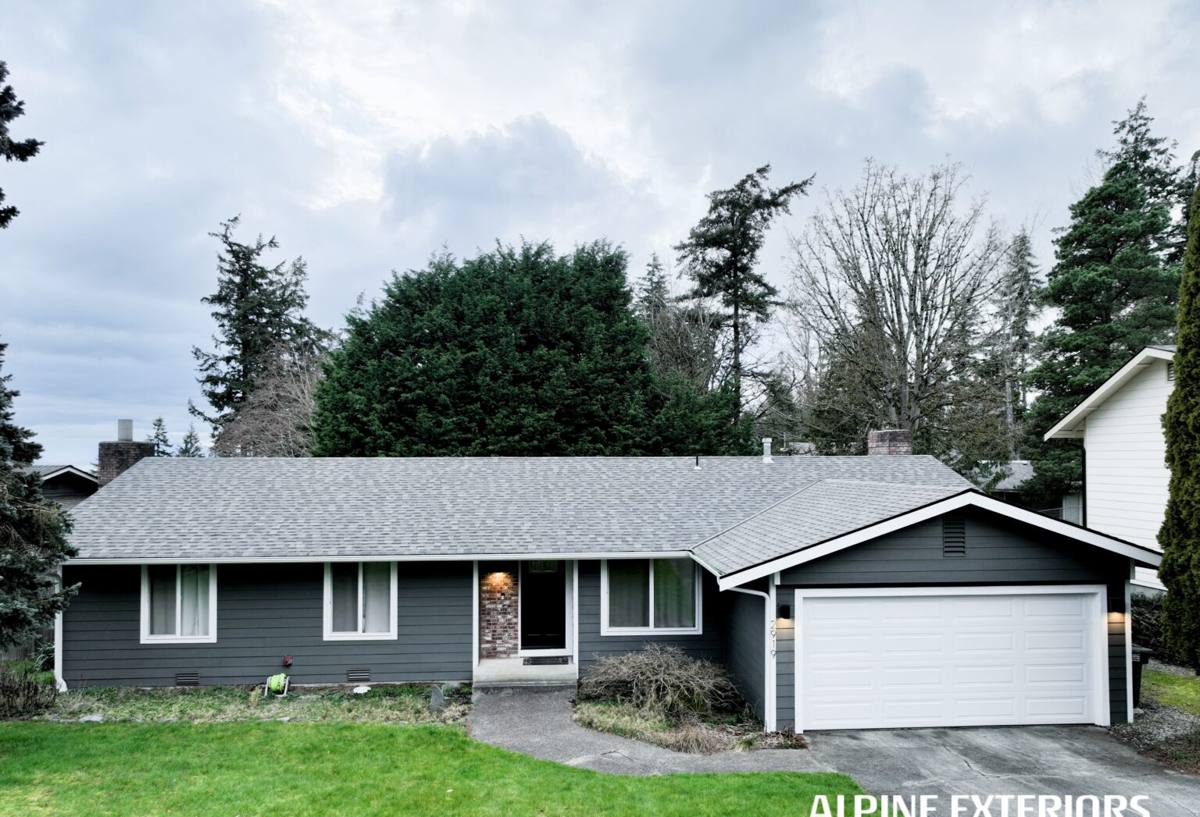
How Different Siding Materials Hold Up Near the Water
We get asked often why we standardized on one product line instead of offering several. The honest answer is that once you weigh salt air, driving rain, and moss exposure together, the gap between materials gets wide.
| Material | Salt Air / Corrosion | Wind-Driven Rain | Moss & Algae Resistance |
|---|---|---|---|
| Cedar / primed wood | Fasteners and trim need frequent inspection | Prone to swelling and cupping if water gets behind it | Low — organic surface, moss takes hold quickly |
| Vinyl | Handles salt air fine but can become brittle | Laps can allow water intrusion behind panels over time | Moderate — surface sheds moss but color fades and chalks |
| Engineered wood (LP-type) | Reasonable if sealed edges are maintained | Edge swelling risk if cut edges aren't field-treated correctly | Moderate — depends heavily on coating and site conditions |
| James Hardie fiber cement | Non-combustible, dimensionally stable, holds fasteners well | Engineered for Pacific Northwest wet climates (HZ5) | Higher — factory ColorPlus finish resists staining better than field-applied paint |
None of this means the other materials are junk — vinyl and engineered wood both have a place, and plenty of homes carry them without major issues. It means that for the specific combination of conditions Blaine Harbor homes deal with, fiber cement engineered for this climate zone gives homeowners the fewest maintenance headaches over the life of the siding, which is why it's the only product we install.
What a Correct Installation Looks Like Here
The siding material is only part of the equation. In a marine climate, the installation details determine whether that material performs for thirty-plus years or fails early.
Weather-Resistive Barrier and Flashing
A continuous weather-resistive barrier behind the siding, with properly lapped and sealed flashing at every window, door, and penetration, is what actually keeps wind-driven rain out of the wall cavity. This is the step that's easiest to rush and hardest to inspect once the siding is up, which is why we treat it as non-negotiable rather than optional.
Clearances and Drainage
Siding needs proper clearance from grade, roof lines, decks, and horizontal surfaces so water has somewhere to go instead of wicking into the bottom edge of a board. We also pay attention to how each wall drains and dries, since a wall that stays damp longer is a wall where moss and rot both get a head start.
Fastening and Joint Treatment
Fastener type, spacing, and placement follow manufacturer specification exactly — not a generalized nailing pattern used on every job. Butt joints and seams get treated correctly rather than caulked over and hoped for, since caulk is a backup measure, not a substitute for correct flashing and joint design.
Our Installation Process for Blaine Harbor Homes
- Site assessment — we look at wind exposure, sun and shade pattern, tree cover, and existing moisture damage before quoting anything.
- Removal and inspection — old siding comes off and we inspect the sheathing underneath for hidden rot or water damage before covering it back up.
- Repair and prep — any damaged sheathing or framing gets repaired; this is where hidden problems get fixed instead of sealed in.
- Weather barrier and flashing installation — installed and lapped correctly at every window, door, and penetration.
- Siding installation to manufacturer spec — James Hardie planks or panels installed with correct clearances, fastener spacing, and joint treatment for this climate zone.
- Trim, caulking, and touch-up — factory-finished ColorPlus edges get sealed and touched up per manufacturer guidelines so the finish performs as intended.
- Final walkthrough — we go over the completed work and the maintenance schedule with the homeowner before calling the job done.
Managing Moss and Algae Long-Term
No installation choice eliminates moss risk entirely on a shaded, damp wall — that's a function of sun exposure and airflow as much as material. What correct installation does is reduce how much of a foothold moss and algae get. Proper drainage keeps walls from staying saturated, and a factory-applied finish resists the kind of surface breakdown that gives spores something to grip. Where a property has heavy tree cover or a wall that rarely sees direct sun, we'll flag that during the estimate so the homeowner knows what to expect and how often a gentle rinse will be worth doing.
Coastal Maintenance After Installation
Fiber cement siding installed correctly is low-maintenance, not no-maintenance. A short annual routine keeps it performing the way it's designed to in a salt-air, high-rainfall environment.
- Rinse siding gently once or twice a year, focusing on north-facing and shaded walls where moss and algae build up fastest.
- Keep gutters and downspouts clear so runoff isn't dumping extra water directly onto siding or foundation walls.
- Walk the exterior after major windstorms and check caulking at trim and penetrations for cracking or separation.
- Trim back vegetation and tree limbs that keep a wall shaded and damp longer than necessary.
- Address small paint or caulk touch-ups promptly rather than letting a small gap become a water entry point.
Why a Crew That Already Works Blaine Harbor Matters
Siding installation isn't one-size-fits-all along this stretch of the Whatcom County coastline. A crew that's already worked Blaine Harbor properties knows which walls typically take the brunt of the wind, which areas hold moss longest, and how local conditions tend to expose weak installation details that wouldn't show up the same way twenty miles inland. That familiarity shows up in faster, more accurate estimates and fewer surprises once the old siding comes off.
It also matters for accountability. A local crew is easy to reach if a question comes up after the job, and has a reputation in the area worth protecting — a different incentive than a crew passing through from out of the region for a single job.
What Siding Installation Costs Depend On
We don't publish blanket prices because the honest cost of a job depends on real, site-specific factors. Here's what actually drives the number up or down.
| Factor | Why It Matters |
|---|---|
| Home size and wall complexity | More square footage and more corners, gables, and trim detail mean more labor and material. |
| Tear-off vs. installing over existing siding | Full removal costs more upfront but lets us inspect and repair the wall assembly underneath. |
| Existing moisture or rot damage | Hidden water damage found during tear-off needs repair before new siding goes on. |
| Home height and access | Multi-story homes and difficult access add equipment and labor time. |
| Trim and detail work | Custom trim, corner boards, and accent details take more time than plain lap siding. |
| Product line and color | James Hardie offers multiple plank profiles and ColorPlus color options at different price points. |
Checklist Before You Hire
- Ask whether the crew has worked in your specific neighborhood before, not just the general region.
- Confirm they're installing to manufacturer specification, including fastener type and flashing details.
- Ask what happens if hidden moisture damage is found during tear-off, and how that gets communicated and priced.
- Get the maintenance plan in writing so you know what upkeep is expected on your end.
- Check that the warranty is transferable if you plan to sell the home down the road.
If you own a home in or near Blaine Harbor and want a straight answer about what your siding needs, we're happy to take a look and walk the property with you. The estimate is free, there's no pressure to sign anything on the spot, and you'll get a clear explanation of what we find — good or bad — before any work starts.