 Blaine Siding
 Why Blaine Harbor's Siding Takes a Different Kind of Beating
Blaine Harbor sits about as close to the water as a Whatcom County neighborhood gets, and that closeness shapes how siding ages there. Homes take in salt-laden air off the water, wind-driven rain that comes in sideways during winter fronts, and a moss season that can stretch from early fall through late spring. None of that looks dramatic on any given day. It's the accumulation — year after year — that separates siding that holds up from siding that quietly fails behind a coat of paint.
Salt air is corrosive to exposed fasteners and hard on any factory finish that wasn't built to resist it. Wind-driven rain doesn't just wet the surface of a wall; it tests every seam, every piece of flashing, every point where two materials meet, looking for a way in. And moss doesn't only grow on roofs — given enough shade, north or west exposure, and standing moisture, it takes hold on siding too, holding water against the surface long after a normal dry stretch would have let the wall breathe out.
None of this means Blaine Harbor is an unusually harsh place to own a home. It means the margin for error on a siding job is smaller than it is a few miles inland, and the products and installation details that would be "good enough" elsewhere aren't always good enough here.
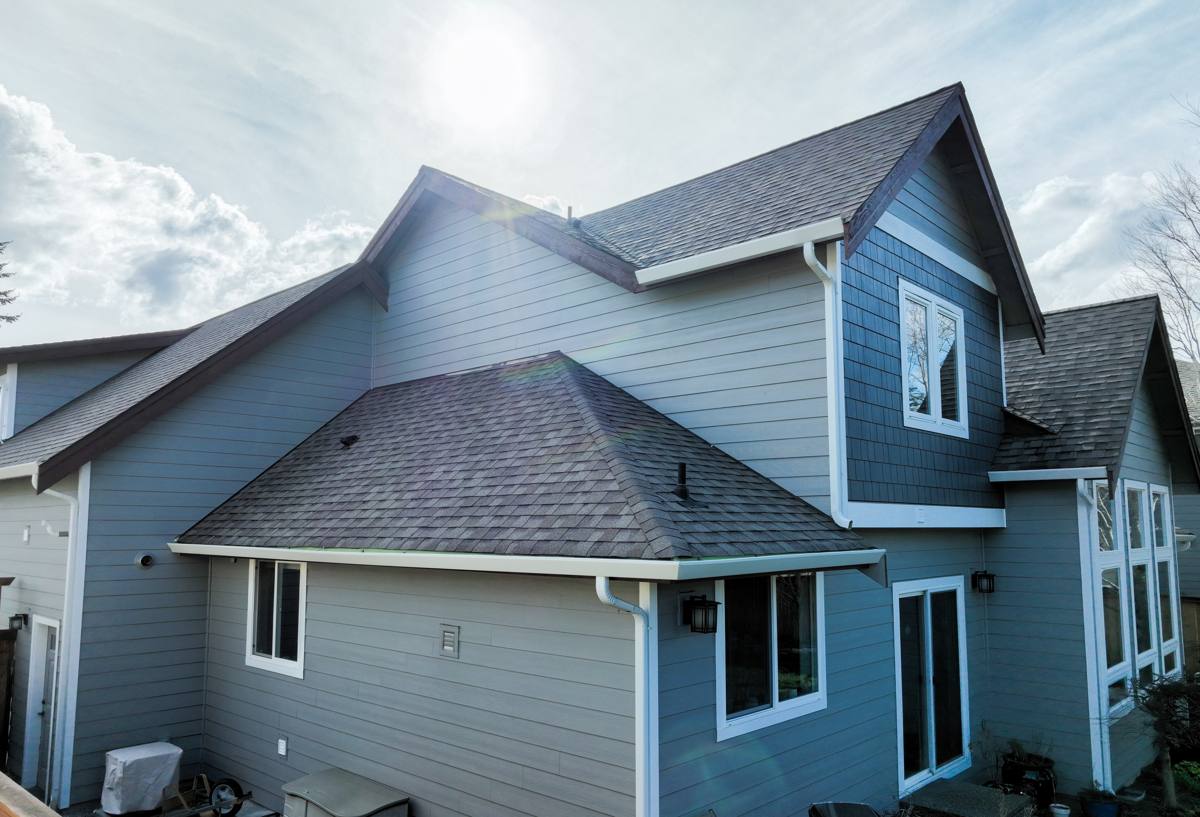
What a Waterfront-Adjacent Home Actually Needs From Its Siding
Three things matter more in Blaine Harbor than in most of Whatcom County:
- Moisture management, not just moisture resistance. The wall assembly behind the siding needs a way to dry out between rain events, not just a surface that sheds water for a few years.
- A finish that holds its color and seal in salt air. Field-applied paint and cheaper factory coatings tend to chalk, fade, or lose adhesion faster near the water than they would inland.
- Material that doesn't feed moss and mildew. Anything organic in the siding itself — wood fiber, untreated cellulose — gives moss and fungal growth something to work with once moisture is present.
This is the practical reason we install James Hardie fiber cement exclusively and don't install vinyl, LP SmartSide, primed spruce, cedar, or other fiber cement brands. Fiber cement is cement, sand, and cellulose fiber — it doesn't rot, it isn't a food source for moss or insects, and it's non-combustible. James Hardie's HZ5 product line is engineered specifically for wetter, cooler climate zones like the Pacific Northwest, and the ColorPlus factory finish is baked on in a controlled environment rather than field-sprayed, which matters a great deal in a neighborhood where salt air is part of daily weather.
What a Correct Siding Replacement Job Involves
Replacing siding is not just pulling off old boards and nailing up new ones. The siding itself is the visible ten percent of the job — the other ninety percent is the wall assembly underneath it, and that's where most siding failures near the water actually start.
Tear-off and inspection
Once the old siding is off, the sheathing gets inspected for water damage, soft spots, and any framing that's been compromised by long-term moisture intrusion. In a neighborhood this close to the water, it's common to find at least some damage around window and door openings, at butt joints, or anywhere flashing was missing or installed backwards. This is the point where a job either gets fixed correctly or gets papered over.
Water-resistive barrier and flashing
A new weather-resistive barrier goes over the sheathing, lapped correctly so water sheds down and out rather than behind the barrier. Every window, door, and penetration gets flashed — head flashing above openings, proper counter-flashing where the siding meets roofs and decks, and kick-out flashing anywhere a roofline meets a wall. These details are invisible once the job is finished, which is exactly why they're worth asking about before hiring anyone.
Rainscreen gap
For a climate with this much sustained rain and humidity, a drainage gap between the water-resistive barrier and the back of the siding gives incidental moisture a path to drain and gives the wall a way to dry. James Hardie's own installation guidance supports rainscreen assemblies, and in a location exposed to driving rain off the water, it's a detail we don't skip.
Installation to manufacturer spec
Fiber cement siding has to be fastened, gapped, and caulked according to the manufacturer's published instructions — correct fastener type and spacing, proper clearance at grade and roof lines, and factory-cut or properly sealed field cuts. Installed off-spec, even the best product on the market will underperform. This detail also determines whether the manufacturer's warranty actually holds if something goes wrong later.
James Hardie Compared to the Other Options Homeowners Ask About
Most homeowners planning a siding replacement have already seen a few different materials pitched to them. Here's an honest look at how they tend to hold up in a salt-air, high-rainfall environment like Blaine Harbor:
| Material | Behavior in salt air & driving rain | Maintenance burden | Fire behavior |
|---|---|---|---|
| James Hardie fiber cement | Engineered HZ5 formulation for wetter climates; factory ColorPlus finish resists fading and salt exposure | Low — occasional rinse and inspection of caulked joints | Non-combustible |
| Vinyl siding | Sheds surface water but relies heavily on correct house-wrap and flashing since seams and panels can let moisture behind the material; can warp or grow brittle over time | Low to moderate — panels can crack or fade and are hard to color-match years later | Combustible; can soften or deform near heat sources |
| LP SmartSide / engineered wood | Wood-strand core is more vulnerable to sustained moisture and edge swelling if caulking or paint fails | Moderate to high — edges and cut ends need diligent sealing and repainting over time | Combustible |
| Cedar / primed spruce | Natural wood; performs well when maintained but is the most vulnerable to moss, rot, and moisture cycling in a wet, salty climate | High — regular refinishing, caulking, and moisture monitoring | Combustible |
Every one of these products has legitimate uses somewhere. Our position is narrower than "vinyl is bad" or "wood is bad" — it's that for the specific combination of salt air, sustained rain, and moss pressure found around Blaine Harbor, fiber cement built for this climate is the material we're willing to stand behind with our own installation.
What Drives the Cost of a Siding Replacement in This Area
No two homes cost the same to re-side, and it's worth understanding what actually moves the number up or down before you get a quote:
| Cost factor | Why it matters here |
|---|---|
| Extent of hidden moisture damage | Homes closer to the water more often need some sheathing or framing repair once old siding comes off |
| Wall complexity | Dormers, bay windows, and multiple roof-to-wall intersections all add flashing detail and labor |
| Product selection | Lap width, texture, and trim profile within the Hardie lineup affect material cost |
| Color | Factory ColorPlus finishes cost more upfront than field-painted primed board but remove a repainting cycle |
| Access and site conditions | Waterfront-adjacent lots, tight setbacks, and slope can affect staging and scaffolding needs |
We won't quote a job sight unseen, and we're upfront that a house with hidden water damage will cost more to do right than one without — but we'd rather tell you that during the estimate than let it become a surprise mid-project.
How Our Process Works, Start to Finish
- On-site walkaround. We look at the existing siding, trim, and any visible signs of moisture or moss before we talk numbers.
- Written estimate. You get a clear scope: product line, color, trim details, and what's included — no vague allowances.
- Tear-off and sheathing inspection. Old material comes off and the wall gets inspected before anything new goes up.
- Repair as needed. Any damaged sheathing or framing gets addressed and documented before the new assembly is installed.
- Water-resistive barrier, flashing, and rainscreen installation. The parts you won't see again once the job is done, installed to spec.
- Hardie siding installation. Fastened, gapped, and finished according to manufacturer instructions.
- Final walkthrough. We go over the finished job with you before calling it complete.
Signs a Blaine Harbor Home May Be Due for Siding Replacement
Some warning signs are easy to miss from the ground, especially on shaded or water-facing walls. Worth checking for:
- Soft or spongy spots when you press on siding, especially near the bottom courses or under windows
- Persistent moss or dark streaking that comes back within weeks of cleaning
- Paint that's bubbling, peeling, or chalking heavily on one side of the house more than the others
- Visible gaps, warping, or buckling in panels or lap boards
- Rising energy bills without another clear explanation, which can point to a wall assembly that's no longer sealing properly
- Musty smells or staining on interior walls that share an exterior wall with visible siding issues
Any one of these on its own isn't necessarily an emergency. Several together, especially on a home that's fifteen-plus years old, usually mean it's worth having someone look at the wall assembly, not just the surface.
Why Local Experience in Blaine Harbor Specifically Matters
A crew that mostly works drier, inland parts of Whatcom County can install siding correctly on paper and still miss the details that matter most a few blocks from the water — how much rainscreen gap to build into a west-facing wall that takes the brunt of winter storms, where moss pressure is likely to be worst based on tree cover and sun exposure, or which flashing details tend to fail first on homes exposed to salt air. None of that is exotic knowledge, but it's the kind of thing you learn by working the same stretch of coastline repeatedly rather than treating every job as a generic install.
It also matters for something more basic: being reachable. A crew based nearby can get back out to a job site for a warranty question or a follow-up look without it being a special trip, and that's worth something on a job that's meant to last decades.
Get a Straightforward Look at Your Siding
If your Blaine Harbor home's siding is showing its age, or you just want an honest opinion on what shape it's in, we're happy to walk the exterior with you and give you a clear, no-pressure estimate for James Hardie siding replacement done right for this climate. Use the form below to get started.