 Blaine Siding
 Building Decks for Nooksack Properties Near Blaine
Nooksack sits inland from the coast but still falls squarely inside Whatcom County's marine-influenced weather pattern — the same salt-tinged air that moves in off Semiahmoo Bay and the Strait of Georgia reaches properties here, combined with a rainy season that runs long and a moss window that rarely closes. A deck built for a dry climate, or built with generic lumber-yard specs, does not hold up the same way out here. We build decks specifically accounting for what this area does to wood, metal, and fasteners over time.
This page covers what a correctly built deck looks like for a Nooksack-area property near Blaine — materials, structure, drainage, and the maintenance rhythm that actually keeps a deck sound for decades rather than years.
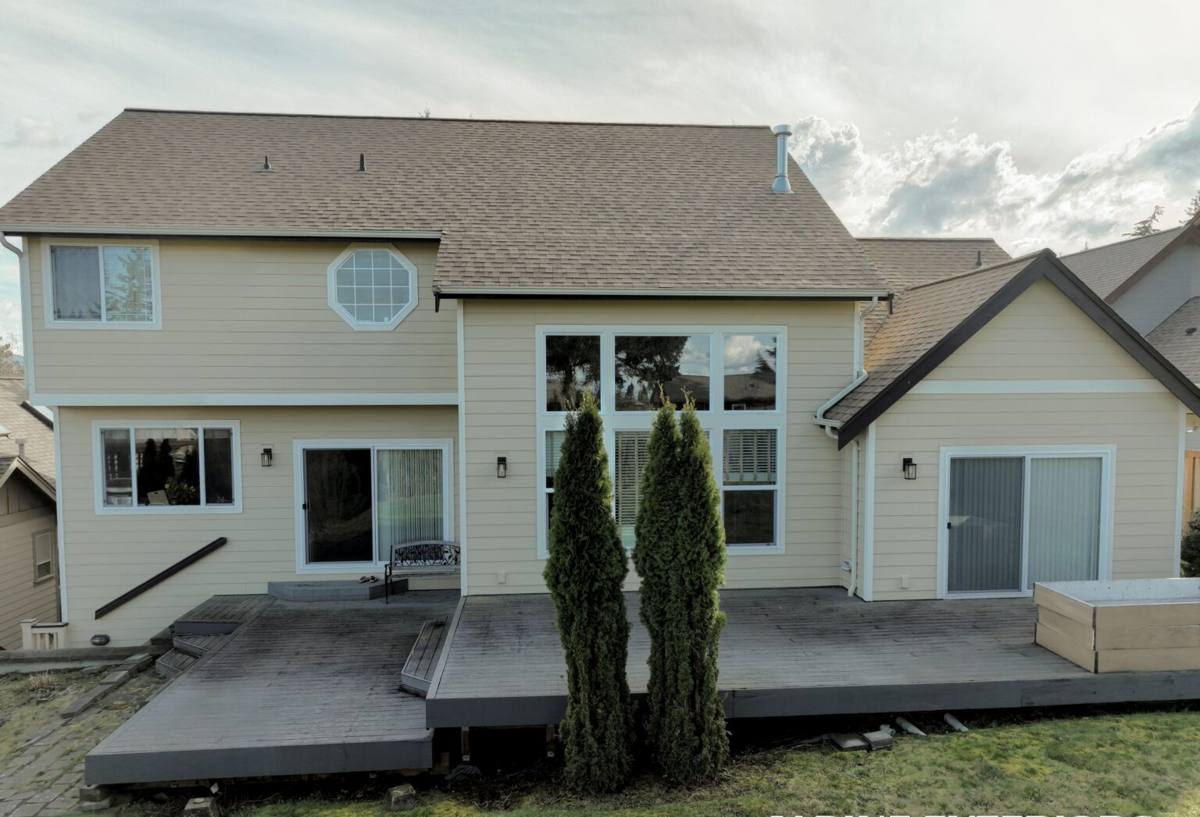
What This Climate Does to a Deck
Three things drive almost every deck problem we see in this part of Whatcom County:
- Salt-bearing air: even properties not directly on the water get airborne salt carried inland, which accelerates corrosion on any exposed metal fastener, bracket, or railing hardware that isn't rated for it.
- Driving rain: wind-driven rain doesn't just fall straight down — it gets pushed sideways under railings, into ledger connections, and behind fascia boards where it can sit against wood that was never meant to stay wet.
- A long moss season: shaded, north-facing, or tree-covered decks stay damp for months at a time. Moss and algae aren't just cosmetic — they hold moisture against the deck surface and turn boards slick and dangerous underfoot.
None of this means a deck can't last in Nooksack. It means the material choice, the framing details, and the fastener spec all have to be picked for this specific climate rather than a national-average one.
Choosing the Right Decking Material
There's no single "best" decking material — there's a best material for a given budget, sun exposure, and how much upkeep the homeowner actually wants to do. Here's how the common options hold up under Whatcom County conditions specifically:
| Material | Moisture / Moss Behavior | Maintenance | Typical Lifespan Here |
|---|---|---|---|
| Pressure-treated pine | Absorbs moisture readily; needs a sealed surface to resist moss growth in shaded areas | Re-stain/seal every 1-2 years | 15-20 years with upkeep |
| Cedar | Naturally moisture- and insect-resistant, but still needs sealing against driving rain and salt air | Sealant every 2-3 years | 20-25 years with upkeep |
| Composite decking | Doesn't absorb water or rot, but can still grow surface moss/algae in shaded, damp spots — needs periodic cleaning | Occasional wash, no staining | 25-30+ years |
| PVC decking | Fully moisture-resistant; best option for shaded or low-airflow deck areas prone to moss | Occasional wash | 25-30+ years |
For decks tucked under tree cover or facing north — common on wooded Nooksack lots — we generally steer homeowners toward composite or PVC in the shaded zones specifically because they don't give moss the organic material it needs to take hold. Wood is still a fine, honest choice on sunnier, more exposed decks where airflow keeps things dry between rains.
A Note on Warranty Structure
Composite and PVC products carry manufacturer warranties, but those warranties are conditioned on correct installation — proper spacing, fastening, and ventilation underneath. We install to the manufacturer's specification on every job specifically so that warranty stays valid if you ever need it.
The Structural Details That Actually Matter
The decking boards are the part everyone sees, but the framing underneath is what determines whether the deck is still solid in fifteen years. A few things we don't cut corners on:
- Ledger board flashing: where the deck attaches to the house, water intrusion at the ledger is the single most common cause of hidden rot. Proper flashing — installed so water sheds outward, not behind the siding — is non-negotiable.
- Footings sized for local soil: footing depth and diameter need to match the soil conditions and frost expectations for this part of Whatcom County, not a generic minimum.
- Joist spacing for the decking chosen: composite and PVC boards often require tighter joist spacing than solid wood to avoid flexing over time — we frame to the product spec, not a one-size-fits-all layout.
- Board gapping: correct spacing between boards lets water and debris pass through instead of pooling, which matters directly for moss prevention.
Fasteners and Hardware That Won't Corrode
This is where a lot of decks quietly fail years after they're built. Standard zinc-coated screws and brackets can start showing rust streaks and losing holding strength within a few seasons once salt-bearing air gets at them repeatedly. On every deck we build, we spec:
- Stainless steel or coated fasteners rated for coastal/marine exposure, not bargain zinc hardware
- Hidden fastener systems where compatible with the decking product, which also reduces the number of exposed metal points that can corrode and stain the board around them
- Structural connectors (joist hangers, post bases) rated for exterior, corrosive-prone environments
- Railing hardware matched to the same corrosion standard, since railings take the most direct weather exposure on the whole structure
The cost difference between standard and marine-grade hardware is small relative to the whole project. The difference in how the deck looks and performs after five wet Whatcom County winters is not small at all.
Designing for Drainage and Moss Resistance
Moss doesn't need much to get started — shade, moisture, and something to grip. A deck designed with drainage in mind gives it far less opportunity:
- Decking run in the direction that lets water drain toward the yard rather than pooling against the house
- Under-deck airflow left open where possible, rather than fully enclosed skirting that traps humidity underneath
- Railing baluster spacing and post placement that don't create dead zones where leaves and needles collect and hold moisture against the boards
- Surface texture selected with grip and drainage in mind for shaded sections, since a slick, mossy board is a fall risk as much as a maintenance headache
Good design won't eliminate the need for occasional cleaning on a shaded lot, but it dramatically reduces how often and how aggressively you have to clean.
Our Process
We keep the process straightforward and the same for every deck project we take on in the Nooksack and greater Blaine area:
- On-site assessment: we look at sun exposure, tree cover, existing structure (if replacing a deck), and how the space is actually used before recommending anything.
- Material and layout recommendation: based on that assessment, we walk through material options honestly, including the maintenance trade-offs of each, rather than pushing one product across every job.
- Written estimate: a clear scope and price before any work starts, no surprise change orders for things we should have caught up front.
- Permitting: most new decks and many deck replacements in Whatcom County require a permit — we handle that process as part of the job.
- Build: footings, framing, decking, and railing installed to spec, with flashing and fastener details treated as first-class parts of the job, not afterthoughts.
- Walkthrough: we go over the finished deck with you, including what maintenance it actually needs going forward.
Maintenance Checklist for Nooksack-Area Decks
Whatever material you choose, a little seasonal attention goes a long way in this climate:
- Sweep debris (leaves, needles, seed pods) off the deck regularly — this is what feeds moss growth in shaded spots
- Rinse or lightly scrub shaded and north-facing boards at the start and end of the wet season
- Check railing hardware and fasteners once a year for early rust staining, especially on wood decks
- Re-seal or re-stain wood decking on the schedule the product calls for — don't wait until it's visibly gray and weathered
- Keep gutters and downspouts near the deck clear so runoff isn't dumping extra water onto or under the structure
- Trim back overhanging branches where practical to cut down on shade and organic debris
Why Local Experience Matters Here
A deck built to a generic national spec will often survive just fine somewhere dry. Out here, the difference between a deck that still looks and performs well after a decade and one that's rotting at the ledger or streaked with rust at every screw head almost always comes down to whether the builder actually accounted for this specific climate — the salt air, the driving rain, the moss season — at every stage, from fastener choice to board spacing. That's the standard we hold every Nooksack-area deck project to, because it's the same weather hitting every property in this part of Whatcom County, year after year.
If you're planning a new deck or need to replace one that's showing its age, we're happy to come take a look and give you a straightforward, no-pressure estimate — just fill out the form below.