 Blaine Siding
 Composite Decking in Everson: Built for What the Weather Actually Does Here
Everson sits inland from Blaine but still gets the full weather pattern that defines this corner of Whatcom County: long stretches of driving rain from fall through spring, damp shoulder seasons where nothing dries out for days at a time, and a moss season that seems to start earlier every year. Add the salt-tinged air that reaches inland on a west wind off the Strait, and you've got a climate that's hard on any exterior surface — decks included.
Composite decking exists precisely because wood decking struggles in conditions like these. But "composite" isn't one product with one installation method. It's a category that ranges from budget capped boards to premium multi-layer systems, and the difference between a deck that looks good for fifteen years and one that cups, stains, or grows moss within three often comes down to installation details most homeowners never see — the substructure, the drainage plan, and the fastening system underneath the boards.
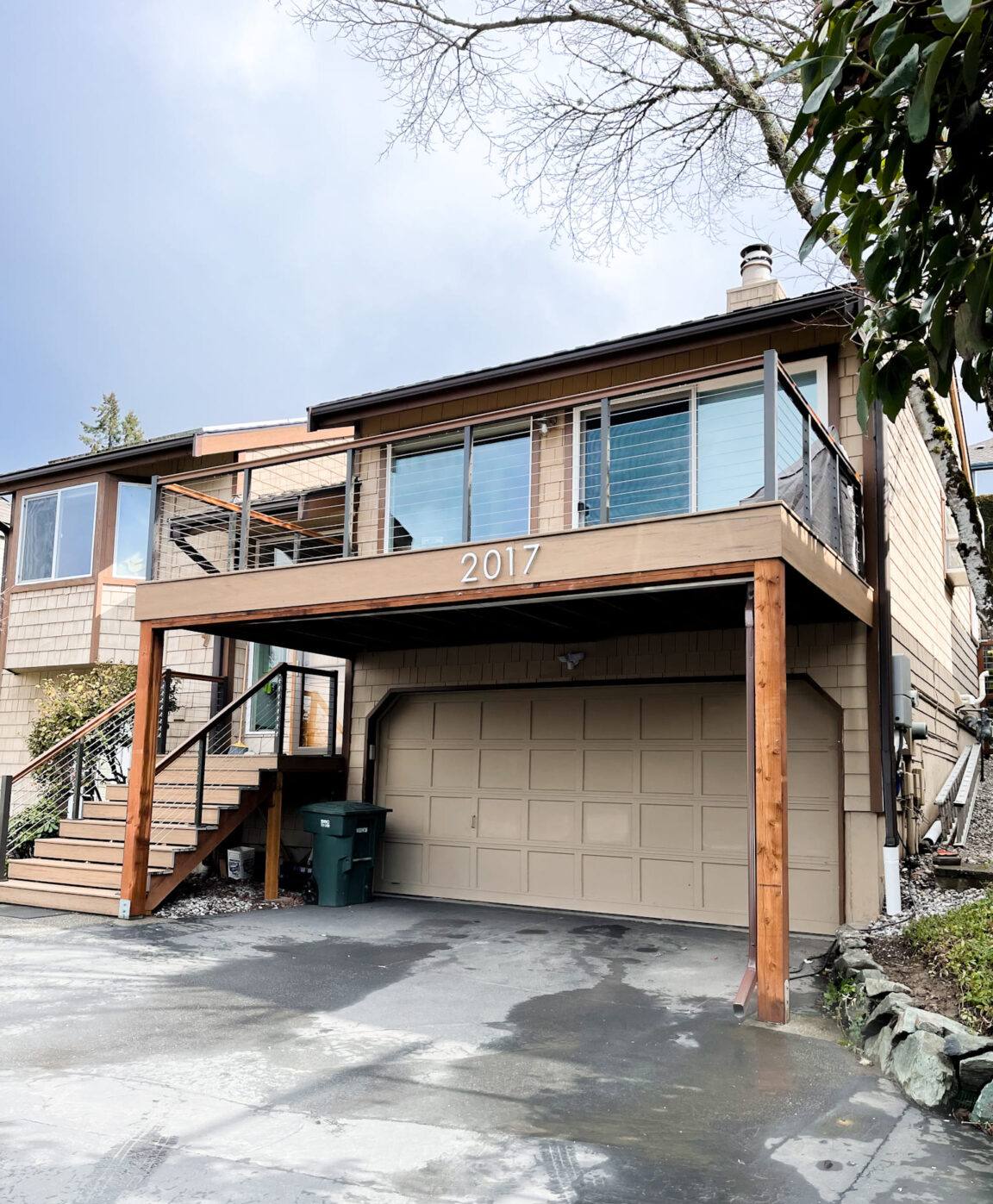
What Composite Decking Needs to Handle in This Climate
Moisture That Doesn't Let Up
Composite boards are more moisture-resistant than wood, but they aren't waterproof, and the framing underneath them isn't composite at all — it's still wood or, less commonly, steel. If that substructure can't shed water and dry between rain events, you get problems: soft joists, rusted fasteners, and boards that trap moisture against the frame instead of letting it evaporate. In a climate where it can rain steadily for a week, that drying window matters as much as the material on top.
Moss and Algae on Low-Sheen Surfaces
Composite decking's textured, low-gloss surface holds onto moisture longer than a smooth painted surface would, which is exactly the kind of surface moss and algae like. Boards that stay shaded, or that don't get airflow underneath, are the first to show green streaking by the second winter. This isn't a defect in the product — it's a predictable outcome of surface texture plus standing moisture, and it's manageable with the right board selection and layout.
Salt Air and Metal Hardware
The fasteners, screws, and structural hardware holding a deck together are usually the first thing to fail in a coastal-influenced climate, long before the decking itself shows wear. Standard fasteners corrode faster here than inland; that corrosion weakens the connection before it's ever visible from the surface.
What a Correct Composite Deck Installation Involves
Substructure and Drainage First
Before a single composite board goes down, the framing underneath has to be built to shed water, not hold it. That means proper joist spacing for the specific board being installed (composite often requires tighter spacing than wood framing rules of thumb), joist tape or flashing on top of the framing to keep water off the wood, and a slope built into the structure — not relied on as an afterthought — so water runs off the deck instead of pooling under it.
Fastening and Board Spacing
Composite boards expand and contract with temperature more than wood does, and the gap left between boards has to account for that movement — too tight and boards can buckle; too wide and they trap debris and moisture. Hidden fastener clip systems, used correctly, also allow for this movement while keeping the surface free of exposed screw heads that can back out or corrode over time.
Trim, Fascia, and Edge Details
The edges of a deck — fascia boards, stair stringers, picture-frame borders — are where water intrusion and premature wear usually start, because end cuts expose the board's core. Cut ends need to be sealed or capped per the manufacturer's requirements, and fascia has to be fastened in a way that doesn't trap water behind it.
Composite vs. Other Decking Materials for This Area
| Material | Moisture Behavior | Moss/Algae Resistance | Maintenance |
|---|---|---|---|
| Capped composite | Resists rot; core is still susceptible if cap is damaged | Moderate — depends on surface texture and shade exposure | Periodic wash; no staining or sealing |
| Uncapped/older composite | Can absorb moisture at cut edges and swell | Lower — more porous surface | Requires more frequent cleaning |
| Pressure-treated wood | Prone to warping, checking, and rot over time in wet climates | Lower — porous grain holds moisture | Annual sealing/staining to keep performance |
| Cedar | Naturally decay-resistant but still needs protection here | Moderate | Regular sealing; sanding as it weathers |
None of these materials is "bad" — the right choice depends on budget, how much upkeep a homeowner wants to do, and how exposed the deck is to shade, sprinklers, and prevailing weather. We'll walk through the honest trade-offs for your specific site rather than push one product line.
Our Process, Start to Finish
- On-site assessment: We look at existing framing (if replacing a deck), drainage path, sun/shade exposure, and how the deck ties into the house — including flashing at the ledger board, which is a common failure point in wet climates.
- Product selection: We walk through composite tiers and finishes based on your budget, the deck's exposure, and how much maintenance you actually want to do.
- Written estimate: Materials, structural work, and labor broken out separately, so you know what you're paying for.
- Substructure work: Repair or rebuild framing, install proper flashing and joist protection, and confirm slope and drainage before decking goes down.
- Decking installation: Boards, fascia, and trim installed to manufacturer spacing and fastening specs, with attention to cut-end sealing at every edge.
- Final walkthrough: We go over care and cleaning expectations specific to the product installed, so there are no surprises the first wet season.
Problems We Commonly Find on Older Decks in the Area
Repair and replacement calls in this part of Whatcom County tend to share a few patterns:
- Ledger boards without proper flashing, letting water track into the house rim joist behind the deck.
- Joists showing soft spots or rot where boards were laid directly on wood with no separation or drainage gap.
- Corroded fasteners that have loosened boards well before the decking surface itself looks worn.
- Moss buildup concentrated in shaded corners or under overhangs where boards never fully dry out.
- Gaps between boards that were cut too tight during a warm-weather install, causing buckling once temperatures dropped.
Most of these trace back to installation shortcuts, not the decking material itself — which is why we treat the substructure and drainage plan as seriously as the visible boards.
Choosing the Right Composite Product
Composite decking generally falls into a few tiers: entry-level capped boards, mid-range products with better fade and stain resistance, and premium lines with enhanced cap technology and longer warranties. We'll bring samples and go through manufacturer warranty terms with you directly, including what's and isn't covered for moisture and staining — that's often where the real difference between price points shows up, more than color or texture alone.
Color and Surface Considerations
Lighter-colored boards show pollen, dirt, and mineral staining differently than darker boards, and darker boards get hotter underfoot in direct summer sun. In a climate with this much overcast and rain, we also factor in how a given surface texture handles standing moisture and how visible moss growth will be against the board color — a practical consideration as much as an aesthetic one.
Maintenance: What Composite Decking Actually Needs Here
One of the appeals of composite is that it doesn't need staining or sealing. That doesn't mean zero maintenance in this climate:
- Sweep debris out of board gaps regularly — trapped leaves and needles hold moisture against the boards.
- Wash the surface once or twice a year (more if the deck is shaded) to keep moss and algae from establishing.
- Check that drainage gaps and under-deck ventilation haven't been blocked by landscaping, storage, or skirting.
- Inspect fastener heads and clips periodically, especially on older installs, for signs of corrosion or loosening.
- Keep gutters and downspouts near the deck clear so runoff isn't dumping extra water onto the structure.
Why a Crew That Already Works Everson and Blaine Matters
Composite decking installed to spec in a dry climate can still fail early here if the crew doesn't build in the drainage, flashing, and fastening margins this weather demands. We work throughout Whatcom County and see the same rain patterns, the same moss pressure, and the same salt-influenced air that Everson and Blaine homes deal with every year. That's not a marketing point — it's the reason our substructure details and fastener choices are built around what actually holds up here, not around a generic install sheet written for a drier region.
Get an Estimate
If you're planning a new composite deck or need an honest look at an existing one, we're glad to come out, walk the site, and give you a straightforward estimate — no pressure, no upsell. Use the form below to get started.