 Blaine Siding
 Siding Installation in Grandview: A Blaine Neighborhood That Asks More of an Exterior
Grandview is one of the residential pockets within Blaine, and like the rest of this corner of Whatcom County, the exterior of a home here works harder than it would somewhere more sheltered. Blaine sits close enough to Semiahmoo Bay and the Strait of Georgia that salt-tinged marine air is a fact of daily life across the whole city, not just for houses with a water view, and Grandview's homes sit inside that same weather pattern even on quieter, tree-lined residential streets set back from the shoreline. Add in driving rain that comes off the water sideways instead of straight down, and a moss season that runs most of the year in this climate, and you've got a set of conditions that reward a carefully installed siding system and punish a rushed one.
This page is specifically about siding installation for Grandview homes — full re-siding or new construction, not spot repair — and what a correct job actually requires in this specific setting. We install James Hardie fiber cement exclusively. We don't offer LP SmartSide, vinyl siding, Cemplank, Allura, primed spruce, or cedar as options, and that's a professional standard built from what we've seen hold up and what hasn't in Whatcom County's coastal, high-moisture climate — not a sales pitch.
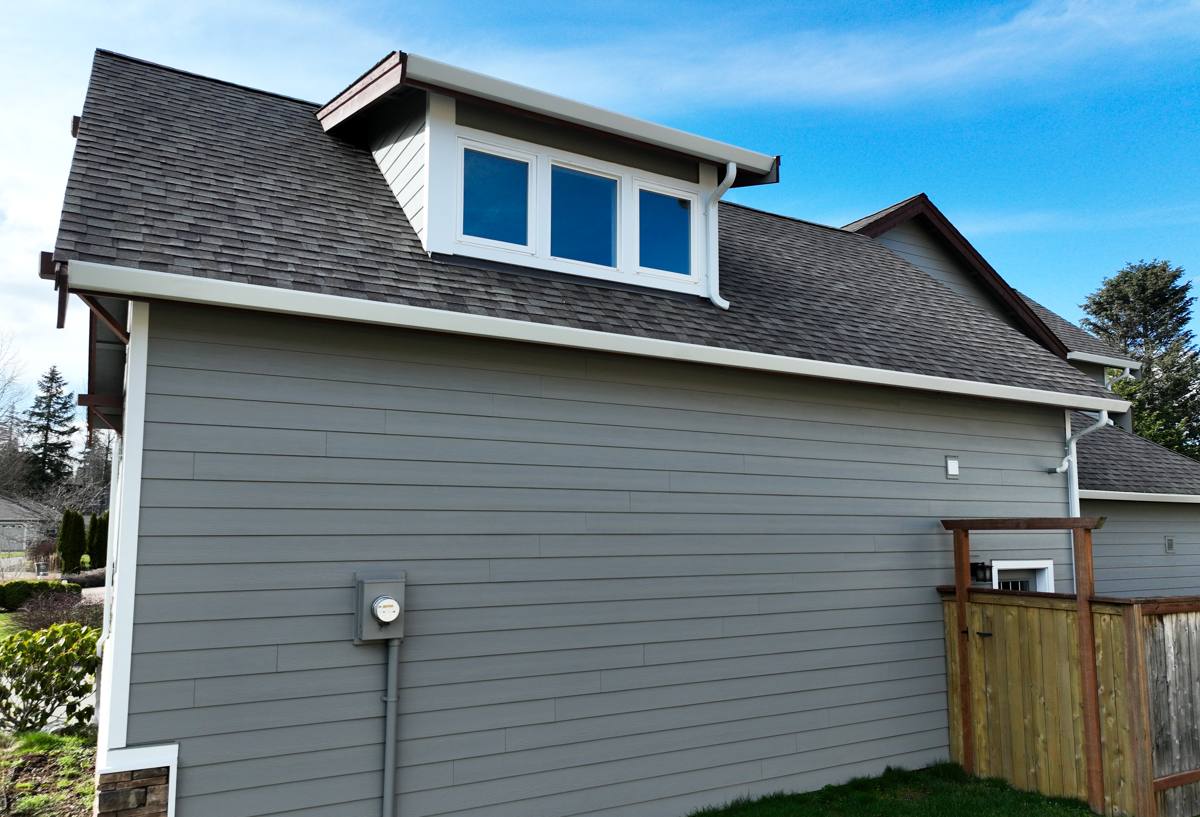
What Grandview's Climate Asks of a Siding Job
Salt Air Drifting In From the Water
Blaine's position on the water means salt-laden air moves across the whole city, and Grandview homes take on a steady dose of it even without a direct waterfront lot. That air is hard on exposed metal — fasteners, flashing, trim hardware — accelerating corrosion in ways that don't show up on install day but show up clearly a few years later as rust streaking, loosened trim, or a finish that dulls faster than it should. It also means the margin for using standard-grade hardware instead of corrosion-resistant material is thinner here than it would be twenty miles inland.
Driving Rain That Doesn't Fall Straight Down
Storm systems coming ashore near the border push rain sideways into wall assemblies rather than dropping it straight down, and that wind-driven pattern is a regular feature of Blaine's weather, not an occasional event. Sideways rain finds panel joints, window flashing, and trim transitions that vertical rain would never reach, which is exactly why the water-resistive barrier and flashing details underneath the siding matter as much as the siding material itself. A wall that's only built to shed straight-down rain is being under-built for what actually hits it here.
A Moss Season That Rarely Takes a Break
Mild temperatures and near-constant moisture add up to a moss and mildew season that can run most of the year on shaded or north-facing walls, and Grandview's mix of mature trees and residential lot layouts means plenty of walls stay in shade for long stretches. Any siding material with surface porosity becomes a growth surface over time in that kind of environment, and a wall that can't dry out between wet spells gives moss more time to establish itself before the next dry window arrives.
Why We Only Install James Hardie Siding in Grandview
We used to work with a broader range of siding products. We narrowed that down to one system after seeing, on tear-offs and service calls across Whatcom County, which materials actually held up to this specific mix of salt air, driving rain, and sustained moisture, and which ones quietly developed problems within a handful of years.
- Non-combustible core: Fiber cement doesn't feed a fire the way wood-based siding products can, which matters for both household safety and, often, insurance considerations.
- Factory-applied ColorPlus finish: The color is baked on under controlled factory conditions rather than brushed on at the job site, so it resists fading, chalking, and moisture intrusion better than field-applied paint over the long run.
- Climate-engineered HZ product lines: Hardie's HZ5 formulation is built for regions with sustained moisture and freeze-thaw cycling, which is a close match for Blaine's marine-influenced climate.
- Dimensional stability: Fiber cement doesn't swell, cup, or warp the way engineered wood products can after repeated wetting, which matters on walls that spend a lot of time damp.
- Strong transferable warranty: Hardie backs correctly installed siding with one of the more substantial warranty structures in the industry, and that warranty follows the house if it sells.
Each of the products we don't install has a place in the broader market, and homeowners elsewhere are happy with them. But in a coastal Whatcom County city like Blaine, we've made a professional call to install one system we can fully stand behind, rather than offer a lower-cost alternative that quietly shifts long-term maintenance and moisture risk onto the homeowner.
What a Correct Installation Looks Like on a Grandview Home
Fastening and Spacing
James Hardie publishes exact fastener type, placement, and spacing requirements, and they aren't the same across every product line or exposure level. Following that spec precisely, rather than a shortcut approximation of it, is what keeps panels secured through coastal wind loads and what keeps the manufacturer's warranty intact if a problem ever surfaces.
Rainscreen and Drainage Detailing
A small drainage gap behind the siding gives any moisture that gets past the outer surface a way to drain and evaporate instead of sitting against the sheathing. On a shaded Grandview lot where walls stay damp longer between dry spells, that detail is the difference between a wall that recovers after a wet stretch and one that stays chronically damp underneath a siding surface that still looks fine.
Flashing at Every Window and Penetration
Windows, doors, hose bibs, and vents all interrupt the plane of the siding, and each interruption is a place wind-driven rain can work its way behind the cladding if it's flashed incorrectly. This is the slowest and least visible part of an installation, and it's usually the part that determines whether a wall stays dry for decades or starts trapping moisture within a few wet seasons.
Clearance Above Grade, Decks, and Roofline
Hardie specifies minimum clearance between the bottom of the siding and grade, decks, roofing, and other horizontal surfaces, and that clearance exists to keep the lowest courses out of standing water and splash-back. It's a detail that's easy to skip for a tidier look on install day, and one of the more common places we find early failure on tear-offs where it was ignored.
Sealed Field Cuts
Every panel cut on site — around a window, at a corner, at the end of a run — needs its cut edge sealed or primed per Hardie's specification before it goes up. An unsealed cut edge is one of the more common places fiber cement actually takes on water, and it has nothing to do with the material being flawed; it's a finishing step that either happens or doesn't.
Installation Shortcuts and How They Show Up Later
| Shortcut | What it looks like on install day | How it shows up later in Grandview |
|---|---|---|
| Standard fasteners instead of corrosion-resistant hardware | No visible difference | Rust streaking and loosening panels within a few years of salt air exposure |
| Panels installed tight with no drainage gap | Appears clean and well-fitted | Trapped moisture and persistent moss on shaded walls |
| Skipped clearance at grade or deck ledger | Siding looks flush and finished | Wicking, softness, and paint failure at the bottom courses |
| Rushed or taped-over window flashing | Looks sealed from the outside | Hidden moisture intrusion, often unnoticed until interior staining shows up |
| Unsealed field-cut edges | Cuts look clean and painted | Localized swelling or delamination at the cut on wind-exposed walls |
Our Installation Process for Grandview Homes
- Exposure walk: We look at how each wall of the house is actually exposed — which faces catch direct wind and salt air, which sit in shade or under tree cover, and whether existing moss or staining points to a chronic moisture issue.
- Tear-off and sheathing inspection: Old siding comes off and the sheathing underneath gets checked before anything new goes up. Covering damaged sheathing with new siding just hides the problem for a few years.
- Water-resistive barrier: The barrier goes on with proper overlap and taped seams at every joint and penetration, since this hidden layer does most of the real work of keeping wind-driven rain out of the wall.
- Siding installation to spec: Panels go up following Hardie's fastening, spacing, and clearance requirements as the standard, not an option, with field cuts sealed as they're made rather than at the end of the day.
- Final walkthrough: We walk the finished job with the homeowner, confirm it matches what was scoped, and cover what basic upkeep looks like on a Blaine home going forward.
Cost and Timeline Factors for a Grandview Siding Project
| Factor | Why it matters |
|---|---|
| Home size and number of stories | More wall area and height mean more labor and, on taller homes, more staging and access equipment |
| Trim and roofline complexity | Homes with more windows, dormers, or roof transitions need more flashing and cutting work |
| Condition of sheathing underneath old siding | Rot or water damage found at tear-off adds repair scope before new siding can go up |
| Wall exposure to wind and salt air | Water-facing or unshaded walls typically warrant closer flashing and drainage attention |
| Product line and ColorPlus finish selection | James Hardie offers multiple panel styles and finish tiers at different price points |
These are general drivers, not a quote. Two homes on the same Grandview street can need noticeably different scopes once we're actually pulling old siding and looking at what's underneath, which is why we walk the property in person before putting a firm number on a job.
Signs a Grandview Home Is Ready for New Siding
- Moss or dark staining that returns quickly after cleaning, especially on shaded or north-facing walls
- Soft or spongy siding, particularly near the bottom of the wall or around window trim
- Rust staining or corroded fasteners and trim hardware
- Cupping, warping, or visible gaps at panel joints and corners
- Peeling paint or a chalky, faded finish that doesn't respond to washing
- Rising energy bills that suggest the wall assembly isn't holding heat the way it should
- Visible rot or soft spots discovered when a section of old siding is pulled for another repair
Why a Crew Already Working in Grandview Matters
A crew that installs siding across Blaine regularly, not occasionally between jobs elsewhere in Whatcom County, makes different calls on install day — where extra flashing attention actually pays off, which walls in a neighborhood like Grandview stay damp the longest, and which fastener and clearance details genuinely can't be shortcut regardless of schedule pressure. That judgment comes from repetition in this specific climate, not from a generic installation checklist applied the same way in a drier part of the state. It's also worth asking any contractor directly about their experience with this coastal, moisture-heavy setting before hiring, since a confident answer there says more than a low bid does.
If you're planning a full siding installation for a Grandview home, or want an honest second opinion on an existing installation, we're glad to walk the property and give you a straightforward assessment. Reach out using the form below for a free, no-pressure estimate.