 Blaine Siding
 Why Peace Arch Homes Need a Different Siding Conversation
Homes near the Peace Arch border crossing sit in one of the more exposed pockets of Whatcom County. You're close enough to the water to get salt-laden air pushing inland on a regular basis, open enough to catch wind-driven rain off the Strait, and shaded enough in places that moss and algae get a long, uninterrupted growing season on north- and west-facing walls. None of that is unique to any one street or block in the area — it's the general character of siting a house this close to Boundary Bay and the Salish Sea coastline. But it does mean the siding decision matters more here than it would forty miles inland.
We install James Hardie fiber cement siding exclusively. This page isn't a general product overview — it's specifically about what a correct Hardie installation looks like on a Peace Arch-area home, why the climate here changes some of the details, and what our process looks like when we're the crew on your street.
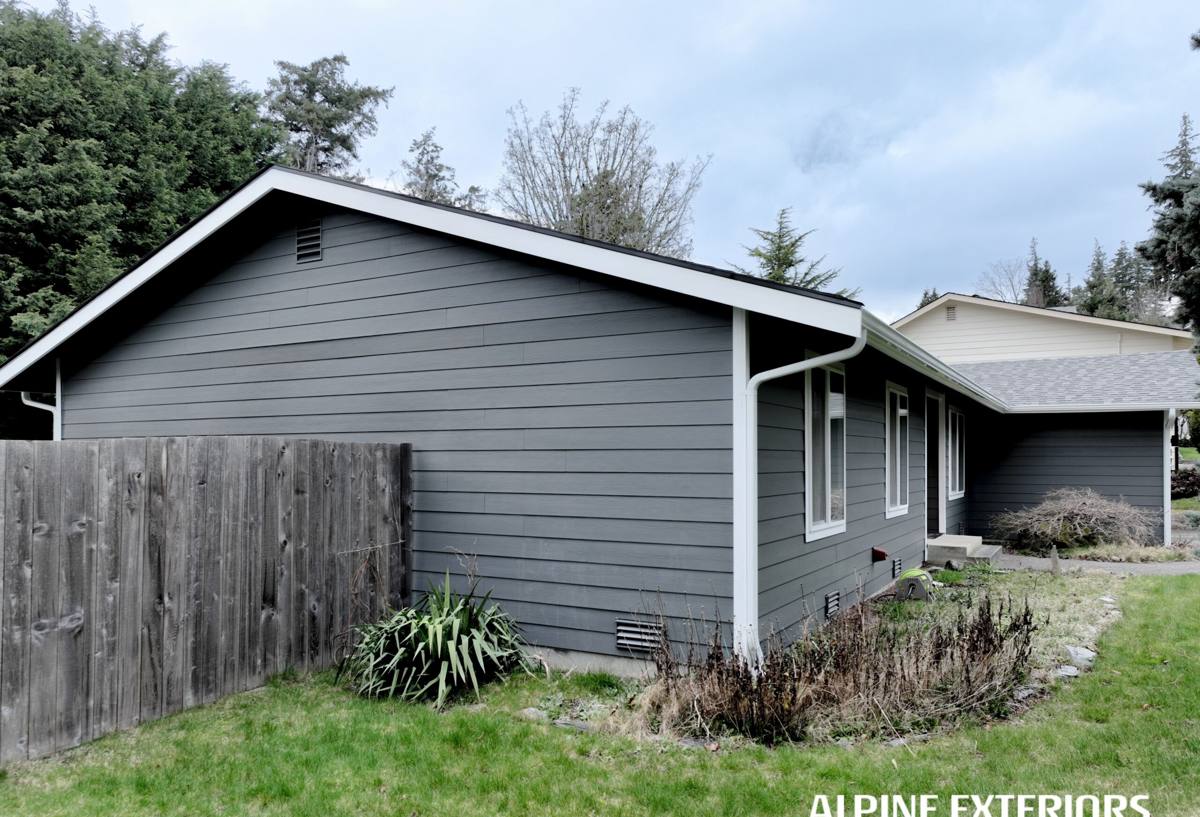
What Salt Air, Rain, and Moss Actually Do to Siding
Salt air
Airborne salt is corrosive to fasteners and hardware long before it does anything visible to a wall surface. Cheap or improperly rated nails and trim screws can start rusting from the inside of a wall assembly years before a homeowner sees staining bleed through the paint. It also accelerates the breakdown of unprotected wood fiber and can dull or chalk lower-grade factory finishes faster than manufacturers advertise.
Driving rain
Wind off the water doesn't just add rainfall totals — it pushes water sideways, into laps, joints, and butt seams that would stay dry in a calmer climate. Siding systems that rely on caulking or careful field-painting for their weather seal are the ones that fail first in these conditions, because caulk is a maintenance item, not a permanent one.
Moss and algae season
Shaded, damp wall sections in this part of Whatcom County can stay wet for months at a stretch. Any siding material that absorbs moisture — even a little — becomes a slow-release reservoir that keeps mold, mildew, and moss spores fed long after the rain has stopped. That's a maintenance and appearance issue as much as a durability one.
Put those three together and you get a simple standard: the siding on a Peace Arch home needs to shrug off water rather than absorb it, needs fasteners and flashing detail that won't corrode ahead of schedule, and needs a factory finish that isn't relying on a housepainter's caulk gun to keep it watertight.
Why We Standardized on James Hardie for This Kind of Exposure
James Hardie fiber cement is manufactured from cement, sand, and cellulose fiber — it doesn't absorb and swell the way wood-based or wood-fiber siding products can, and it's non-combustible. For a coastal-influenced climate like Blaine's, the practical benefit is that the board itself isn't the weak point in a driving-rain event the way a moisture-sensitive substrate can be.
Hardie also engineers specific product lines (their "HZ5" designation) for regions with harsher moisture and freeze-thaw cycling, and the Pacific Northwest is squarely in that specification. We use the HZ5 line on installations in this area rather than a generic climate-zone product, because the extra margin against moisture cycling is exactly what this stretch of coastline calls for.
The factory-applied ColorPlus finish is the other half of the equation. It's baked on under controlled conditions rather than field-applied, which means the color and the protective topcoat go on more evenly and adhere better than a site-painted finish typically can. In a salt-air environment, a finish that's already fighting less UV and moisture degradation from day one holds its color and its seal longer between recoats — which, on this material, usually means over a decade before you're thinking about repainting at all, not the 3-5 year repaint cycle you'd budget for wood.
What a Correct Installation Involves
The product is only half of the durability equation. Fiber cement siding fails prematurely almost exclusively because of installation mistakes, not material defects — and in a high-moisture, high-wind area, those mistakes show up faster.
- Weather-resistive barrier and rainscreen detailing — a drainage gap behind the siding lets any incidental moisture that gets past the cladding actually dry out instead of sitting against the sheathing.
- Correct fastener spec — hot-dip galvanized or stainless fasteners, placed and spaced to Hardie's published fastening schedule, not whatever happens to be in the nail gun.
- Proper clearances — minimum gaps from grade, roof lines, decks, and abutting hardscape so the bottom edge of the siding isn't sitting in standing water or splash-back.
- Butt joint and seam treatment — joints flashed or treated per manufacturer instruction rather than relied on caulk alone to stay sealed through wind-driven rain.
- Window and door flashing integration — siding tied into the flashing system correctly so water sheds outward at every penetration, not into the wall cavity.
- Field-cut edge sealing — any cut edge of the board gets primed or sealed on-site since the factory finish only covers the original edges.
Skip any one of these and you can install genuine James Hardie board and still end up with the moisture problems the product was chosen to avoid. This is why we treat installation method as inseparable from the product decision — it's also the core reason we don't install other siding types alongside Hardie: doing one system well, to spec, on every job is how these details stay consistent.
Our Process for a Peace Arch Project
1. On-site assessment
We look at existing siding condition, sheathing and moisture status where accessible, current flashing and drainage detailing, and the specific exposure of each elevation — a north wall tucked against tree cover behaves differently than a south wall catching direct wind off open water.
2. Product and color selection
We walk through the relevant Hardie board profiles (lap, panel, shingle-style) and ColorPlus palette options suited to the home's style and the neighborhood's general character, and confirm HZ5 specification for the job.
3. Written scope and schedule
You get a clear scope of work covering tear-off (if applicable), house wrap or rainscreen approach, flashing and trim details, fastener spec, and a realistic install timeline that accounts for regional weather windows.
4. Installation
Crew-managed installation following Hardie's fastening and clearance specifications throughout, with attention to the moisture-management details outlined above at every seam, corner, and penetration.
5. Final walkthrough
We review the finished work with you, confirm caulking and touch-up at cut edges, and go over basic maintenance expectations so you know what a properly installed Hardie exterior does and doesn't need going forward.
Cost Factors for This Type of Project
Every project is different, but the variables that move the price on a Peace Arch-area Hardie installation are fairly consistent. We give firm numbers after an on-site look, not off a phone estimate, because exposure and existing wall condition vary house to house even on the same block.
| Factor | Why It Matters Here |
|---|---|
| Existing siding removal | Tear-off scope and any hidden moisture damage found underneath affect labor and sheathing repair |
| Wall complexity | Dormers, gables, and cut-up elevations increase flashing and trim work, which matters more in a driving-rain climate |
| Product line and profile | HZ5 lap vs. panel vs. shingle-style Hardie boards carry different material and labor costs |
| ColorPlus vs. field paint | Factory finish costs more up front but removes the repaint cycle almost entirely |
| Rainscreen/drainage upgrade | Adding or upgrading a drainage gap behind the siding is a smart investment on shaded, damp elevations |
| Access and site conditions | Lot slope, landscaping, and proximity to neighboring structures affect scaffolding and staging |
Signs Your Current Siding Isn't Handling This Climate
- Persistent moss or dark streaking that returns within a season of cleaning
- Soft or spongy spots, especially near the bottom courses or around windows
- Visible fastener staining or rust bleed-through
- Paint that's chalking, peeling, or needing recoat far sooner than expected
- Gaps opening at butt joints or trim after a windy, wet winter
- A musty smell or visible interior staining on an exterior wall
Any of these on a home in this area is worth a look before it becomes a sheathing or framing repair rather than a siding one.
Why Hiring a Crew That Already Works This Area Matters
A siding crew that regularly works Blaine and the surrounding Whatcom County coastline already has calibrated judgment about which elevations need extra drainage detailing, how far clearances should run given local rain patterns, and what fastener spec actually holds up here versus what a generic spec sheet assumes for a drier region. That's not something a crew based hours away, working the area occasionally, builds the same intuition for. It also means warranty support and any follow-up questions come from people who aren't strangers to your specific climate conditions.
If you're weighing a siding replacement or new construction siding decision for a home in the Peace Arch area, we're happy to come take a look, walk the exterior with you, and put together a straightforward, no-pressure estimate — no obligation, just an honest read on what your home needs.