 Blaine Siding
 Why Semiahmoo's Location Puts Extra Demands on Siding
Homes along the Semiahmoo spit and the shoreline neighborhoods around it sit closer to open water than almost anywhere else in Whatcom County. That proximity is the whole appeal of living there, and it's also exactly why siding fails faster in this pocket of Blaine than it does a few miles inland. Salt-laden air moves off the water and settles on every exterior surface, wind-driven rain gets pushed sideways into seams and laps that would stay dry in a calmer location, and the shaded, damp stretches of the season let moss and algae get a foothold that plain paint and softer siding materials struggle to shed.
None of that is a reason to avoid a beautiful coastal home. It's a reason to be deliberate about what goes on the outside of it. Siding on a Semiahmoo property isn't a cosmetic decision — it's the first line of defense against a climate that combines three separate stresses at once: salt exposure, sustained moisture, and organic growth. Get the material and the installation wrong, and you're repainting, re-caulking, or replacing sections within a decade. Get it right, and the siding becomes something you stop thinking about.
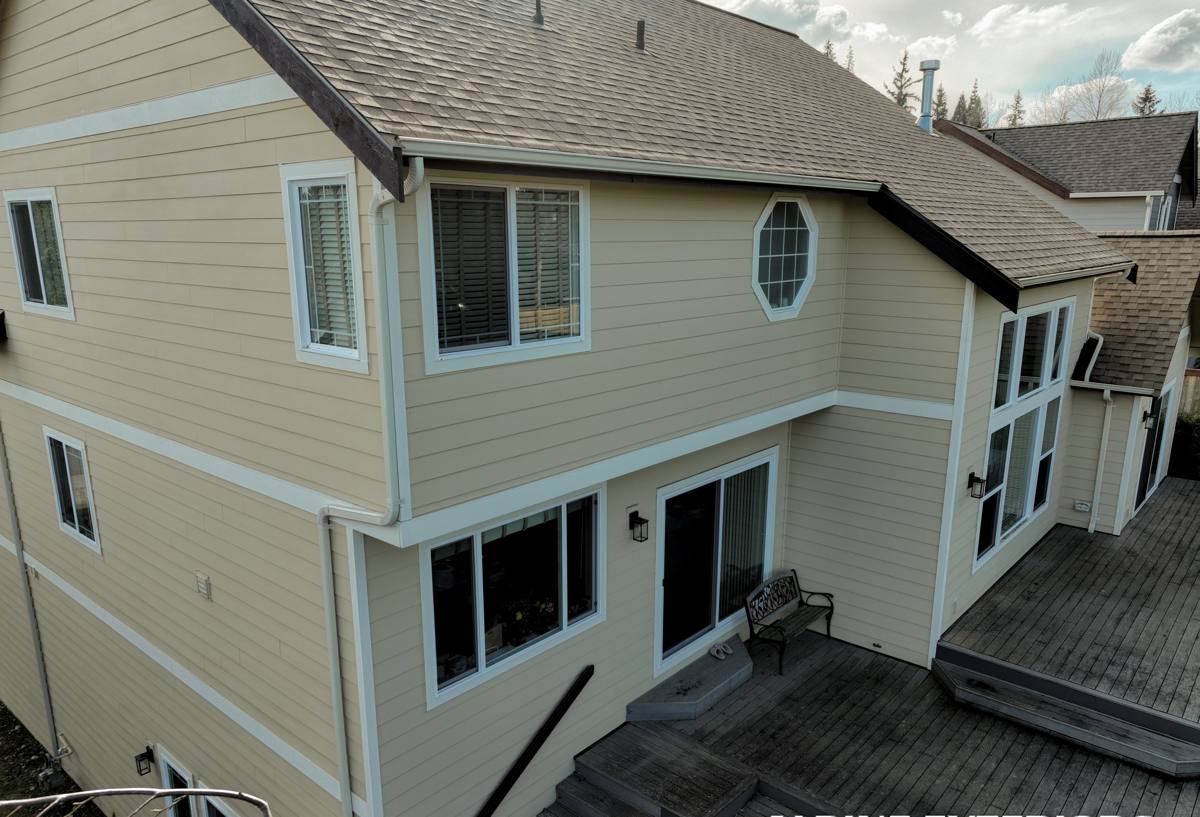
What Salt Air Actually Does to Exterior Materials
Salt air isn't just "humid air with a coastal smell." Airborne salt is hygroscopic — it pulls moisture out of the air and holds it against whatever surface it lands on, which keeps wood-based products and many composite panels damp far longer than they'd stay in a dry inland climate. That prolonged dampness is what drives swelling, edge softening, and eventually rot in materials that aren't engineered to resist it. Salt residue can also be mildly corrosive to unprotected metal fasteners and trim over many years, which is part of why fastener choice matters as much as the siding panel itself.
Fiber cement doesn't have the same vulnerability. It's a mix of cement, sand, and cellulose fiber — there's no wood core to swell, no organic substrate for moisture to migrate into. That's the core reason we standardized on James Hardie products for homes in this area rather than wood-based or vinyl alternatives: the base material itself isn't fighting the climate, it's indifferent to it.
Driving Rain and Wind-Driven Moisture
Blaine's weather regularly pushes rain sideways off the Strait, and homes on more exposed lots around Semiahmoo take the brunt of it. Sideways rain finds every gap a straight-down rain would never reach — under-lap seams, butt joints, window and door trim, penetrations for hose bibs and vents. This is a water-management problem as much as a siding-material problem, which is why the flashing, house wrap, and drainage plane behind the siding matter just as much as the panels themselves. We'll get into exactly what that involves further down.
The Long Moss Season
Western Whatcom County's cool, wet stretch of the year runs long, and shaded north- and west-facing walls near mature trees or close neighboring structures can stay damp for weeks at a time. That's exactly the environment moss and algae need to establish. On untreated or poorly finished surfaces, that growth isn't just cosmetic — it holds moisture against the surface underneath it, extending the damp period even further and accelerating whatever deterioration was already happening.
Why James Hardie Is the Product We Install Here
We install James Hardie fiber cement siding exclusively — we don't offer vinyl, LP SmartSide, primed spruce, cedar, or other fiber cement brands like Cemplank or Allura. That's a deliberate standard, not a lack of options. Here's the reasoning specific to a climate like Semiahmoo's:
- Non-combustible core: fiber cement doesn't burn, which matters everywhere but is a genuine asset near wildland-urban interface zones and during dry-season wind events.
- No wood substrate to rot: unlike engineered wood siding, there's no organic core that can absorb and hold salt-laden moisture over years of exposure.
- Factory-applied ColorPlus finish: a baked-on finish that resists fading and moisture intrusion far better than field-applied paint, which matters when you're fighting UV, salt, and damp air simultaneously.
- Climate-engineered HZ product lines: Hardie manufactures region-specific formulations (HZ5 for the Pacific Northwest's wetter, milder climate) rather than a single one-size-fits-all panel.
- A warranty structure built around correct installation: Hardie's transferable limited warranty assumes the product is installed to their published specifications — which is also why installation quality is the other half of this equation.
Vinyl siding can crack and fade under UV and salt exposure over time, and its expansion and contraction can open gaps at seams over the years. Primed wood and spruce siding require an ongoing repainting and caulking commitment that's harder to keep up with in a climate that stays damp for so much of the year. LP SmartSide and other engineered wood products still rely on a wood-strand core, which means their long-term performance depends heavily on the integrity of the factory coating staying intact at every cut edge and fastener point — something that's much harder to guarantee on a home exposed to constant salt air. We'd rather put a material on your home that isn't relying on a coating to keep moisture out of a vulnerable core.
Choosing the Right Hardie Line and Profile for a Coastal Home
Not every Hardie product or profile is the right fit for every wall on a coastal property. Part of our job is matching the product to the exposure.
| Product | Best Use on a Semiahmoo Home | Why |
|---|---|---|
| HardiePlank lap siding | Most wall areas, standard exposure | Traditional look, strong track record, available in smooth or cedar-textured finishes |
| HardiePanel vertical siding | Accent walls, gables, modern designs | Clean lines, fewer horizontal laps for wind-driven rain to catch |
| HardieTrim boards | Corners, window and door surrounds | Matches the same non-combustible, moisture-resistant performance as the field siding |
| HardieSoffit panels | Eaves and overhangs on exposed sides | Ventilated or non-vented options to manage moisture at the roofline |
On the most exposed elevations — typically the sides facing open water or prevailing wind — we'll often recommend tighter fastener schedules, additional sealant detailing at trim joints, and sometimes a shift in board exposure width to reduce the number of horizontal seams. These are small decisions, but on a home taking direct salt spray and driving rain, they add years to how the siding performs.
What Correct Installation Actually Involves
The siding panel is maybe half the story. The other half is everything behind it, and it's where most premature siding failures we get called to look at actually originate — not from the panel material, but from water management that was rushed or skipped.
The Drainage Plane and Water-Resistive Barrier
A correctly installed system includes a continuous water-resistive barrier behind the siding with a drainage gap that lets any moisture that does get past the panels drain out and evaporate instead of sitting against the sheathing. On a home taking regular wind-driven rain, this layer is doing real work, not just checking a code box.
Flashing at Every Penetration
Windows, doors, hose bibs, light fixtures, and any other wall penetration need proper flashing that directs water outward and down, never behind the barrier. This is one of the most common places we find shortcuts on older installs — flashing that was skipped, reversed, or sealed with caulk alone instead of lapped correctly.
Fastener Selection and Placement
In a salt-air environment, fastener corrosion resistance matters. We use fasteners rated for the exposure and follow Hardie's specified nailing patterns and clearances — over-driving or under-driving fasteners is a common cause of panel cracking and loosening over time.
Clearances and Gaps
Hardie specifies minimum clearances from grade, roofing, decks, and other abutting surfaces, along with gaps at butt joints and trim to allow for material movement and drainage. Closing those gaps up tight might look cleaner on install day, but it traps moisture and shortens the life of the assembly.
Caulking and Sealant Details
Not every joint should be caulked — some are designed to stay open as drainage or expansion gaps. Sealing the wrong joints is a mistake we see fairly often on prior installs, and it usually makes moisture problems worse, not better, because it traps water that would otherwise have drained out.
Our Process on a Semiahmoo Project
- On-site assessment: we look at wall exposure, existing moisture damage, trim condition, and which elevations take the most direct salt and rain exposure.
- Product and profile selection: matching Hardie lines, textures, and colors to the home's design and its specific exposure conditions.
- Tear-off and sheathing check: removing existing siding and inspecting the sheathing underneath for hidden rot or moisture damage before anything new goes on.
- Water-resistive barrier and flashing installation: the layer that does the real long-term work, installed to manufacturer spec at every seam and penetration.
- Siding, trim, and soffit installation: installed to Hardie's fastening, clearance, and gap specifications, elevation by elevation.
- Final detailing: caulking only where specified, touch-up of factory finish at cut edges, and a walkthrough of the finished work.
What Drives Cost on a Project Like This
| Factor | Why It Matters |
|---|---|
| Existing sheathing condition | Hidden rot found during tear-off adds repair scope before new siding can go on |
| Number of wall penetrations | More windows, fixtures, and vents mean more flashing detail work |
| Wall exposure and elevation count | Highly exposed sides may warrant tighter fastening or added detailing |
| Product line and profile | Panel vs. lap siding, trim complexity, and ColorPlus color selection affect material cost |
| Access and site conditions | Multi-story sections, decks, or tight lot lines can affect labor time |
We won't throw out a broad number without seeing the home — a straightforward single-story re-side is a very different scope than a home with extensive trim work, multiple elevations of full exposure, and sheathing repairs discovered mid-project. What we can tell you upfront is that we price the job to be done to Hardie's installation spec, not to a stripped-down version of it.
Keeping Moss and Salt Residue From Taking Hold
Even the right siding benefits from a little homeowner attention in this climate. None of this is heavy maintenance — it's the kind of thing that takes an afternoon once or twice a year and meaningfully extends how long the finish looks good.
- Rinse salt residue off exterior walls periodically, especially on elevations facing the water, using a garden hose and soft brush rather than a pressure washer at close range.
- Trim back vegetation and tree limbs that keep a wall shaded and damp longer than the rest of the house.
- Check gutters and downspouts each fall so overflow isn't running down the siding face.
- Look at caulked joints annually for cracking or separation and have any gaps addressed before winter rains set in.
- Address moss or algae growth early with a gentle wash rather than letting it establish and hold moisture against the surface.
Why Hiring a Crew That Already Works Semiahmoo Matters
A siding installer who mostly works drier, inland jobs can still do competent work on a coastal home — but the margin for error is smaller here, and the details that matter shift. Knowing which elevations on a typical Semiahmoo lot take the worst of the wind-driven rain, how aggressively to detail flashing on a shoreline-facing wall, and which fastener and clearance choices actually hold up against sustained salt exposure isn't something you get from a spec sheet. It comes from having done the work in this specific stretch of Whatcom County and having seen, firsthand, what fails first when those details get skipped.
That's also why we don't try to be a one-brand-fits-every-budget siding company. Standardizing on James Hardie means every crew member is deeply familiar with one installation system rather than juggling the different quirks of five different products. On a home fighting salt air, driving rain, and a long moss season, that consistency shows up in how the siding performs ten and twenty years out, not just on install day.
If you're weighing a re-side or new siding for a home in or around Semiahmoo, we're happy to take a look and walk you through what your specific walls need. Reach out for a free, no-pressure estimate — there's a form right below to get started.