 Blaine Siding
 Siding Built for a Border-Town Marine Climate
Homes in the Peace Arch area of Blaine sit about as close to the water and the weather as a house in Whatcom County can get. That location is part of what makes the neighborhood desirable, and it's also exactly why generic siding advice doesn't hold up here. Salt-laden air off the Salish Sea, long stretches of wind-driven rain through fall and winter, and a moss season that can stretch from early fall into late spring put more stress on exterior cladding than most manufacturers' marketing photos ever account for. This page is about one thing specifically: what it takes to put fiber cement siding on a Peace Arch home correctly, and why that's a different job than siding a house forty miles inland.
We install James Hardie fiber cement exclusively, and we've built our process around what this specific stretch of Whatcom County does to a house's exterior year after year. Not every siding product, and not every installation shortcut, survives that environment gracefully.
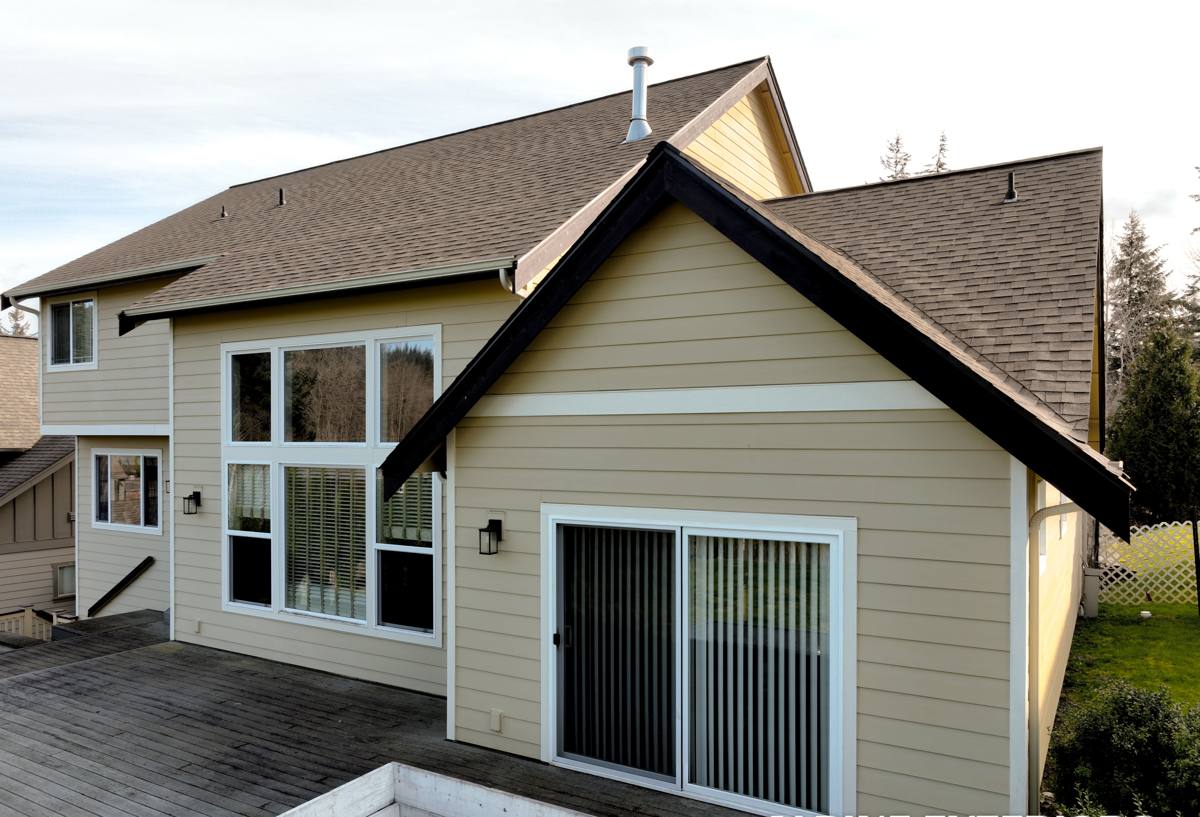
What Salt Air, Driving Rain, and Moss Actually Do to a House
Salt Air
Airborne salt doesn't just sit on the surface of your siding — it works into fastener heads, trim joints, and any exposed cut edge, accelerating corrosion in metal flashing and fasteners that aren't rated for coastal exposure. Over years, it also breaks down lower-grade paint finishes faster than inland weathering would, which is why the factory finish on your siding matters as much as the substrate underneath it.
Driving Rain
Blaine gets rain that doesn't fall straight down — it gets pushed sideways by wind off the water, directly into siding laps, corner joints, and anywhere a window or door meets the wall. A siding system that isn't detailed for that kind of exposure will eventually let water past the face material, even if the material itself is sound. This is a installation-detail problem far more often than it's a product problem.
Moss and Prolonged Dampness
Shaded, north-facing walls and anything under tree cover holds moisture longer here than it does in drier parts of the state. Moss and algae take hold on any siding surface that stays damp, and once established they hold water against the wall behind them, which is a slow but real problem for moisture-sensitive materials. Fiber cement doesn't feed rot the way wood does, but moss still needs to be kept in check so it doesn't compromise caulking, trim, and finish over time.
Why We Install Only James Hardie Fiber Cement
We made a deliberate decision to standardize on one product system rather than offer a menu of siding materials, and the Peace Arch climate is a big part of why. Fiber cement is non-combustible and dimensionally stable in a way wood and vinyl aren't — it doesn't swell and shrink with every wet-dry cycle the way wood-based products can, and it doesn't soften, warp, or fade under UV and salt exposure the way vinyl does over a couple of decades. James Hardie also engineers specific product lines for wet coastal climates like ours (their HZ5 line is built for exactly this kind of exposure), and their ColorPlus factory-applied finish is baked on under controlled conditions, which holds color and resists the salt-air fading and chalking that field-applied paint tends to show first.
That's not a knock on every other product on the market — cedar has real appeal, and vinyl and engineered wood products have their place. But we've seen what a marine climate does to materials that depend on perfect, ongoing maintenance to perform, and we'd rather install one system correctly than install several systems and hope the homeowner keeps up with each one's specific upkeep demands. Hardie is what we put on Peace Arch homes because it's the product we can stand behind for the long haul in this exact environment.
What a Correct Fiber Cement Installation Involves
A Real Drainage Gap
Fiber cement should be installed over a rain screen or furring gap that lets any moisture that gets behind the siding drain and dry out, rather than sitting against the sheathing. This is one of the most commonly skipped steps on rushed jobs, and it's one of the most important details for a house that takes as much driving rain as a Peace Arch home does.
Fastening and Clearances
Fiber cement needs to be fastened per manufacturer spec — correct nail type, spacing, and depth — and held clear of grade, roofing, decks, and patios so water can't wick up into the bottom edge of the board. Getting this wrong doesn't show up as a problem in year one; it shows up as soft trim and staining three or four winters later.
Flashing and Sealant at Every Penetration
Windows, doors, hose bibs, vents, and light fixtures are where wind-driven rain finds its way in. Every one of those penetrations needs proper flashing integrated with the water-resistive barrier underneath the siding, not just a bead of caulk over the gap. Caulk is maintenance; flashing is the actual water management.
Joint and Seam Treatment
Butt joints, corners, and trim intersections need to be treated with the right sealant and, where called for, flashed rather than just caulked. In a climate with this much sustained wet weather, joints are where a mediocre install fails first.
Matching the Right Hardie Product to a Peace Arch Home
Not every Hardie product line fits every house, and part of doing this job right is picking the profile that suits the home's style and exposure.
| Product | Profile | Best Fit |
|---|---|---|
| HardiePlank Lap Siding | Horizontal lap, several width and texture options | Traditional and craftsman-style homes; the most common choice in the area |
| HardiePanel Vertical Siding | Large-format vertical panels | Modern builds, accent walls, gable ends, and mixed-material facades |
| HardieShingle | Staggered or straight-edge shingle profile | Homes going for a cottage or shingle-style look without the maintenance of real cedar shingle |
| HardieTrim | Fascia, corner boards, and window/door trim | Paired with any of the above for a finished, weather-sealed edge |
HZ5 vs. HZ10
James Hardie makes climate-specific formulations, and for Blaine's marine exposure the HZ5 line is the appropriate choice — it's engineered for wetter, cooler coastal regions rather than the drier interior climates HZ10 is built for. Using the correct HZ designation for the region isn't cosmetic; it affects how the material performs against moisture over its service life.
Our Process, Start to Finish
Every Peace Arch project follows the same sequence, because skipping a step is where problems start.
- On-site inspection of the existing siding, sheathing, and any signs of past moisture intrusion
- Removal of old siding and evaluation of the sheathing and water-resistive barrier underneath
- Repair of any compromised sheathing before new material goes on — never siding over a problem
- Installation of the rain screen/furring system and correct water-resistive barrier detailing
- Hardie installation to manufacturer spec: fastening, clearances, flashing, and joint treatment
- Trim, caulking, and final ColorPlus finish inspection
- Site cleanup and a walkthrough so you know what was done and why
What Drives the Cost of a Project
| Factor | Why It Matters |
|---|---|
| Home size and number of stories | More surface area and more staging/scaffolding for taller walls |
| Condition of existing sheathing | Rot or moisture damage found during tear-off adds repair scope |
| Trim and architectural detail | Corners, gables, dormers, and window/door count all add labor |
| Product line and profile | Lap, panel, and shingle profiles differ in material and install time |
| Site access | Tight lots, slopes, or landscaping near the foundation can slow staging |
We won't quote a project sight unseen — every estimate starts with an actual look at the house, because the sheathing condition alone can change the scope significantly once old siding comes off.
Maintenance for a Peace Arch Home
Fiber cement is low-maintenance compared to wood, but "low-maintenance" doesn't mean "no maintenance" in this climate. A short annual routine keeps siding performing the way it's supposed to:
- Rinse the exterior with a garden hose (not a pressure washer aimed directly at seams) once or twice a year to clear salt residue and organic buildup
- Keep gutters and downspouts clear so water isn't overflowing directly onto siding and trim
- Trim back shrubs and tree limbs that are keeping any wall shaded and damp longer than the rest of the house
- Check caulking at windows, doors, and trim joints annually and have gaps resealed before winter rains set in
- Watch shaded, north-facing walls for early moss or algae growth and address it before it spreads
- Repaint only if and when the ColorPlus finish is genuinely due — most homeowners go well over a decade before that's a conversation
Why Local Experience Near Peace Arch Matters
A contractor who mostly works drier inland neighborhoods and occasionally takes a job in Blaine will size up a house differently than a crew that works this stretch of Whatcom County regularly. We know which sides of a house typically take the worst wind-driven rain in this area, how moss behaves on shaded walls through a wet winter, and how to detail flashing and rain screens for sustained coastal exposure rather than an average Pacific Northwest install. That local pattern recognition is part of what separates a siding job that looks fine on install day from one that's still performing correctly ten winters later.
If you're planning a siding project for a Peace Arch home, we're happy to take a look and walk you through what your house specifically needs — no pressure, no obligation. Request a free estimate below and we'll schedule a time to come out and inspect your siding in person.