 Blaine Siding
 Siding Replacement in Custer: Why Local Climate Should Drive the Decision
Custer sits in the rural stretch of Whatcom County between Blaine and Ferndale, close enough to the Strait of Georgia that homes here deal with a mix of coastal and inland weather in the same season. You get salt-tinged air carried in on marine wind, long stretches of driving rain off Pacific storm systems, and the kind of low, damp, shaded conditions that keep moss and mildew growing on north-facing walls well into what should be dry season. None of that is unusual for this part of Washington. What is unusual is how often siding gets replaced without anyone accounting for it, and the homeowner ends up doing the job again in twelve or fifteen years instead of thirty or forty.
Siding replacement isn't just a cosmetic swap. It's the single biggest decision you'll make about how your home handles moisture for the next few decades. In Custer specifically, that means picking a material that won't wick water, won't feed mold and moss, and won't corrode or crack under the freeze-thaw cycles that show up in colder snaps blowing down from the north. This page walks through what a correct siding replacement looks like for a Custer home, what our process involves, and why we've standardized on one product system instead of offering a menu of options.
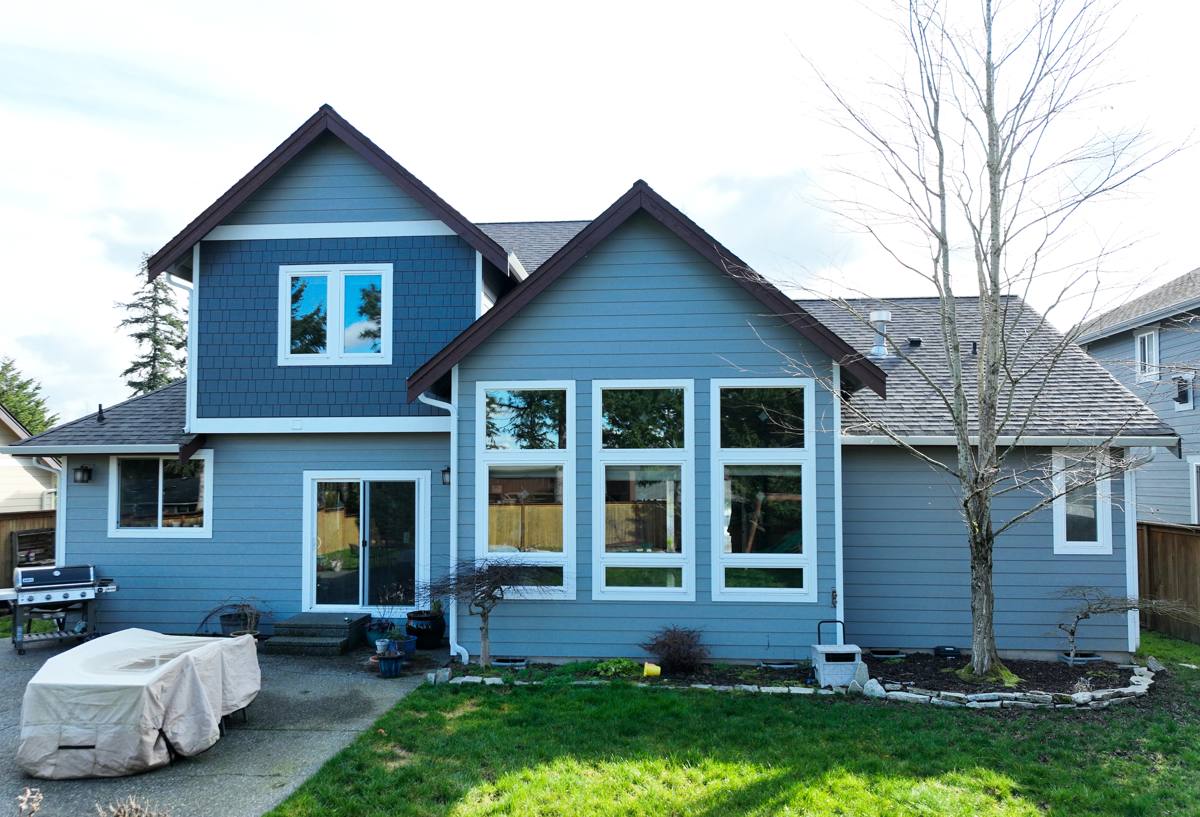
What Custer's Climate Actually Does to Siding
Salt Air, Even Inland
Custer isn't beachfront, but it's close enough to the Strait and Boundary Bay that airborne salt reaches homes here, especially during windier winter months. Salt accelerates corrosion on exposed fasteners, staples, and metal trim, and it speeds up the breakdown of coatings that aren't formulated to handle it. Siding with a weak factory finish or field-applied paint job will chalk, fade, and lose its water resistance faster here than it would fifty miles inland.
Driving Rain
Storms moving through this part of Whatcom County frequently bring horizontal rain, not just vertical. That matters because it's wind-driven rain — not simple downpour — that finds its way behind poorly lapped siding, undersized flashing, and gaps at trim and window returns. A siding system that looks fine in a light rain can still be letting water into the wall assembly during a real Pacific storm.
Extended Moss Season
Between the tree cover common on Custer properties and the persistent damp, shaded conditions through fall, winter, and spring, moss and algae have a long runway to establish themselves on siding, especially on north and west-facing walls. Once moss takes hold, it holds moisture against the surface constantly, which is exactly the condition that rots wood-based products and stains poorly-finished siding.
What a Correct Siding Replacement Involves
Replacing siding is not simply pulling off the old material and nailing up new panels. Done right, it's a full envelope job. Here's what should happen on any Custer siding replacement, regardless of the size of the home:
- Full tear-off and inspection — old siding comes off so the sheathing underneath can be checked for rot, soft spots, or prior water damage that's been hidden for years.
- Repair before cover-up — any damaged sheathing or framing gets fixed. Covering rot with new siding just hides the problem until it's worse and more expensive.
- Weather-resistive barrier — a proper water-resistive barrier goes on correctly lapped, shingle-style, so water sheds down and out rather than working its way in at seams.
- Drainage plane / rain screen detailing — especially important in a climate with this much sustained rain; siding needs a way to dry out after it gets wet, not just resist water on the surface.
- Correct flashing at every penetration — windows, doors, vents, and any wall penetration are the most common failure points, not the field of the siding itself.
- Manufacturer-spec fastening — fastener type, spacing, and placement affect both wind resistance and long-term durability, and they vary by climate zone and product line.
- Proper clearances — siding held off grade, decks, roof lines, and hardscape per code and manufacturer requirements, so it isn't sitting in standing moisture.
Skip any one of these steps and you can end up with siding that looks good from the street for a few years but fails from behind, which is the most common and most expensive kind of siding failure.
Why We Install Only James Hardie Fiber Cement
We don't offer vinyl, LP SmartSide, primed spruce, cedar, or other fiber cement brands as options on Custer homes. That's a deliberate standard, not a lack of familiarity with the alternatives. Each of those materials has a real trade-off that shows up specifically in a climate like this one:
| Material | Where it struggles in Custer's climate |
|---|---|
| Vinyl siding | Can warp or buckle under temperature swings, and seams give wind-driven rain an easier path behind the panel; color is not repairable if damaged. |
| Engineered wood (LP SmartSide) | Wood-strand core is vulnerable at cut edges and fastener points if moisture gets in; performance depends heavily on maintaining the factory coating without gaps. |
| Primed spruce / untreated wood | Needs frequent repainting to stay sealed; once the coating fails, wood is highly susceptible to the sustained damp and moss exposure common here. |
| Cedar siding | Beautiful material, but requires ongoing sealing/staining and is a natural food source for the mold and moss that thrive in this level of shade and moisture. |
| James Hardie fiber cement | Non-combustible, dimensionally stable, factory ColorPlus finish resists fading and moss staining, engineered HZ product lines built for Pacific Northwest moisture exposure. |
James Hardie's fiber cement is cement, sand, and cellulose fiber — it doesn't rot, it doesn't feed moss the way wood-based products do, and it holds its shape through the wet-to-dry cycles that are constant in this part of Whatcom County. The ColorPlus factory finish is baked on under controlled conditions, which gives it better fade and moisture resistance than field-applied paint, and it comes backed by a strong transferable warranty. That combination is why it's the only siding system we put on Custer homes.
Our Process on a Custer Siding Replacement
We work Custer and the surrounding Blaine area regularly, which means we already know what these homes tend to need before we show up. Our process is straightforward:
- On-site assessment — we look at current siding condition, wall orientation relative to prevailing wind and rain, moss/moisture patterns, and any visible trim or flashing issues.
- Written scope and product plan — which James Hardie product line, profile, and color, plus what tear-off, sheathing repair, and flashing work is included.
- Tear-off and sheathing inspection — old material removed, framing checked, any rot addressed before anything new goes up.
- Weather barrier and flashing installation — done to manufacturer spec, with particular attention to window and door penetrations, since that's where most rain intrusion starts.
- Hardie installation — correct fastening, clearances, and joint treatment for the specific product line chosen.
- Final walk-through — we go over the finished work with you before calling the job done.
Why Hiring a Crew That Already Works Custer Matters
Siding installation quality comes down to details that don't show up in a walk-by: how flashing is lapped, how much clearance is left at grade, whether fastener spacing matches the product's engineering, whether the drainage plane actually drains. A crew that regularly works Blaine and Custer has already seen how local wind direction, tree cover, and rain patterns affect specific walls and details on homes like yours — and adjusts for it, rather than applying a generic install that was designed for a drier climate. That local repetition is what prevents callbacks two winters later.
Signs Your Custer Home May Need Siding Replacement Now
- Persistent moss or algae staining that returns quickly after cleaning, especially on shaded walls
- Soft spots, bubbling, or visible warping in the siding surface
- Paint or coating that's chalking, peeling, or no longer shedding water
- Visible gaps or separation at seams, corners, or trim
- Rising energy bills with no other explanation, suggesting compromised insulation behind the siding
- Interior signs like musty smells, stained drywall, or damp spots near exterior walls
Any one of these on its own isn't necessarily an emergency, but a few together usually mean the siding is no longer doing its job as a water barrier, and that's worth an inspection before it turns into a sheathing or framing repair.
What Affects Cost on a Custer Siding Job
| Factor | Why it matters |
|---|---|
| Home size and wall complexity | More corners, gables, and dormers mean more cutting, flashing, and labor time. |
| Condition of existing sheathing | Hidden rot found during tear-off adds repair scope that can't be fully known before opening the wall. |
| Product line and profile | Lap width, textured vs. smooth finish, and color selection affect material cost. |
| Trim and accessory work | Fascia, soffit, and trim replacement alongside siding adds scope but keeps the whole exterior consistent. |
| Access and site conditions | Tree cover, slope, or tight lot lines common in rural Custer properties can affect staging and labor time. |
We don't quote broad numbers without seeing the home, since the variables above shift the scope meaningfully from one property to the next. What we can tell you upfront is that a correct James Hardie installation, done once, tends to cost less over the life of the siding than repeated repairs or a second replacement on a shorter-lived material.
If you're in Custer or anywhere around Blaine and want a straight answer on what your home's siding actually needs, we're glad to take a look. Fill out the form below for a free, no-pressure estimate — no obligation, just an honest read on your home's condition and what it would take to get it right.