 Blaine Siding
 Why Metal Roofing Makes Sense for Sumas Properties
Sumas sits in a stretch of Whatcom County that takes weather seriously. Homes here deal with a combination that's tougher on a roof than most people realize: salt-laden air moving in off the coast, long stretches of driving rain through fall and winter, and a moss season that can run most of the year in shaded, north-facing sections of a roof. Asphalt shingles can hold up for a while under those conditions, but they're fighting an uphill battle the whole time. Metal roofing was built for exactly this kind of environment, which is why we install more of it every year for homeowners in this area.
The appeal isn't just curb appeal, though a well-installed standing seam or metal shingle roof does look sharp. It's about what happens to the roof over the next 20, 30, 40 years. Metal sheds water fast, doesn't give moss the organic surface it needs to colonize, and handles the freeze-thaw cycles and wind-driven rain that define a Whatcom County winter without the granule loss and curling that eventually catches up with shingles.
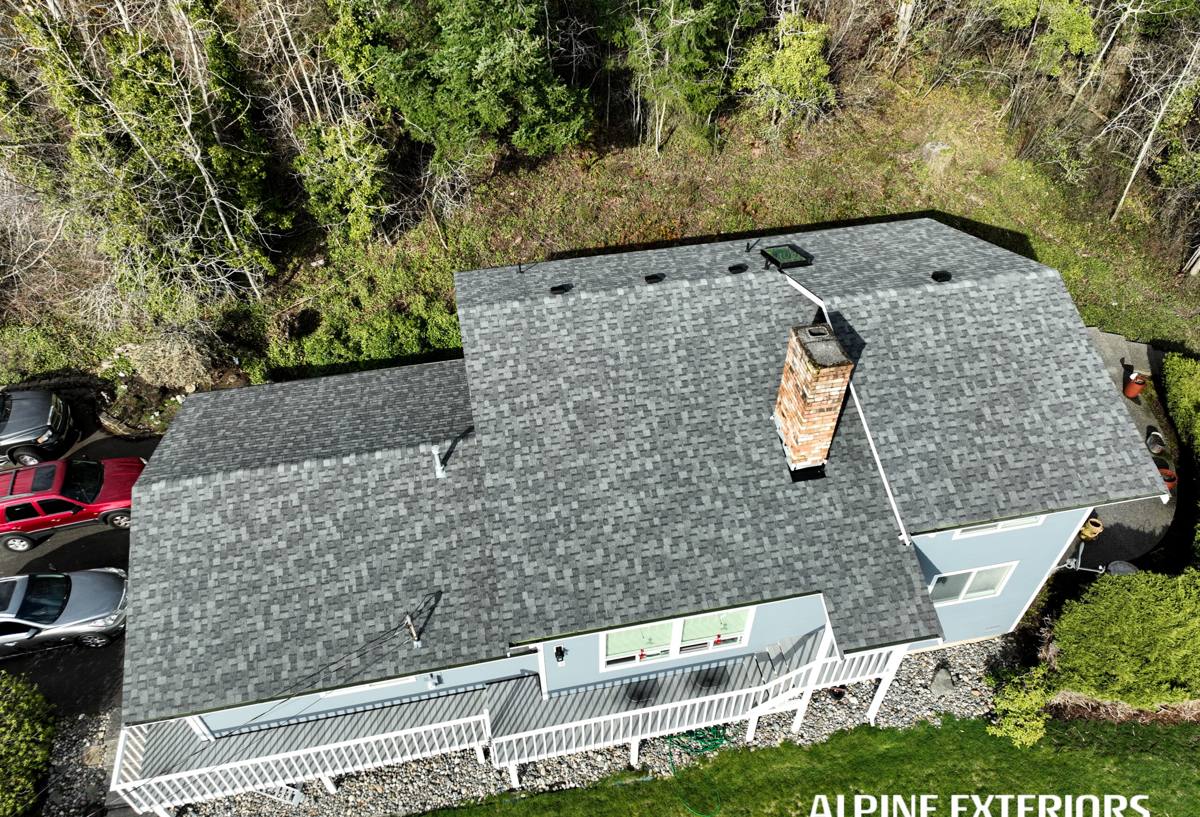
What Sumas' Climate Actually Does to a Roof
Salt Air and Corrosion
Even a few miles inland, coastal air carries enough salt to accelerate corrosion on unprotected metal fasteners, flashing, and gutters. This is one of the most overlooked factors in a roofing job — not the field material itself, but the small metal components around it. A roof can look fine from the ground while its flashing and fastener heads are quietly rusting away underneath.
Driving Rain
Rain around here rarely falls straight down. Wind pushes it sideways, which means water gets tested against every seam, lap, and penetration on a roof — not just the open field. A roof that would perform fine in a calmer climate can leak here simply because the underlayment, flashing details, or seam spacing weren't built for wind-driven moisture.
Moss Season
Shaded roof sections, especially north- and east-facing slopes near tree cover, stay damp long enough for moss and lichen to take hold for much of the year. Moss doesn't just look bad — it holds moisture against the roof surface, works its way under shingle tabs, and can lift material over time. Metal panels give moss almost nothing to grip, which is a major reason we recommend it for shaded lots in this area.
What a Correct Metal Roof Installation Involves
A metal roof is only as good as the details underneath it. We've seen plenty of metal roofs installed elsewhere that look right from the street but were rushed on the parts nobody sees. Here's what we consider non-negotiable on every metal roofing job we do around Sumas and Blaine:
- Full tear-off and deck inspection — metal goes over a sound, dry deck, not over existing damage or rot
- High-temp, self-adhering underlayment at eaves, valleys, and all penetrations, given how much wind-driven rain this area sees
- Correct panel or shingle-style metal fastening pattern, matched to local wind exposure
- Stainless or coated fasteners rated for coastal-adjacent salt exposure, not standard interior-grade hardware
- Properly lapped and sealed flashing at every wall, chimney, and vent penetration
- Ice-and-water protection at eaves and valleys where snow and ice can dam in a cold snap
- Ventilation checked and corrected where needed — trapped moisture under a metal roof causes its own problems
Skipping any one of these doesn't show up on day one. It shows up in year five or ten, as a leak, a rust streak, or a lifted panel — usually right when the original crew is long gone.
Choosing the Right Metal Roofing Type for Your Home
Not every metal roof product is the same, and the right choice depends on your roof's slope, exposure, and how much you want the finished look to read as "metal" versus blend in with a more traditional profile.
| Type | Best For | Trade-Offs |
|---|---|---|
| Standing seam | Full sun exposure, steep slopes, modern or clean architectural look | Higher upfront cost, but fewer exposed fasteners and the longest service life |
| Metal shingles/shakes | Homes wanting a traditional look with metal's durability | More seams and fastener points than standing seam, still far more moss-resistant than asphalt |
| Exposed-fastener panel | Budget-conscious projects, outbuildings, simpler rooflines | Fasteners need periodic inspection and occasional re-torquing over the roof's life |
We'll walk through which option fits your specific roof during the estimate rather than pushing one product for every house. A steep, heavily shaded roof and a low-slope, sun-exposed roof don't need the same solution.
A Note on Coatings and Finishes
Not all paint finishes on metal roofing hold up the same way in a coastal-influenced climate. We favor higher-grade PVDF-type finishes over cheaper baked-enamel coatings for homes in this area, because the better finishes resist chalking and color fade under UV exposure and hold their protective properties longer against salt air. It costs a bit more up front. It's also the difference between a roof that still looks new at year fifteen and one that's visibly faded and starting to spot.
Our Process, Start to Finish
- On-site inspection — we look at the existing roof, deck condition, ventilation, and problem areas like shaded valleys or north slopes before recommending anything
- Straight-talk estimate — a written quote that spells out material, underlayment, flashing detail, and fastener spec, not a vague lump sum
- Tear-off and deck prep — old roofing removed, deck inspected and repaired as needed before anything new goes down
- Underlayment and flashing — the part that actually keeps water out, done to the standard the climate demands
- Panel or shingle installation — installed to manufacturer spec with attention to expansion allowance and correct fastening
- Final walkthrough — we go over the finished roof with you, including anything you should keep an eye on seasonally
We keep the process transparent because a metal roof is a long-term investment, and you should understand what's happening at each stage rather than just seeing a crew show up and a roof appear.
Cost Factors Homeowners Should Understand
Metal roofing costs more upfront than asphalt shingles — that's a fair trade-off to go in with your eyes open about. What actually moves the number for a given home isn't just square footage. Roof complexity (valleys, dormers, chimneys), the metal type chosen, current deck condition, and how much tear-off and repair work is needed all factor in. A simple, straightforward gable roof will price differently than one with multiple valleys and penetrations, even at the same square footage. We give exact numbers during the on-site estimate rather than broad figures that don't reflect your actual roof.
Maintenance: What Metal Roofing Does and Doesn't Need
One of the real advantages of metal roofing in a moss-prone climate is how little routine maintenance it needs compared to shingles. That said, "low maintenance" isn't "no maintenance":
- Keep gutters clear so water isn't backing up against eave flashing
- Clear overhanging branches that keep a section of roof shaded and damp longer than the rest
- Do a visual check after major windstorms for lifted flashing or debris buildup in valleys
- Have fastener-style panel roofs inspected periodically, since exposed fasteners can loosen slightly over many seasons of thermal cycling
Compare that to the annual moss treatment, granule loss monitoring, and shorter overall lifespan that come with asphalt in this climate, and the maintenance case for metal becomes pretty clear.
Why a Crew That Already Works Sumas Matters
Metal roofing isn't a forgiving material to learn on. Panel seams, flashing details, and fastening patterns that work fine in a mild, dry climate can fail here within a few seasons if they're not adjusted for wind-driven rain and salt exposure. A crew that already works Sumas and the broader Blaine area knows which roof details need extra attention on a specific lot — which slopes hold moss longest, which exposures take the worst of the wind, and which flashing details actually hold up through a full Whatcom County winter rather than just looking finished on installation day.
That local experience is also why we don't treat every metal roofing job the same. A shaded, tree-lined property near Sumas has different priorities than an open, wind-exposed lot closer to the water. Knowing the difference before the first panel goes down is what separates a roof that performs for decades from one that needs attention again in five years.
Signs It Might Be Time to Consider Metal
If you're weighing whether metal roofing makes sense for your home right now, a few signs point toward yes:
- Your current roof shows recurring moss growth despite cleaning
- You're seeing granule loss, curling, or shingle lifting after wind events
- You've had leaks trace back to flashing or valley failures rather than field damage
- You're planning to stay in the home long-term and want to stop re-roofing every 15-20 years
- You want a roof that handles this area's rain and salt exposure without constant upkeep
None of these mean metal is automatically the right call for every home — but they're the questions worth raising during an inspection.
If you're in Sumas or anywhere around Blaine and want a straight answer on whether metal roofing is the right move for your home, we're glad to take a look. The estimate is free, there's no pressure, and you'll get a clear breakdown of what your roof actually needs — just use the form below to get started.