 Blaine Siding
 Why Birch Bay's Climate Is Hard on an Asphalt Shingle Roof
Birch Bay sits right on the water, and that location shapes what a roof has to deal with year after year. Salt-laden air moves off the bay and settles on every exposed surface, including the roof deck. Add Whatcom County's long wet season — driving rain that comes in sideways during winter storms — and a moss season that can stretch from fall through spring, and you have a roofing environment that's noticeably tougher than what you'd find twenty miles inland.
None of this means asphalt shingle roofing is a bad choice for Birch Bay. It's still the most practical, cost-effective roofing material for the vast majority of homes here. But it means the installation has to account for conditions that a generic roofing job in a drier climate wouldn't need to worry about as much. A roof that's correctly built for this specific stretch of coastline will outlast one that was installed using standard practices from a catalog spec sheet.
What "Coastal Wear" Actually Looks Like
On homes near the bay, we typically see three patterns of wear that show up faster or more severely than they would further from the water: granule loss accelerated by wind-driven rain, moss and algae staining and lifting shingle edges, and corrosion on exposed metal fasteners and flashing that weren't rated for a salt-air environment. Individually, none of these is dramatic. Together, over ten or fifteen years, they're what separates a roof that needs a full replacement at year eighteen from one that's still sound at year thirty.
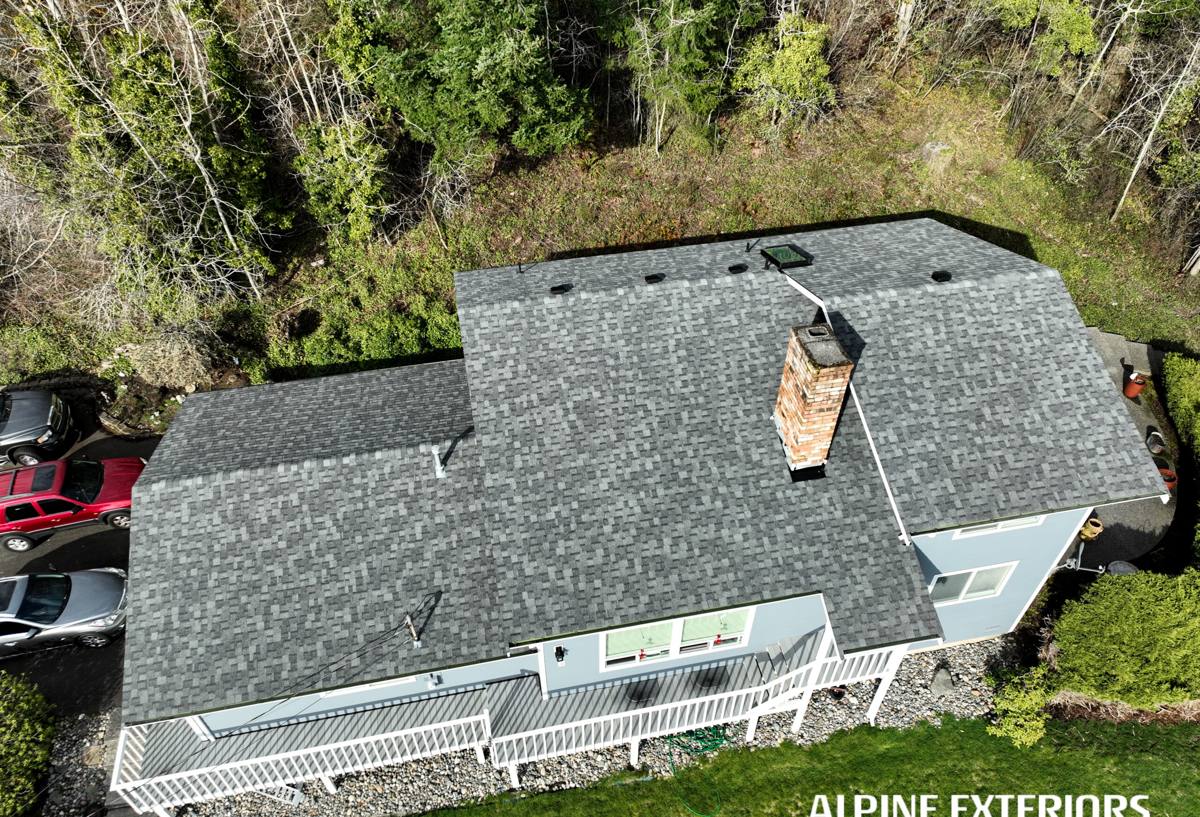
What a Correct Asphalt Shingle Roof Needs Here
Starting From the Deck Up
A roofing job is only as good as the layers underneath the shingles, and in a wet coastal climate those layers matter more than usual. That starts with the deck itself — any soft, delaminated, or water-damaged sheathing gets replaced before anything else happens, because shingles installed over a compromised deck will fail early no matter how good the shingle is. From there, a self-adhering waterproof membrane belongs at the eaves, valleys, and any low-slope transitions, since these are the areas most exposed to wind-driven rain and the most common spots for ice or water backup during winter storms.
Ventilation Matters More Near the Water
A roof assembly in a humid coastal climate needs to breathe. Without balanced intake and exhaust ventilation, moisture gets trapped in the attic, condenses, and works against the roof deck and insulation from the inside — a problem that has nothing to do with the shingle brand and everything to do with how the roof was built. We check existing ventilation on every Birch Bay project and correct it where it's undersized, which is common on older homes that were built before current ventilation standards.
Flashing and Fasteners
Metal flashing around chimneys, skylights, sidewalls, and roof-to-wall transitions is where most roof leaks actually start — not in the field of the shingles. In a salt-air environment, we spec corrosion-resistant flashing and fasteners rather than standard galvanized components, because standard hardware corrodes faster this close to the water and a corroded fastener eventually stops holding.
Choosing the Right Shingle for a Birch Bay Home
Not every asphalt shingle product is built the same way, and the differences matter more in a climate like this one. The table below outlines the main categories we work with and how they hold up under Birch Bay conditions specifically.
| Shingle Type | Typical Lifespan | Coastal Performance |
|---|---|---|
| 3-tab asphalt | 15–20 years | Lowest cost, but thinner profile is more vulnerable to wind-driven rain and granule loss near the water |
| Architectural (laminated) | 25–30 years | Heavier, more wind-resistant, better performer in Whatcom County's storm patterns; our standard recommendation for most Birch Bay homes |
| Algae-resistant (AR) architectural | 25–30 years | Copper-infused granules resist the streaking and moss growth common in shaded, damp coastal lots |
| Impact-rated (Class 4) | 25–30+ years | Added durability against debris and hail; sometimes qualifies for an insurance discount, worth asking your carrier |
For most homes in Birch Bay, we recommend an algae-resistant architectural shingle. The upcharge over a standard architectural shingle is modest, and it directly addresses the moss and staining issue that's specific to this area rather than a general concern.
Our Installation Process
Every roofing job follows the same sequence, though the details shift based on what we find once the old roofing is off.
- Inspection and estimate. We walk the roof, check the deck condition where visible, assess ventilation, and note any problem areas — valleys, chimneys, skylights — before quoting the job.
- Tear-off and deck check. Old roofing comes off down to the deck, which gets inspected board by board. Any soft or damaged sheathing is flagged and replaced before installation continues.
- Waterproofing layer. Self-adhering membrane goes down at eaves, valleys, and other vulnerable transitions, followed by synthetic underlayment across the rest of the field.
- Flashing. New corrosion-resistant flashing is installed at all penetrations, walls, and valleys rather than reusing old flashing, which is a common shortcut we don't take.
- Shingle installation. Shingles go down per manufacturer specification for nailing pattern and exposure, which is what keeps the warranty valid and the roof performing in high wind.
- Ventilation correction. Intake and exhaust venting is checked and adjusted if the existing setup is undersized for the attic volume.
- Final walkthrough. We inspect the finished roof, clean up the site including a magnetic sweep for stray fasteners, and go over the workmanship warranty with you.
Moss, Algae, and Salt Air: What Ongoing Care Looks Like
An asphalt shingle roof in Birch Bay isn't maintenance-free, even when it's installed correctly. Regular, light upkeep is what keeps a well-built roof performing for its full lifespan instead of losing years to preventable moss and algae damage.
- Have moss and debris cleared from valleys and gutters at least once a year, more often under overhanging trees
- Avoid pressure washing shingles — it strips granules and shortens shingle life; use a soft-bristle approach or a zinc/copper treatment instead
- Keep gutters and downspouts clear so wind-driven rain during winter storms has somewhere to go
- Trim back branches that keep sections of the roof shaded and damp, which is where moss takes hold first
- Schedule a visual inspection after any major windstorm to check for lifted or missing shingles
- Watch for granules collecting in gutters, which signals accelerated shingle wear worth having looked at
Common Problems We Find on Roofs in This Area
Working on homes throughout the Birch Bay and Blaine area, certain issues come up repeatedly enough that they're worth flagging before they become expensive.
- Moss wedged under shingle edges holds moisture against the roof and gradually lifts shingle tabs, letting wind and rain get underneath
- Undersized or blocked attic ventilation that traps humid air and accelerates deck rot from the inside out
- Corroded or improperly lapped flashing around chimneys and skylights, usually the actual source of a leak that looks like it's coming from the shingles
- Nail pops and improperly fastened shingles from installations that didn't follow manufacturer nailing patterns, which shows up as wind damage sooner than it should
- Clogged valleys and gutters from evergreen debris, which backs water up under the shingle courses during heavy rain
What Affects the Cost
Every roof is different, and we won't quote a number without seeing the job, but these are the main factors that move the price up or down on a typical Birch Bay asphalt shingle roofing project.
| Factor | Why It Matters |
|---|---|
| Roof size and pitch | More square footage and steeper pitches mean more material and labor time |
| Deck condition | Rotted or soft sheathing found during tear-off adds replacement cost that can't always be predicted upfront |
| Shingle grade | 3-tab, standard architectural, algae-resistant, and impact-rated products carry different material costs |
| Number of penetrations | Chimneys, skylights, and vents each require flashing work that adds labor |
| Layers of old roofing | Removing multiple layers of old shingles costs more in labor and disposal than a single-layer tear-off |
| Access and site conditions | Steep lots, limited driveway access, or difficult staging near the water can affect labor time |
Why a Crew That Already Works Birch Bay Matters
Roofing crews that work regularly in this specific area build a working knowledge of what actually goes wrong here — which shingle lines hold up against the salt air, which flashing details fail first in this weather pattern, and how much ventilation a typical attic in this area actually needs. That's different from general roofing experience picked up in a drier or more inland climate. It also means we're familiar with permitting and inspection expectations for Whatcom County and the Blaine area, so there are fewer surprises mid-project.
There's also a practical side to hiring locally: a crew based nearby can respond faster if a storm causes damage and you need an inspection or emergency tarp, and they have a reputation in the community to stand behind, not just a one-time job to finish and move on from.
Warranty Coverage: What It Actually Means
Asphalt shingle roofing typically carries two separate warranties, and it's worth understanding the difference before you sign anything. The manufacturer's warranty covers defects in the shingle material itself and is generally prorated over time. The workmanship warranty, which comes from the contractor who installed the roof, covers installation errors — things like improper nailing, flashing mistakes, or ventilation problems that cause a leak. A shingle can be a perfectly good product and still fail early if it wasn't installed correctly, which is why the workmanship warranty matters just as much as the shingle brand. We go over both in plain terms before work starts, not buried in fine print afterward.
If your roof is showing granule loss, moss buildup, or you're just not sure how much life is left in it, we're happy to take a look. Fill out the form below for a free, no-pressure estimate on asphalt shingle roofing for your Birch Bay home.