 Blaine Siding
 Why Bellingham Decks Wear Out Faster Than You'd Think
Bellingham sits in one of the wetter corners of Whatcom County, close enough to the water that homes deal with salt-laden air on top of the region's long, gray, drizzly stretch of fall through spring. Individually, salt air, driving rain, and moss aren't dramatic problems. Together, over years, they're exactly what breaks decks down from the inside before most homeowners notice a problem from the outside.
Salt air accelerates corrosion on fasteners, joist hangers, and any exposed metal hardware. Driving rain doesn't just fall straight down here — wind pushes it sideways into ledger connections, stair stringers, and the gaps between deck boards, where it can sit longer than it should. And the region's long moss season means organic growth gets a real foothold on any horizontal wood surface that doesn't dry out quickly, holding moisture against the boards even on the occasional sunny day.
None of this means a deck in Bellingham can't last a long time. It means the deck has to be built and replaced with this specific climate in mind, not with a one-size-fits-all approach borrowed from a drier part of the country.
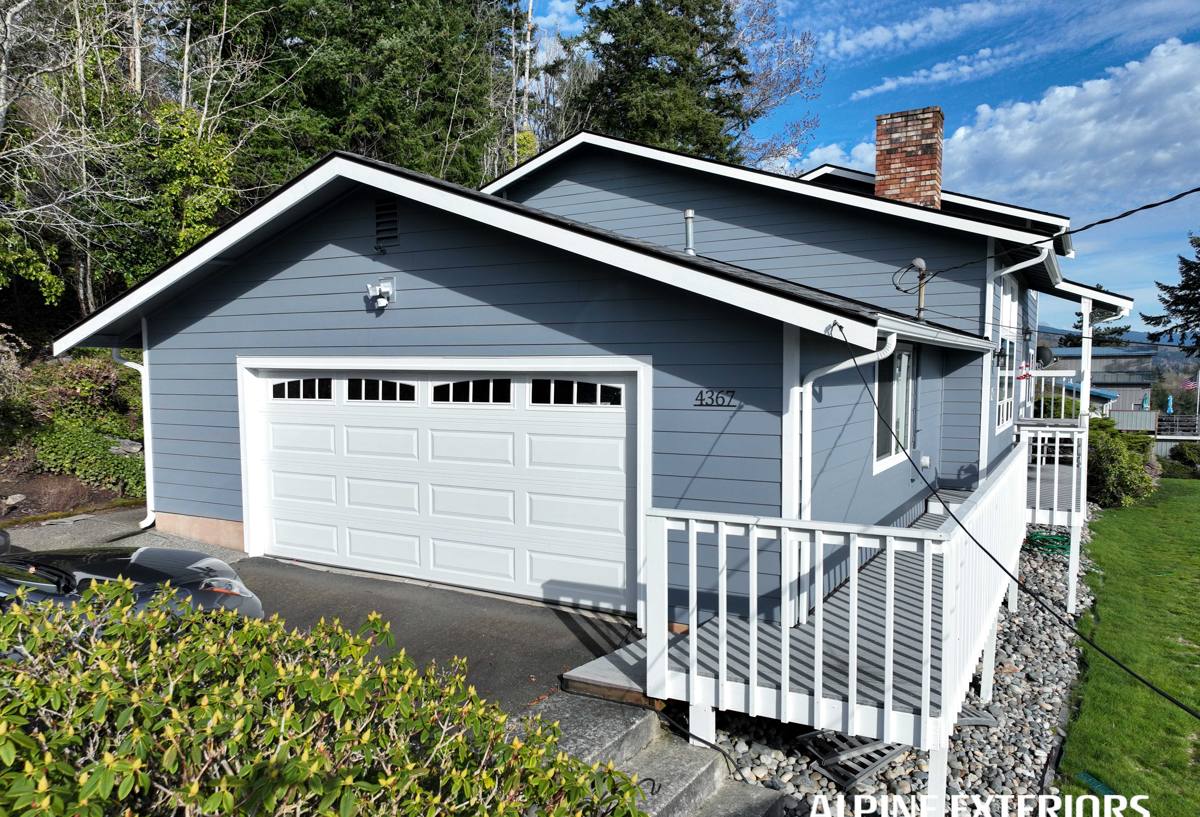
Signs a Deck Needs Replacement, Not Just Repair
We get called out to plenty of decks where the owner is hoping for a repair, and sometimes that's the right call. But there's a point where patching individual boards or re-securing a railing is just delaying a bigger problem. Here's what tends to separate a repair job from a replacement job:
Structural red flags
- Soft, spongy, or spring-loaded decking in more than a couple of spots
- Visible rot or dark staining at the ledger board where the deck meets the house
- Rusted, stained, or corroded joist hangers and fasteners
- Posts or footings that have shifted, settled, or show cracking
- Railings that flex noticeably when leaned on
Cosmetic issues that usually don't require full replacement
- Faded or weathered finish on otherwise sound wood
- A handful of cupped or cracked boards on an otherwise solid frame
- Surface moss or algae that hasn't yet caused rot underneath
If the framing and ledger connection are sound, a partial repair or resurfacing can make sense. If the substructure has been compromised by years of moisture, replacement is the more honest recommendation — and the safer one.
What a Correct Deck Replacement Actually Involves
A deck replacement is more than pulling up old boards and screwing down new ones. In a climate like ours, the parts you don't see matter more than the parts you do.
The ledger and flashing
The ledger board — where the deck attaches to the house — is the single most common failure point on decks in wet climates. If it's not properly flashed to shed water away from the house sheathing, moisture works its way behind the ledger and into the rim joist, often invisibly, for years. A correct replacement means proper ledger flashing, appropriate fasteners, and a connection that keeps water moving away from the structure instead of trapping it.
Joists, hardware, and footings
We check footing depth and condition, joist spacing and span for the decking material being used, and we replace hardware with fasteners and hangers rated for the environment — not just whatever is cheapest at the yard. Given the salt air common closer to the water in this area, corrosion-resistant hardware isn't an upsell, it's a baseline requirement for the work to hold up.
Drainage and airflow underneath
A deck that can't shed water and dry out underneath will always struggle here, regardless of what decking material sits on top. Proper spacing between boards, grading beneath the deck, and keeping vegetation from crowding the underside all matter more in a climate that doesn't give wood much of a chance to dry between storms.
Choosing the Right Decking Material for This Climate
There's no single "best" decking material — there's a best material for your budget, your maintenance appetite, and how much moisture and moss pressure your particular site sees. Here's how the common options stack up for a Bellingham-area deck:
| Material | Moisture Behavior | Maintenance | Typical Lifespan |
|---|---|---|---|
| Pressure-treated wood | Resists rot chemically but still absorbs water; needs to dry out between storms | Annual cleaning and periodic re-staining or sealing | 10-15 years with upkeep |
| Cedar | Naturally rot-resistant but softer; still needs to shed water well | Regular sealing to maintain color and resistance | 15-20 years with upkeep |
| Capped composite | Shell resists moisture intrusion; core still needs good drainage underneath | Occasional washing, no staining or sealing | 25-30+ years |
| PVC / cellular | Fully synthetic, essentially impervious to water absorption | Lowest maintenance of the group; occasional washing | 25-30+ years |
In a climate with this much rain and moss pressure, we generally steer homeowners away from uncapped, budget-tier composite products — the exposed cores on those can absorb moisture at the cut ends and edges over time, which shows up as swelling or discoloration well before a capped product would. That's not a knock on composite decking as a category; it's why we specify capped or fully encapsulated products when a client wants low-maintenance decking. Real wood, properly maintained, is still a perfectly good choice for homeowners who don't mind the annual upkeep and like the look.
Our Deck Replacement Process
1. On-site evaluation
We start by looking at the whole system — ledger connection, framing, footings, and drainage — not just the surface boards. This tells us honestly whether you need a full replacement or a more targeted repair.
2. Material and design conversation
We walk through decking material options, railing style, and layout based on how you actually use the space, your budget, and how much long-term maintenance you want to take on.
3. Permitting
Deck replacement work often requires permitting depending on size, height, and scope of the project. We handle the paperwork side of this so you're not left guessing what's required for your property.
4. Demolition and disposal
Old decking, framing, and hardware are removed and hauled away. We check the ledger and rim joist area at this stage for any hidden moisture damage that wasn't visible from the surface.
5. Rebuild
Framing, flashing, footings, and hardware are installed or upgraded to current standards, followed by decking, stairs, and railings.
6. Final walkthrough
We go over the finished deck with you, including basic maintenance guidance specific to the material you chose and this climate.
Living With Moss and Moisture Long-Term
No deck in this part of Washington is going to be maintenance-free forever, even the low-upkeep composite and PVC products. What changes with the right material and build is how much effort that maintenance takes and how forgiving the deck is if you fall behind on it.
Simple habits that extend deck life here
- Keep gutters and downspouts near the deck clear so water isn't dumping directly onto or under it
- Sweep leaves and debris off the deck surface regularly during fall, since trapped organic matter feeds moss growth
- Trim back vegetation that shades the deck and slows drying time
- Rinse off surface moss and algae before it has a chance to establish, rather than after
- Check railings and stair connections once a year for movement or corrosion
A deck that's built correctly for this climate will tolerate a homeowner falling behind on maintenance for a season without serious consequences. A deck that was built without the region in mind won't give you that margin.
Permits and Local Code Considerations
Deck replacement projects in Whatcom County typically fall under local building code requirements once you're dealing with structural framing, footings, or railings above a certain height — this isn't unique to Bellingham, but it's worth knowing before assuming a "like-for-like" replacement is exempt from permitting. Requirements can vary based on deck size, attachment to the home, and height above grade. We factor this into the estimate and process rather than leaving it as a surprise partway through the project.
What to Ask Before Hiring a Deck Replacement Crew
Deck work is easy to do poorly in a way that looks fine for the first year or two and then fails at the ledger or framing level. Before hiring anyone for a deck replacement in this area, it's worth asking:
- Will you inspect and replace the ledger flashing, not just reattach the old board?
- What fastener and hardware grade do you use, given the salt air in this area?
- Will the footings be inspected and, if needed, brought up to current requirements?
- Do you pull permits, or is that left to me?
- What's your recommendation for decking material given how this particular site drains and dries?
- Can you walk me through what happens if hidden rot is found once demolition starts?
A contractor who can answer these clearly and specifically, without hedging, is one who's done this work in this climate before.
Why a Crew That Already Works in Bellingham Matters
Deck replacement isn't just a materials question — it's a site-specific one. A crew that regularly works Bellingham and the surrounding Whatcom County area has already seen how ledger boards fail near this level of coastal moisture, how quickly moss establishes on north-facing decks under tree cover, and which hardware actually holds up rather than just what's rated to on paper. That experience shows up in fewer surprises during demolition and a deck that's built to handle the specific conditions of your property, not a generic set of assumptions.
If your deck is showing soft spots, rot at the ledger, or you're simply ready to replace an aging structure with something built to last in this climate, we're happy to take a look and walk you through your options. Reach out for a free, no-pressure estimate using the form below.