 Blaine Siding
 What Bellingham's Weather Actually Does to a House
Homes in and around Bellingham sit close enough to the Salish Sea that salt-laden air is a fact of life, not an occasional event. Add Whatcom County's long wet season — driving rain that comes in sideways off the water more days than it doesn't — and an exterior wall here is under near-constant moisture load for the better part of eight or nine months. The mild, damp summers that follow don't really give siding a break either; they just trade rain for humidity, which is exactly what moss and algae need to establish themselves and keep growing. None of this is extreme weather. It's persistent weather, and persistent moisture combined with salt exposure is what separates siding that looks good at year twenty-five from siding that starts failing at year eight.
Wood-based siding swells, splits, and rots under that kind of repeated wet-dry cycling. Vinyl can warp and chalk under UV and temperature swings, and its seams give water a path to travel behind the cladding rather than shed off the face of it. Salt air speeds up corrosion on fasteners and trim components that aren't rated for coastal exposure. None of this means Bellingham is an unusually punishing place to build — it means the siding going on a Bellingham home has to be matched to the conditions it will actually sit in for the next few decades, not to a generic national spec.
Why James Hardie Fits This Climate — and Why It's the Only Product We Install
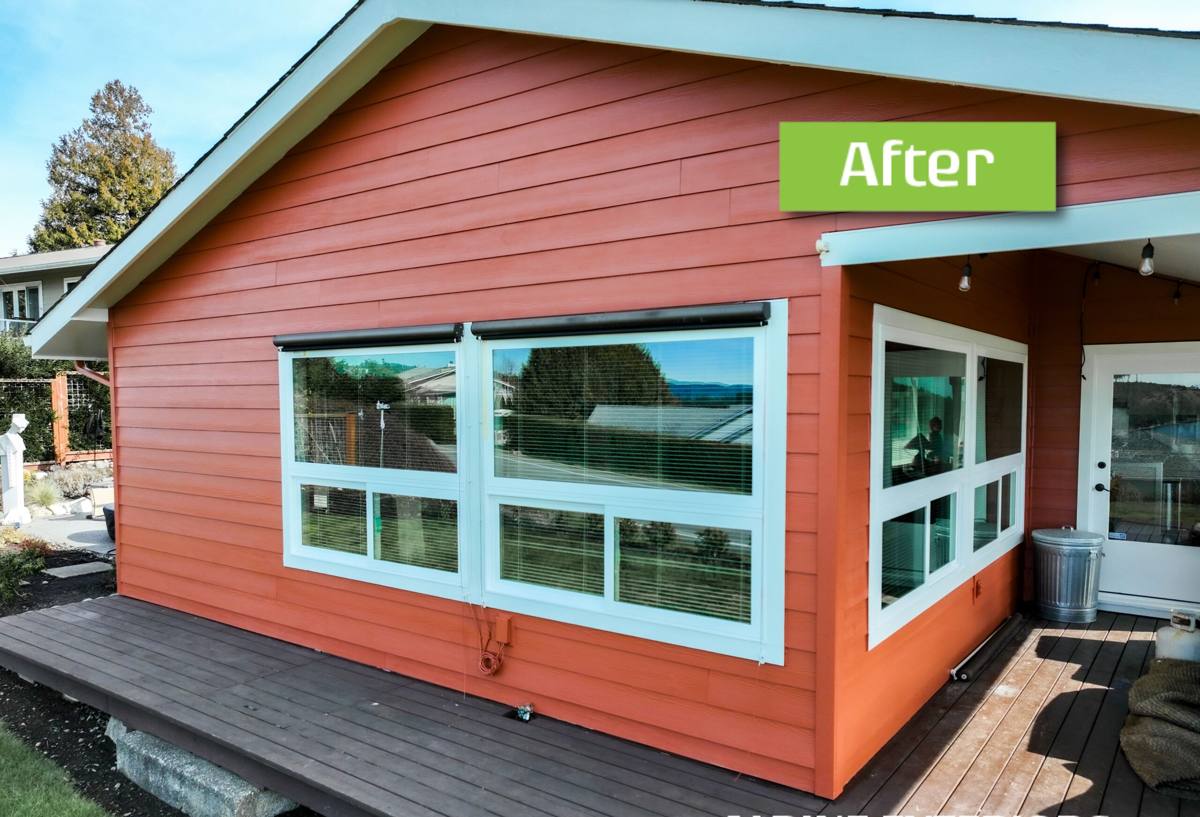
James Hardie fiber cement is cement, sand, and cellulose fiber, cured into a rigid board. It doesn't absorb water the way wood does, it doesn't have plastic's expansion-contraction problems, and it's non-combustible, which matters more each fire season even on the wet side of the state. Hardie also builds region-specific formulations — the HZ5 line is engineered for climates with freeze-thaw cycling and sustained damp conditions, which describes Whatcom County well. That's a meaningful difference from a one-size-fits-all siding product: the board itself is built to hold up to the moisture cycling this area produces, rather than just tolerating it.
The factory-applied ColorPlus finish is the other half of the equation. It's baked on in a controlled environment rather than field-applied with a brush, which gives more even coverage, better adhesion, and a finish that resists fading and the kind of algae staining that shows up fast on north-facing walls in a climate like this. We install James Hardie exclusively — not LP SmartSide, not vinyl, not cedar or primed spruce, not other fiber cement brands — because after years of doing exterior work in this specific climate, it's the product we trust to still be doing its job in year twenty without the maintenance headaches the alternatives tend to bring.
How Hardie's Lines Compare for a Bellingham Home
| Product | Core Material | How It Handles Salt Air & Rain | Typical Maintenance |
|---|---|---|---|
| James Hardie (HZ5) | Fiber cement | Non-combustible, dimensionally stable, factory finish resists moisture and algae staining | Occasional wash; repaint not required for years |
| Vinyl siding | PVC plastic | Seams allow water intrusion behind panels; can warp under thermal stress | Low, but panels crack and fade over time |
| Cedar / primed spruce | Solid wood | Absorbs moisture, prone to rot and splitting in sustained damp conditions | Regular repainting/sealing, ongoing rot inspection |
| LP SmartSide | Engineered wood strand | Treated to resist moisture, but a wood-based core is still more moisture-sensitive than fiber cement | Caulk and paint maintenance at cut edges and seams |
What a Correct Hardie Installation Actually Involves
Fiber cement performs the way it's supposed to only when it's installed to spec. A rushed or generic install — the kind that ignores manufacturer flashing and gapping requirements — can undercut everything the product is engineered to do, and in a climate that stays wet as long as this one does, those shortcuts show up faster.
Flashing and Moisture Management
Every window, door, and roof-to-wall transition needs proper flashing and a drainage plane behind the siding, not just caulk covering the gap. In a region with this much sustained rainfall, water that gets behind the cladding needs somewhere to go — a functioning weather-resistive barrier and rainscreen gap (where the wall assembly calls for one) are what keep incidental moisture from turning into rot in the sheathing.
Fastening and Panel Gaps
Hardie specifies exact nailing patterns, fastener types, and minimum gaps between panels and at trim. Corrosion-resistant fasteners matter more here than in a dry inland climate — salt air will find any fastener that isn't rated for it. Panels installed too tight, without the manufacturer's expansion gap, are more likely to buckle or crack as they respond to temperature and moisture changes through the year.
Trim, Caulking, and Touch-Up
Cut edges of fiber cement need to be sealed and back-primed where the factory finish has been exposed by cutting, or moisture can wick in at those points. Trim and caulk lines need to be the compatible, paintable products Hardie specifies — not whatever's cheapest — because the wrong sealant fails faster under this much rain exposure and creates the entry points that undo an otherwise good installation.
The Moss and Mildew Reality
Whatcom County's moss season runs long, and it's not just a roof problem — north- and shade-facing wall sections, areas under eaves, and anywhere airflow is restricted are all candidates for algae and moss growth on siding. This is one of the clearest practical arguments for a factory-cured finish over a field-painted or unfinished surface: ColorPlus resists organic staining better than paint applied on-site, and fiber cement's rigid, non-porous surface doesn't give moss the same foothold that wood grain or a rough-textured composite can. It's not maintenance-free — an occasional gentle wash keeps a Bellingham home's siding looking like it did on install day — but it's a far lighter maintenance burden than wood siding demands in this climate.
Our Process for a Bellingham Siding Project
We work Whatcom County regularly, and the process for a Bellingham home follows the same disciplined sequence every time:
- Assessment: we inspect existing siding, sheathing, and trim for hidden moisture damage before quoting anything — you can't price a re-side accurately without knowing what's underneath the current siding.
- Tear-off and sheathing check: old siding comes off and the sheathing gets inspected and repaired as needed before anything new goes up. Covering damaged sheathing with new siding just hides a problem that will resurface.
- Weather barrier and drainage plane: a proper weather-resistive barrier goes on (or gets verified) before Hardie panels go up, sized to this climate's rain exposure.
- Installation to Hardie spec: correct fastening, gapping, and flashing at every penetration, trim piece, and transition — no shortcuts on the details that matter most in wet, salt-exposed conditions.
- Final walkthrough: caulk lines, touch-up, and trim details get checked before we call the job done.
What Drives Cost on a Bellingham Hardie Project
Every home is different, so we don't publish flat prices — but the cost factors on a typical Bellingham job break down predictably:
| Factor | Why It Matters Here |
|---|---|
| House size and wall complexity | More corners, gables, and trim details mean more cut edges and flashing points to detail correctly |
| Condition of existing sheathing | Sustained moisture exposure in this climate makes hidden rot repair a real possibility on older homes |
| Siding profile and finish selection | Lap width, shingle-style panels, and ColorPlus color options vary in material cost |
| Trim and accessory scope | Corner boards, window trim, and fascia work add labor and material beyond the field siding itself |
| Access and site conditions | Lot slope, landscaping, and staging space affect labor time |
Signs Your Bellingham Home May Need New Siding
- Soft or spongy spots when you press on the siding, especially near the bottom courses or below windows
- Persistent moss or dark streaking that comes right back after cleaning
- Paint that's peeling, bubbling, or won't hold in the same spots year after year
- Visible gaps, warping, or cracked panels, particularly on walls that face prevailing wind and rain
- Rising energy bills that don't match any change in how the house is heated or cooled
- Musty smells or visible staining on interior walls that back up to exterior siding
Why It Matters to Hire a Crew That Already Works Bellingham
A crew that installs siding across a range of climates has to relearn the details every time the weather changes. A crew based in Blaine and working Whatcom County regularly already knows what this specific stretch of coastline does to a wall assembly — how much rain exposure to plan for, where moss tends to establish first, and which flashing details matter most on homes exposed to wind off the water. That local pattern recognition, combined with installing one product to one manufacturer's spec rather than juggling several product lines with different requirements, is what keeps an installation crew consistent from house to house instead of improvising on each job.
If your Bellingham home's siding is showing its age, or you're planning ahead rather than reacting to a problem, we're happy to take a look and give you a straightforward assessment. Reach out for a free, no-pressure estimate using the form below.