 Blaine Siding
 Why Bellingham Roofs Age Differently Than Roofs Inland
A roof in Bellingham does more work than a roof fifty miles east of the Cascades. It sits under a marine layer that keeps things damp for days at a time, takes on salt-laden air off Bellingham Bay and the Strait of Georgia, and spends a good chunk of the year shaded by fir and cedar canopy that drops needles and feeds moss. None of that is dramatic on its own, but stacked together over a few decades it's exactly the combination that shortens roof life when the original installation cut corners on ventilation, flashing, or underlayment.
We install roofs across Whatcom County, and Bellingham roofs get their own set of habits baked into the plan before a single shingle goes down. That's the difference between a roof that looks fine for five years and one that actually performs for its full warranty term in this climate.
Salt Air and Metal Components
Homes closer to the water deal with airborne salt that accelerates corrosion on exposed metal — fasteners, flashing, vents, and gutter hardware. Standard electro-galvanized fasteners can start showing rust streaks well before the shingles around them are due for replacement. We spec corrosion-resistant fasteners and flashing on Bellingham jobs as a matter of course, not an upsell.
Driving Rain, Not Just Rain
Whatcom County doesn't just get a lot of rain — it gets wind-driven rain off the water that pushes moisture sideways and up under laps that would stay dry in a calmer climate. Roofs here need extra attention at every horizontal seam, every valley, and every place a wall meets a roof plane, because that's where wind-driven water finds its way in if the underlayment and flashing aren't lapped correctly.
A Long Moss Season
Shade, moisture, and mild temperatures give moss and algae a long growing season on north-facing and tree-shaded slopes. Moss isn't just cosmetic — it holds water against the roofing material, works its way under shingle tabs, and lifts edges over time. A new roof installed with the right underlayment and, where appropriate, algae-resistant shingles or a zinc/copper strip strategy, starts that fight from a much stronger position than a roof that was never set up to resist it.
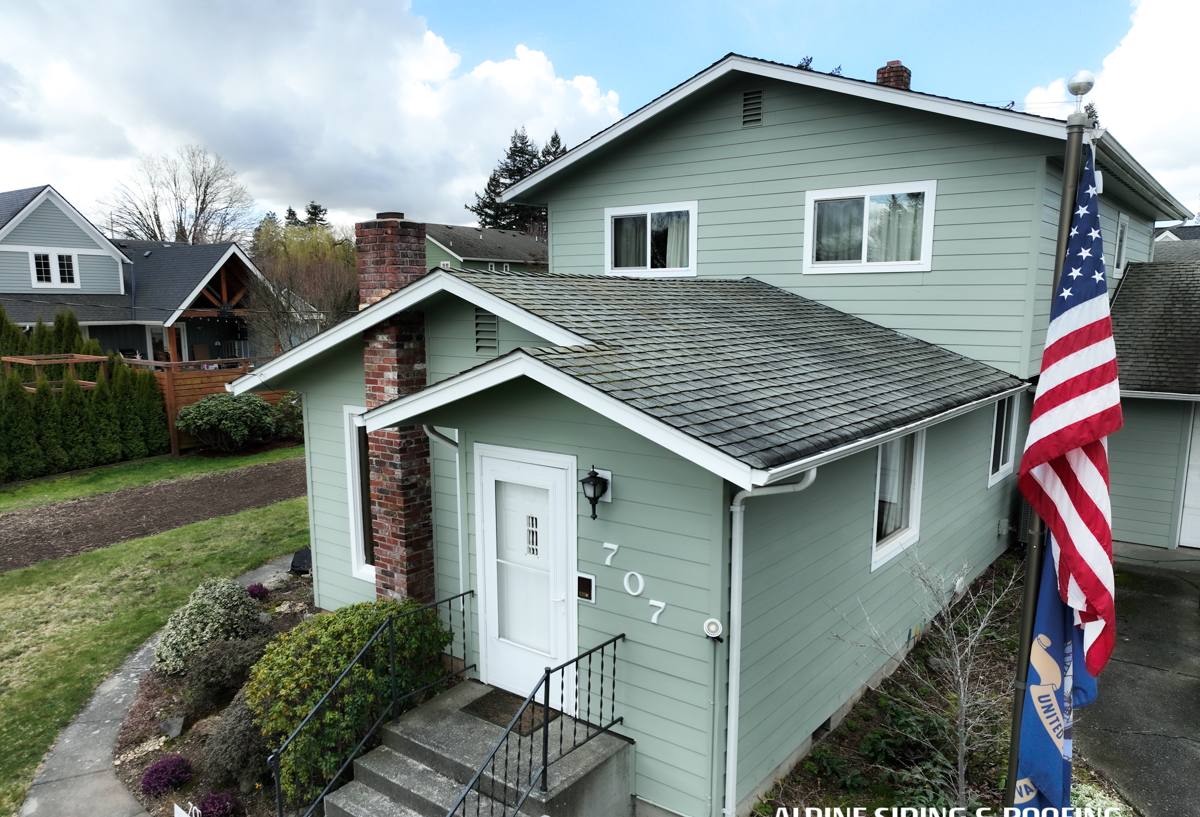
What a Correct New Roof Installation Actually Involves
"New roof" sounds simple, but the parts that determine whether it lasts 15 years or 30 happen underneath the shingles, where nobody sees them. Here's what we consider non-negotiable on every Bellingham installation.
Full Tear-Off and Deck Inspection
We don't install over existing layers. Tearing off down to the deck lets us actually see the plywood or plank sheathing underneath, find soft spots from long-term moisture intrusion, and replace only the sections that need it — instead of guessing and hoping. Given how much water this region moves through a roof system over its life, skipping this step is how small leaks turn into structural repairs.
Underlayment and Ice-and-Water Barrier
A synthetic underlayment across the whole roof is standard now, but the detail that matters most locally is self-adhering ice-and-water barrier at eaves, valleys, and roof-to-wall transitions — the exact spots wind-driven rain targets. This membrane seals around fastener penetrations, which ordinary felt doesn't do.
Flashing at Every Transition
Chimneys, skylights, dormers, sidewall intersections, and valleys all need step flashing, counter-flashing, or valley metal installed in the correct sequence with the underlayment and roofing material — not just caulked and covered. Caulk fails; properly lapped flashing sheds water by design and keeps working long after sealant has dried out and cracked.
Ventilation That Matches the Attic
A roof that's tight on the outside but poorly vented on the inside traps moisture in the attic, which condenses on cold sheathing during our damp winters and rots the deck from underneath — invisible until it's a real problem. We balance intake (soffit) and exhaust (ridge or roof vents) so the attic can actually dry out between wet spells.
Roofing Material Options for Bellingham Homes
Every material has trade-offs here. We'll walk through what fits your roof pitch, tree cover, and budget, but this is the honest short version.
| Material | Best fit for | Moss/moisture behavior | Maintenance |
|---|---|---|---|
| Architectural asphalt shingle | Most homes; balance of cost and durability | Algae-resistant granules available; still needs periodic cleaning under tree cover | Low to moderate |
| Standing seam metal | Steeper roofs, modern or farmhouse styles | Sheds moss and debris well; minimal surface for growth to grip | Low |
| Cedar shake | Homes matching a Pacific Northwest traditional look | Most moisture-sensitive option; needs disciplined maintenance to resist rot in this climate | High |
| Synthetic/composite shingle | Homeowners wanting shake or slate appearance with less upkeep | Doesn't absorb moisture like wood; holds up well under shade | Low to moderate |
We're candid with clients who ask about cedar shake: it can look great, but in a climate with this much sustained moisture and shade, it demands more frequent treatment and inspection than most homeowners want to keep up with. If the look matters more than the maintenance schedule, a quality synthetic shake gets you close without the same moisture exposure.
Our Installation Process
- On-site inspection and estimate. We look at the existing roof, attic ventilation, flashing points, and any moss or moisture staining before quoting anything.
- Material selection. We go over options against your budget, roof pitch, and how much shade and moss exposure the roof actually gets.
- Scheduling around weather. Tear-off and dry-in happen on a day with a workable weather window — we don't leave a roof deck exposed overnight without protection.
- Tear-off and deck repair. Old material comes off, the deck gets inspected, and any damaged sheathing is replaced before anything new goes down.
- Underlayment, flashing, and ventilation installed. This is where the roof's actual lifespan gets decided.
- Roofing material installed to manufacturer spec. Correct nailing pattern, exposure, and fastener count — not just "close enough."
- Final walkthrough. We show you the completed work, the flashing details, and answer questions before we consider the job done.
Signs a Bellingham Home Needs a New Roof, Not Another Patch
- Granules collecting in gutters or at downspout outlets in noticeable amounts
- Shingles that are cupping, curling, or cracking, especially on south- and west-facing slopes
- Moss established at the shingle edges rather than just on the surface
- Daylight visible through the roof deck from inside the attic
- Soft or spongy spots when walked on, or sagging along the ridge or rafter lines
- Repeated leaks around the same chimney, skylight, or valley despite prior patch repairs
- The roof is past, or close to, its material's expected service life
What Drives the Cost of a New Roof
| Factor | Why it matters |
|---|---|
| Roof size and number of planes | More area and more valleys/hips means more material and labor |
| Pitch and access | Steep or hard-to-access roofs take longer and need more safety setup |
| Material choice | Asphalt, metal, and shake sit at different price points and installation labor |
| Deck condition | Rotted sheathing found at tear-off adds material and time to replace |
| Ventilation and flashing scope | Adding proper intake/exhaust venting or re-flashing multiple penetrations adds labor |
| Tear-off layers | Removing multiple existing layers takes longer than a single-layer tear-off |
We won't quote a number without seeing the roof — anyone who does is guessing. What we can tell you is that the cheapest bid is rarely the cheapest roof over ten years, especially here, where a poorly detailed roof shows its weaknesses fast.
Why Hire a Crew That Already Works in Bellingham
A roofer who works Whatcom County regularly already knows which slopes hold moss longest, which neighborhoods get the harshest wind off the water, and which flashing details actually hold up through a full wet season instead of just looking right on installation day. That's not something you can fully substitute with a generic install checklist — it comes from doing the work here, repeatedly, and seeing which roofs come back with problems and which don't.
It also means when something needs a warranty callback or a quick check after a bad storm, you're not waiting on a crew that has to drive in from out of the area. We're local; this is our region too.
After Installation: Keeping a New Roof Performing
A correctly installed roof still benefits from basic upkeep in this climate:
- Keep gutters clear so water isn't backing up under the eave edge
- Trim back overhanging branches to reduce shade and debris buildup on the roof surface
- Have moss treated before it establishes at shingle edges, not after
- Get a quick visual check after major windstorms, especially around flashing points
None of this requires a service contract — it's just basic awareness of what this climate does to a roof over time.
If you're weighing a new roof in Bellingham, we're happy to take a look and give you a straight, no-pressure estimate — what we'd actually do, what it involves, and why. Use the form below to get started.