 Blaine Siding
 Why Birch Bay Is a Tougher Climate on Siding Than It Looks
Birch Bay sits right on the water in Whatcom County, and that location cuts both ways. It's part of what makes the area beautiful, and it's also what wears out siding faster than homes even a few miles inland. Salt-laden air moves off the water and settles on everything nearby, including exterior walls. Add in driving rain that comes in sideways during winter storms, and a moss season that can stretch from late fall through spring in the shaded, damp corners of a lot, and you've got a combination that punishes the wrong siding material and rewards the right one.
None of this is unique to any one house in Birch Bay — it's the baseline for the whole community. Homes closer to the water see it most directly, but wind-driven moisture and moss pressure show up throughout the area. Siding here needs to handle repeated wet-dry cycling, resist the slow corrosive effect of salt air on fasteners and trim, and shed water fast enough that algae and moss don't get a foothold on north-facing walls and shaded eaves.
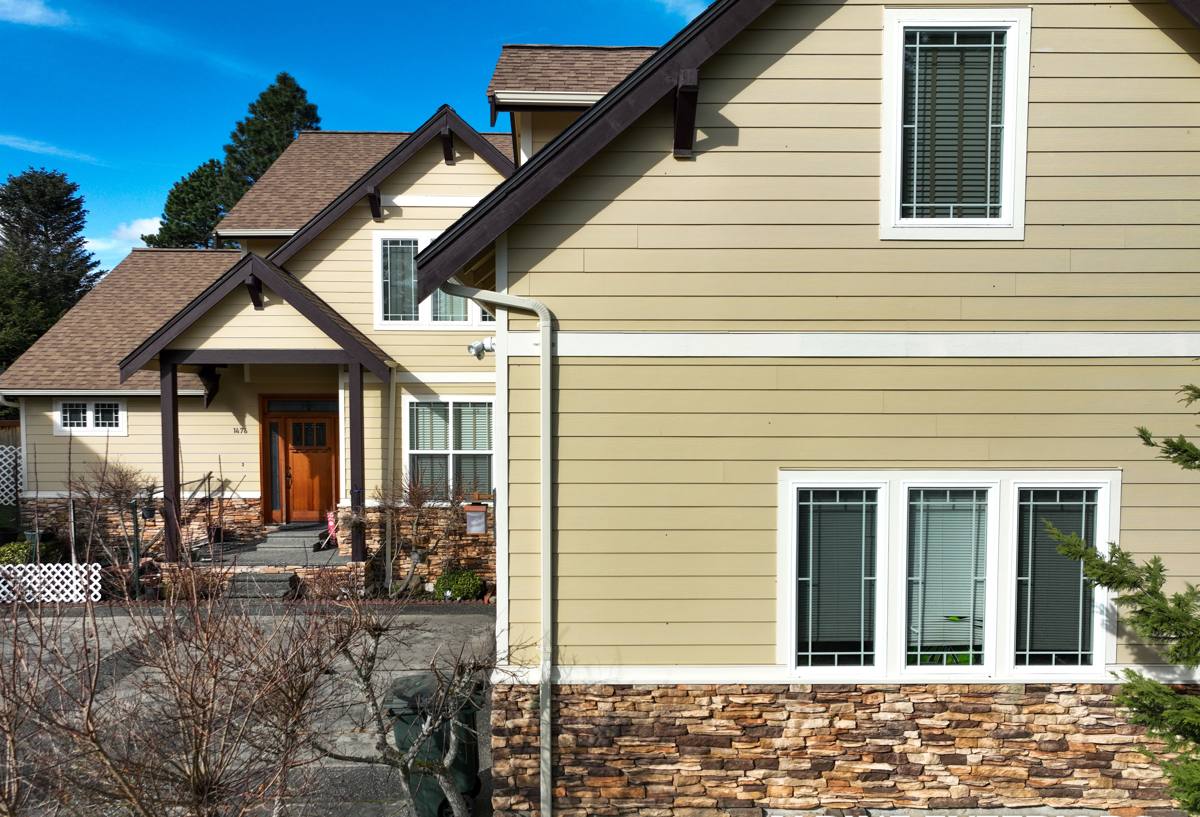
Why We Install Only James Hardie Fiber Cement
We don't install vinyl, LP SmartSide, Cemplank, Allura, primed spruce, or cedar. That's not a marketing line — it's a standard we hold to because of what we've seen these products do (and not do) in exactly this kind of coastal, wet climate. Vinyl expands and contracts with temperature swings and can warp or crack in sustained wind exposure. Wood-based and OSB-substrate products depend heavily on an unbroken paint film to keep moisture out; once that film is compromised by driving rain or physical damage, the substrate underneath is vulnerable to swelling and rot. Cedar is a beautiful, legitimate material, but it demands a maintenance commitment — refinishing, sealing, moisture monitoring — that most homeowners don't want to sign up for indefinitely.
James Hardie fiber cement is cement, sand, and cellulose fiber. It doesn't have an organic substrate to rot, it doesn't expand and contract the way vinyl does, and it's non-combustible. It was also built with this kind of climate in mind — Hardie engineers specific product lines for different moisture zones across North America, and the Pacific Northwest falls into their higher-moisture engineering category (marketed as their HZ5 line in this region). That means the product itself is formulated for exactly the wet, humid, salt-influenced conditions Birch Bay sees every winter.
What "Climate-Engineered" Actually Means
It's not just marketing language. Hardie's HZ5 formulation is designed to resist moisture-related damage and is backed by a warranty specific to this region. The factory-applied ColorPlus finish is baked on under controlled conditions and carries its own finish warranty, which matters here because field-painted siding in a wet climate is only as good as the paint job and the weather window it was applied in.
What Correct James Hardie Installation Involves
Fiber cement siding fails less because of the material and more because of how it's installed. In a climate like Birch Bay's, the details matter more than they would in a drier region, because any gap in the water management system gets tested constantly instead of occasionally.
- A properly lapped weather-resistive barrier behind the siding, with all penetrations (vents, outlets, hose bibs) flashed and sealed before a single board goes up
- Correct fastener placement and spacing per Hardie's published installation instructions — under-fastening or over-driving nails is one of the most common causes of early failure
- Proper clearance at the bottom of the siding from grade, decks, patios, and roof lines, so water and moss-prone debris don't sit against the board
- Caulked and sealed joints at butt seams, corners, and trim intersections, using sealants rated for the exposure
- Correct nail gap and expansion allowance so the board can handle seasonal movement without cracking the finish
- Factory-cut and factory-primed edges kept intact wherever possible, since field-cut edges need to be sealed to maintain the moisture protection
Skipping any one of these doesn't usually cause a visible problem in year one. It shows up two, five, or ten years later as a soft spot, a stain, or a section of siding that's holding moisture behind it — right when a homeowner assumes fiber cement means "no more thinking about it."
How Salt Air and Moisture Change the Installation Approach
Working this close to the water changes a few practical decisions on the job. We use fasteners and flashing components rated for coastal exposure rather than standard-grade hardware, because salt air accelerates corrosion on anything less. We pay close attention to any wall section facing the water or sitting in consistent shade, since those are the walls that stay damp longest and are most likely to develop moss or algae growth over time. And we're deliberate about sealant choice at trim and window returns, since a sealant that's fine in a drier inland climate can fail faster under Birch Bay's rain and salt exposure.
None of this changes the core installation — it's still James Hardie siding installed to Hardie's specification — but it does mean the small material and hardware choices around the siding get upgraded to match the environment, not just picked from a standard parts list.
Comparing Siding Materials in a Coastal, Wet Climate
| Material | Moisture/Salt Resistance | Maintenance Burden | Typical Concern in Birch Bay |
|---|---|---|---|
| James Hardie fiber cement (HZ5) | High — engineered for wet climates | Low — factory finish, periodic cleaning | Requires correct installation to realize its full lifespan |
| Vinyl | Moderate — doesn't rot, but can warp/crack | Low | Wind exposure and temperature cycling near the water |
| LP SmartSide / OSB-based | Depends entirely on intact paint film | Moderate to high | Substrate swelling if moisture gets past the finish |
| Cedar | Good if maintained, poor if neglected | High — refinishing on a recurring cycle | Ongoing sealing/staining commitment in a wet climate |
| Primed spruce | Low — relies fully on paint maintenance | High | Fast repaint cycle in driving rain and salt exposure |
This table isn't meant to trash the alternatives — vinyl, wood, and OSB-based products all have legitimate uses. It's meant to show why, for a coastal Whatcom County climate specifically, we standardized on the one material that doesn't ask the homeowner to maintain a protective finish just to keep water out.
What Drives Cost on a Birch Bay Job
| Factor | Why It Matters Here |
|---|---|
| Existing wall condition | Homes near the water sometimes have hidden moisture damage behind older siding that needs addressing before new siding goes on |
| Exposure and orientation | Water-facing and wind-exposed walls may call for upgraded fasteners and flashing details |
| Trim and detail complexity | Corners, window returns, and transitions all add labor, and each one is a place water can get in if rushed |
| Siding profile and finish | Lap width, texture, and ColorPlus color selection affect material cost |
| Access and site conditions | Waterfront lots, slopes, and tight setbacks can affect staging and labor time |
We don't publish blanket price lists because every one of these factors changes the number, but we'll walk your specific house and give you a real, itemized estimate rather than a ballpark guess.
How Our Process Works
We start with a walk-around of the exterior, checking for existing moisture damage, moss buildup, and problem areas — especially on shaded or water-facing walls, since those tell us the most about what the new siding needs to handle. From there we go over product line, color, and trim details, then handle tear-off, any necessary repair to sheathing or framing, house wrap, flashing, and the full Hardie installation to manufacturer specification. We inspect our own work against Hardie's published requirements before calling a job finished, not just against "does it look good from the street."
We also stand behind the labor, separately from Hardie's product and finish warranties, so you're not left trying to figure out who's responsible if a question comes up down the road.
Simple Maintenance Once It's Installed
Part of the appeal of James Hardie in a climate like this is how little ongoing work it actually requires compared to wood or field-painted alternatives.
- Rinse the siding periodically, especially shaded or water-facing walls where salt residue and organic buildup collect faster
- Keep gutters clear so water isn't overflowing directly onto siding sections
- Trim back vegetation and keep mulch or soil from piling against the bottom edge of the siding
- Do a quick visual check after major winter storms for any caulking that's pulled loose at trim or seams
- Address any small chip or ding in the finish promptly with a matching touch-up rather than letting it sit exposed
Why a Crew That Already Works Birch Bay Matters
A contractor who's worked this specific stretch of coastline knows which walls tend to hold moisture, how far moss pressure extends up a wall in a shaded yard, and which hardware upgrades are worth the cost versus which are unnecessary. That's the kind of judgment that doesn't come from a manufacturer's install manual alone — it comes from having done the work in this exact environment repeatedly and having seen how different details hold up over time. It's also easier to get warranty and follow-up support handled locally rather than through a crew that did one job in the area and moved on.
If you're weighing a siding replacement in Birch Bay, we're glad to walk your home, look at what your walls are actually dealing with, and give you a straightforward, no-pressure estimate for James Hardie siding done right. Use the form below to get started.