 Blaine Siding
 Grandview's Climate Is Hard on Siding — Here's Why
Homes in the Grandview area of Blaine sit close enough to the water and the Canadian border that they take on a specific combination of punishment most inland Washington homes never see. Salt-laden marine air works its way into every seam and fastener point. Wind-driven rain doesn't fall straight down here — it comes in sideways during winter storms and finds any gap in a wall assembly that isn't properly flashed. And the long, damp stretch from October through May gives moss, algae, and mildew months on end to colonize anything that stays wet longer than it should. None of this is unique to one house on one street — it's the baseline every exterior in this part of Whatcom County has to deal with, and it's the reason siding choice matters more here than it would in a drier climate.
Salt Air
Airborne salt is corrosive to exposed metal fasteners and accelerates the breakdown of paint films and caulk. Siding materials that rely on a surface-applied paint job — rather than a factory-cured finish — tend to chalk, fade, and lose adhesion faster in salt air than they would twenty miles inland.
Driving Rain
Wind-driven rain doesn't test whether a siding material can shed water on a calm day — it tests the whole wall assembly: the water-resistive barrier behind the siding, the flashing above windows and trim, the gaps left at butt joints, and the caulking at penetrations. A siding product can be excellent and still fail a home if any of those details are wrong.
Moss and Mildew Season
Shaded north- and west-facing walls in Grandview can stay damp for days at a time in winter. Any siding material that absorbs moisture, or that has seams and joints where organic debris can collect, gives moss and mildew a foothold that's difficult to remove without damaging the surface underneath.
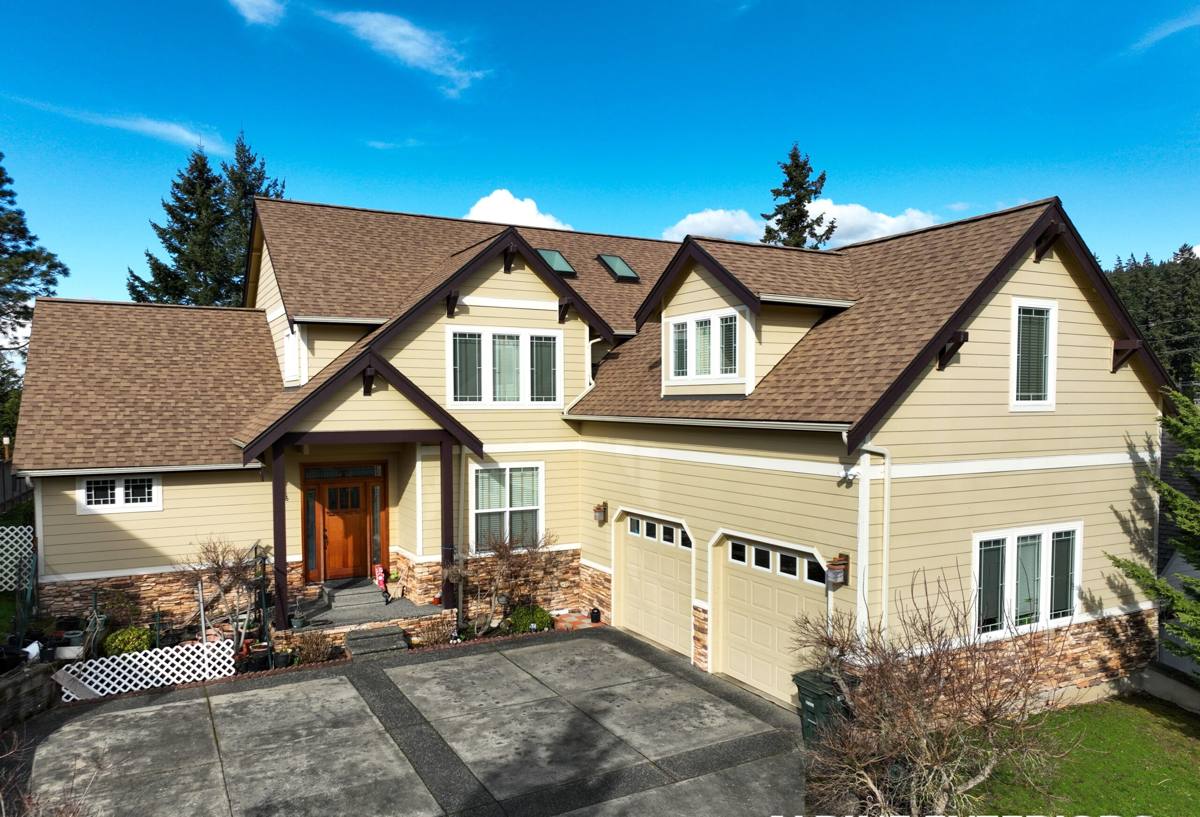
Why Fiber Cement Is the Right Material for This Climate
Fiber cement is a mix of cement, sand, and cellulose fiber, pressed and cured into planks and panels. Unlike wood-based sidings, it doesn't swell, rot, or delaminate when it absorbs moisture, and unlike vinyl, it doesn't warp or become brittle with temperature swings. It holds paint and factory finishes far longer than wood substrates because it's dimensionally stable — it doesn't expand and contract enough to crack a coating the way wood fiber products can. For a neighborhood dealing with salt air, driving rain, and a real moss season, that stability is the whole ballgame. It's also non-combustible, which matters increasingly to insurers and to homeowners thinking about wildfire smoke and ember exposure during dry summer stretches.
Not all fiber cement is installed — or engineered — the same way, though, which is why the brand and the installer both matter as much as the material category.
Why We Install Only James Hardie Fiber Cement
We standardized on James Hardie products exclusively. We don't install LP SmartSide, vinyl, Cemplank, Allura, primed spruce, or cedar, and we're upfront with Grandview homeowners about why:
- Climate-engineered product lines. Hardie's HZ product system is formulated by region rather than sold as one national product, which matters in a climate that alternates between salt-air exposure and prolonged winter wet.
- ColorPlus factory finish. The color is baked on in a controlled factory process rather than field-applied, which gives far more consistent adhesion and UV/salt resistance than a job-site paint job, and it means touch-up work — when it's ever needed — uses matched factory product.
- Non-combustible core. Cement-based composition doesn't support combustion the way wood-based or foam-backed products can, which is a meaningful difference for insurance underwriting in Washington.
- A warranty structure we can stand behind. Hardie's transferable limited warranty is well documented and widely honored, which matters if a Grandview home changes hands — a common outcome in a market where remodeled and resale homes both trade often.
- A long track record installed to spec. Hardie has been on the market long enough, in this exact climate, that we know how it performs over decades when it's installed correctly — not just how it looks on day one.
We're not going to tell you every other product on the market is junk — several of them are reasonable materials with real trade-offs. What we will say is that after years of siding work in this climate, Hardie is what we're willing to put our name on, and it's the only product we install.
What a Correct Fiber Cement Installation Actually Involves
Fiber cement is only as good as the installation behind it. Most of the siding failures we get called out to inspect in this area aren't material failures — they're installation shortcuts that let water get behind a wall that looked fine from the curb.
Flashing and Water Management
Every window head, door top, and horizontal trim transition needs proper flashing that directs water out and away from the wall assembly, not just caulk covering a gap. In a driving-rain climate, flashing detail is the single biggest factor separating a siding job that lasts thirty years from one that has rot behind it in five.
Fastening
Hardie planks require the correct fastener type, spacing, and penetration depth specified by the manufacturer. Under- or over-driven nails, or fasteners in the wrong location on the plank, can crack the material or leave it loose enough to move and eventually let water in.
Gaps, Caulking, and Butt Joints
Manufacturer specifications call for specific gaps at butt joints and terminations, sealed with the right sealant — not just whatever caulk is on the truck. Getting this wrong is one of the most common sources of premature paint failure and water intrusion we see on homes that weren't installed to spec.
Starter Strips, Weep Screeds, and Clearances
Siding needs to sit at the correct clearance above grade, decks, and roof lines, with proper starter strips at the base. Skipping this detail lets moisture wick up into the bottom courses — exactly the kind of slow, hidden damage that's expensive to catch late.
Our Process for Grandview Projects
- On-site assessment. We walk the exterior, check the existing wall assembly, look for signs of moisture damage or rot behind the current siding, and identify problem areas like north-facing walls with heavy moss buildup.
- Scope and product selection. We walk you through the relevant Hardie product line, plank profile, and ColorPlus color options, and put together a written scope covering trim, flashing, and any sheathing repair the assessment turned up.
- Prep and removal. Old siding comes off, the sheathing and water-resistive barrier get inspected and repaired as needed, and any rot or damage found underneath is addressed before anything new goes back up — not covered over.
- Installation to manufacturer spec. Flashing, fastening, gaps, and clearances are installed to Hardie's published specifications, not shortcuts, because that's what the warranty and the performance both depend on.
- Final walkthrough. We go over the finished job with you, check caulking lines and trim details, and make sure everything matches the agreed scope before we call it done.
What Fiber Cement Siding Costs in Grandview
Every home is different, but the factors below are what actually move the price on a Grandview fiber cement project. We'll give you a firm, itemized number after the on-site assessment — not a phone-quote guess.
| Cost Factor | Why It Matters |
|---|---|
| Home size and wall complexity | More corners, dormers, and trim details mean more cutting, fitting, and labor time |
| Condition of existing sheathing | Rot or moisture damage found during tear-off has to be repaired before new siding goes on |
| Plank profile and finish | Lap width, texture, and ColorPlus color selection affect material cost |
| Trim and accessory scope | Corner boards, window trim, and fascia work are often bundled with a siding project |
| Access and site conditions | Multi-story walls, tight lot lines, or landscaping obstructions affect labor time |
| Tear-off and disposal | Removing and hauling away the old siding is part of the job, not an add-on surprise |
Signs Your Grandview Home May Need New Siding
- Persistent moss or algae growth that comes back within weeks of cleaning
- Paint that's peeling, bubbling, or chalking heavily, especially on north- or west-facing walls
- Soft or spongy spots when you press on the siding, particularly near the base of walls
- Visible gaps, warping, or cracking at seams and butt joints
- Rising heating bills or noticeably drafty rooms along exterior walls
- Siding that's original to a home built more than 20-25 years ago and hasn't been reassessed
Why Hiring a Crew That Already Works Grandview Matters
A contractor who works this part of Whatcom County regularly already knows which wall orientations in Grandview take the worst of the winter rain, how aggressive moss growth gets on shaded elevations here, and what flashing details actually hold up against salt air over time. That's different from a crew that installs siding all over the region and treats every job the same regardless of exposure. Local, consistent work also means we're not guessing at permitting requirements or inspection expectations for Blaine — we've been through the process enough times that it doesn't slow your project down.
If your Grandview home's siding is showing its age, or you're planning ahead rather than waiting for a problem, we're happy to take a look. Reach out for a free, no-pressure estimate — we'll walk your home, tell you honestly what we see, and give you a straightforward number for doing it right.