 Blaine Siding
 Lynden's Weather Is Tougher on Siding Than It Looks
Lynden sits in a part of Whatcom County that takes a steady beating from the weather most of the year. Moist air off the Salish Sea carries salt inland on the wind, storms roll through with driving, wind-pushed rain rather than gentle vertical rainfall, and the gray stretch from fall through spring gives moss, algae, and lichen months on end to get established on anything that stays damp. None of that is dramatic on any given day. The damage shows up slowly, over years of repeated wetting and drying, and by the time it's visible on the surface, it has usually been working on the wall underneath for a while.
That's the real argument for choosing the right siding system in this area, not just any siding that looks good on day one. A product that performs fine in a dry inland climate can struggle here, and a product that's installed correctly but with the wrong material choice will still let you down eventually. This page is about one specific job done right: fiber cement siding, installed to spec, on a Lynden home.
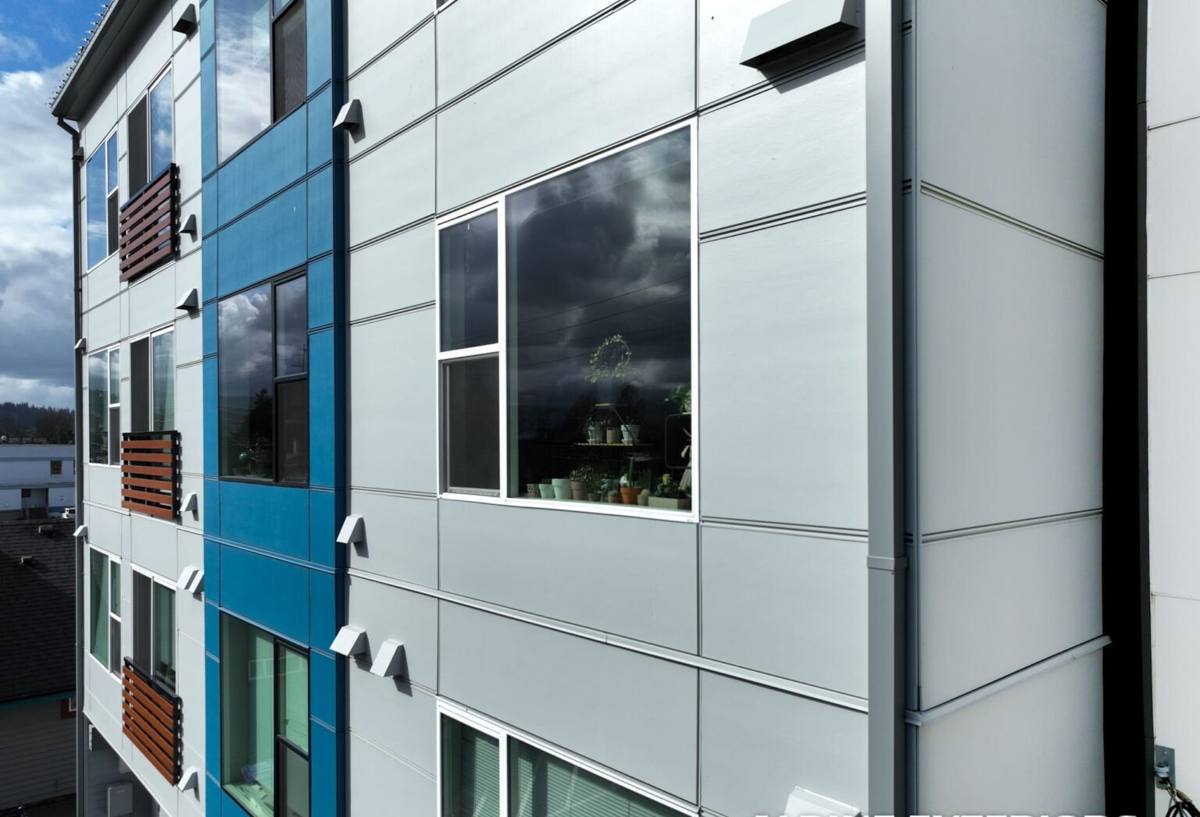
What Salt Air, Driving Rain, and Moss Season Actually Do to a Wall
Salt-laden air
Even well inland from the water, salt-bearing air moves through Whatcom County on prevailing winds. Over time it accelerates corrosion on exposed fasteners and hardware, and it speeds up the breakdown of field-applied paint finishes, which chalk and fade faster than they would in a drier, saltier-free climate. Caulk joints exposed to salt air and UV also tend to lose flexibility and crack sooner than the manufacturer's stated service life would suggest.
Driving rain
Wind-driven rain doesn't fall straight down — it gets pushed sideways and upward under laps, around trim, and into any gap in the water-resistive barrier or flashing detail. On a home with proper flashing and correctly lapped siding, that rain sheds off the wall the way it's supposed to. On a home where those details were rushed, water finds its way behind the cladding at butt joints, corners, and window and door returns, and it stays there, out of sight, doing damage to the sheathing and framing long before anyone notices a problem from the curb.
Moss, algae, and prolonged damp
Shaded, tree-lined lots are common around Lynden, and north-facing walls in particular can stay damp for days at a stretch during the wetter months. Moss and algae aren't just a cosmetic nuisance — they hold moisture directly against the siding surface, which is exactly the condition that causes trouble for any material that isn't dimensionally stable when wet. A long moss season means more weeks per year where a wall is damp, not fewer.
Why We Install Only James Hardie Fiber Cement
We standardized on James Hardie fiber cement siding and don't install vinyl, LP SmartSide, primed spruce, cedar, or other fiber cement brands. That's not a marketing position — it's a decision based on what holds up under exactly the conditions described above. Fiber cement is a mix of cement, sand, and cellulose fiber, engineered to be dimensionally stable when it's repeatedly wetted and dried. It doesn't absorb moisture the way wood-based products can, it won't swell, delaminate, or feed rot the way engineered wood siding can if a seam or cut edge is compromised, and it's non-combustible, which matters regardless of climate.
HardiePlank vs. HardiePanel
Most Lynden homes we work on use HardiePlank lap siding, which gives the traditional horizontal, overlapping look most people expect from a Northwest home. Some projects — modern builds, accent walls, or homes going for a board-and-batten look — call for HardiePanel vertical siding instead. Both are part of James Hardie's engineered product system, and both are manufactured in a version formulated for this climate zone rather than a generic, one-size-fits-all formulation.
ColorPlus factory finish
Where possible, we recommend ColorPlus finish over field-applied paint. It's baked on at the factory in a controlled environment, which gives it better adhesion and more consistent coverage than paint applied on-site, and it holds color and resists fading noticeably better under the UV-and-damp cycling this area sees every year. Fewer repaint cycles means fewer chances for a maintenance gap to turn into a moisture problem.
Warranty
James Hardie backs its siding with a long-term, transferable limited warranty, and ColorPlus finishes carry their own separate finish warranty. We back our labor with our own workmanship warranty. Between the two, a homeowner has real coverage rather than a vague promise — and a warranty structure that's actually documented is one of the practical reasons we don't install products that rely on thinner or less established coverage.
What a Correct Fiber Cement Job Involves
Fiber cement siding is only as good as its installation. The material is engineered to perform in wet climates, but that engineering only pays off if the details underneath and around it are done correctly. A rushed or generic install can undercut even the best siding product.
- Sheathing and framing checked and repaired before new siding goes on — never installed over hidden rot
- Weather-resistive barrier installed and correctly lapped, shingle-style, so water sheds outward at every seam
- Flashing installed at every window, door, and roofline intersection, not just caulked over
- Starter strip set level and true, since everything above it follows that line
- Fasteners placed per manufacturer specification — correct type, spacing, and depth to avoid splitting or overdriving
- Butt joints and trim gaps sized to the manufacturer's spec, not caulked tight everywhere out of habit
- Proper clearance maintained from grade, roof lines, decks, and other siding terminations
- Cut edges sealed or field-touched with matching finish before they're exposed to weather
Skipping any one of these doesn't usually cause an immediate, visible failure. It shows up two, five, or ten years later as a soft spot at a corner or a stain under a window — which is exactly the kind of slow, hidden damage Lynden's climate is good at causing when the installation gives it an opening.
How Fiber Cement Compares to Other Siding Options
We get asked fairly often why we don't install other common siding products. Here's an honest look at how they generally stack up for a climate like this one.
| Material | Moisture Behavior | Maintenance | Fire Resistance | Fit for This Climate |
|---|---|---|---|---|
| Vinyl | Doesn't rot, but can warp, crack, or fade; seams and panels can allow water behind the wall if not detailed carefully | Low, but repairs and color-matching aging panels can be difficult | Combustible | Workable, but not what we install given the moisture exposure here |
| Cedar / primed spruce | Absorbs moisture; prone to swelling, checking, and rot without diligent upkeep | High — regular sealing, painting, and inspection required | Combustible | Traditional look, but demanding in a wet, moss-prone climate |
| LP SmartSide (engineered wood) | Treated to resist moisture, but still wood-based; vulnerable at cut edges and seams if caulking or paint fails | Moderate — finish needs to be maintained to keep moisture out | Combustible | Better than raw wood, but still sensitive to prolonged wet exposure |
| James Hardie fiber cement | Dimensionally stable when wet; doesn't swell, rot, or delaminate the way wood-based products can | Low — periodic cleaning, occasional caulk inspection | Non-combustible | Engineered climate-specific product lines built for wet, coastal-influenced conditions |
Our Process for a Lynden Fiber Cement Project
We start with an on-site look at the existing siding and, where it's accessible, the condition of the sheathing underneath — not just a walk-around estimate. If there's existing moisture damage from a prior installation, we address that before anything new goes up; siding over a compromised wall just hides the problem for a while. From there, we install the water-resistive barrier and flashing package, set the starter course, and run the Hardie siding per James Hardie's published installation instructions for our climate zone, not a generalized approach. Trim, caulking, and any field touch-up finishing happen last, followed by a final walk-through so you know exactly what was done and why.
Why Local Experience in Whatcom County Matters
A crew that already works in Lynden and around Blaine has seen which details fail first in this specific climate — where moss tends to establish on older homes with mature tree cover, which wall orientations take the worst of the driving rain, and how salt-influenced air affects fasteners and finishes over time. That's not something you get from a general installation manual alone; it comes from doing this work repeatedly in this county, on homes dealing with the same weather yours does. It also means fewer surprises during permitting and inspection, since the process has already been run here before.
Maintenance and What to Expect Over Time
Fiber cement is genuinely low-maintenance, not maintenance-free. In a climate with a long moss season, an occasional gentle rinse to keep organic growth from establishing on the siding goes a long way. It's worth having caulk joints and trim checked periodically, since caulk is typically the first thing to age out even when the siding itself is holding up fine. With a ColorPlus factory finish, you should expect the color to hold well for a long stretch before any repainting is even a consideration; with field-applied trim paint, plan on repainting on a more normal cycle. None of this is heavy upkeep — it's the kind of routine attention that keeps a correctly installed system performing the way it's designed to.
If you're weighing siding options for a home in Lynden or elsewhere in the Blaine area, we're happy to take a look and give you a straight answer on what your home needs. Use the form below to request a free, no-pressure estimate.