 Blaine Siding
 Why Decks Near the Peace Arch Wear Out Faster Than You'd Expect
Homes in the Peace Arch area sit close to the water and close to the border, which means they take a specific kind of weather beating that inland Whatcom County properties don't see as often. Salt-laden air moves in off the coast and settles into wood grain, metal fasteners, and painted surfaces. Combine that with the long, wet Pacific Northwest fall and winter — driving rain that comes in sideways more often than straight down — and you get decks that look fine on the surface while the structure underneath is quietly failing. Add a moss season that can run six months or more in a shaded, damp yard, and you have three separate forces working against a deck at the same time: corrosion, moisture intrusion, and organic growth that holds water against the wood.
A deck built with standard hardware and generic construction practices might hold up for a decade in a drier inland climate. Near the Peace Arch, that same deck often shows real trouble in half that time — soft spots at the ledger board, rusted-through fasteners, and boards that stay slick with moss well into late spring.
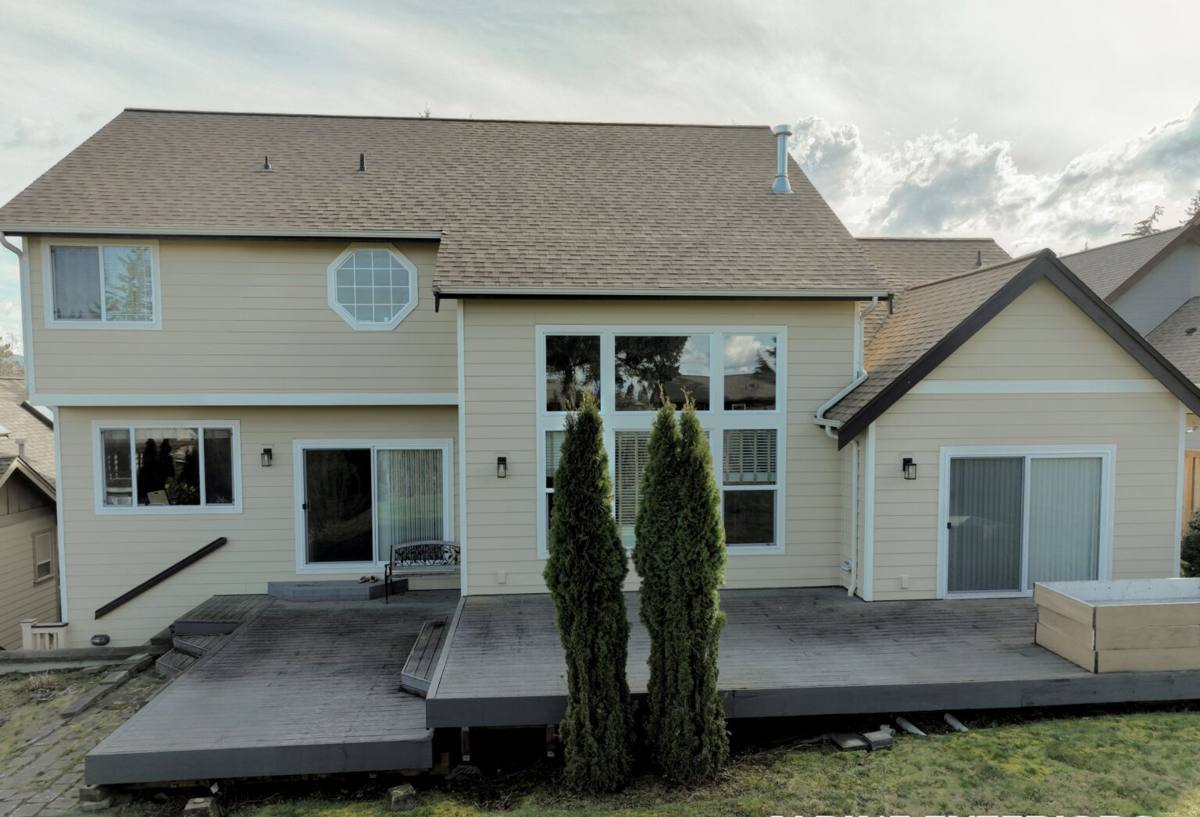
Signs a Deck Needs Replacement, Not Just Repair
Not every tired-looking deck needs a full teardown. But there's a point where patching individual boards is a waste of money because the framing or connection points underneath are the real problem. Before we quote anything, we check the structure, not just the surface.
- Soft, spongy, or bouncy decking — especially near the house or at stair landings
- Rust streaks or crumbling at joist hangers, bolts, or the ledger connection to the house
- Persistent moss or black-green staining that comes back within weeks of cleaning
- Gaps opening up between boards, or boards cupping and warping unevenly
- A ledger board that's separating from the house rim joist, even slightly
- Railings that flex or feel loose when leaned on
- Visible rot at post bases or anywhere wood sits close to grade or standing water
If we find two or three of these at once, repair usually just delays a bigger bill. We'll tell you honestly which category your deck falls into — that's part of the estimate, not an upsell.
What a Correct Deck Replacement Involves Here
Substructure and Framing
The framing is where most deck failures near coastal Whatcom County actually start, even though it's the part homeowners see least. We replace ledger flashing with a proper moisture barrier and drip cap so water sheds away from the house rim joist instead of running behind the siding — this single detail is one of the most common causes of hidden rot we find on teardowns. Joists, beams, and posts get sized to current code span tables, not just matched to what was there before, and every structural connector is stainless steel or heavy hot-dip galvanized rated for coastal exposure, not the lighter-duty hardware that's fine inland but corrodes fast this close to salt air.
Footings and Posts
Where soil, drainage, or frost conditions call for it, we upsize or add footings rather than reusing undersized original ones. Posts get proper post bases that hold the wood above grade and standing water — ground contact is one of the fastest ways moss and rot take hold on a deck that otherwise looks solid.
Decking Surface
The board choice matters more here than in a drier climate, because moisture cycling and moss growth are constant rather than seasonal. We'll walk through real trade-offs — appearance, upkeep, and how each material actually behaves wet — rather than pushing one product on every job.
Decking Material Comparison for This Climate
| Material | How It Handles Moss & Moisture | Maintenance | Typical Lifespan Here |
|---|---|---|---|
| Pressure-treated lumber | Needs sealing to resist moss staining and cupping; absorbs moisture readily if finish lapses | Annual cleaning, re-seal every 1-2 years | 10-15 years with upkeep |
| Cedar | Naturally moisture-resistant, but greys and can stay damp under moss without regular cleaning | Cleaning and oil/finish every 1-2 years | 15-20 years with upkeep |
| Composite decking | Doesn't absorb water into the board, but surface moss and mildew still need periodic washing | Occasional cleaning, no sealing or staining | 25-30+ years, manufacturer-backed |
| PVC decking | Fully water-resistant board; least hospitable surface for moss to root into | Lowest — rinse and occasional wash | 25-30+ years, manufacturer-backed |
There's no universally "right" answer — a homeowner planning to sell in a few years has different priorities than one settling in for the long haul. We'll give you our honest read on which material fits your budget and how much upkeep you actually want to do, rather than steering every job toward the highest-margin product.
Our Process, Start to Finish
- On-site assessment — we get under the deck, check the ledger connection, probe framing for soft spots, and look at drainage around posts and footings.
- Honest scope and estimate — a clear breakdown of what's structural, what's cosmetic, and what your material options cost installed, not just per board.
- Permit and code check — we confirm what the City of Blaine or Whatcom County requires for your specific deck (height, guardrails, footings) before work starts.
- Tear-off and disposal — full removal of the old deck, hauled off site, with the area protected during demolition.
- Framing rebuild — new or reinforced joists, beams, posts, and footings, with coastal-rated hardware and corrected ledger flashing.
- Decking, railing, and stairs installed — to your chosen material, with fastening methods appropriate to that product's warranty.
- Final walkthrough — we check for level, gaps, railing rigidity, and drainage before calling the job done.
Permits and Code Considerations Near the Border
Deck replacement projects in Blaine typically require a permit once you're rebuilding structural elements like framing, footings, or attaching a new ledger — this isn't a formality we skip to save you time. Inspectors are checking guardrail height, stair rise and run, and structural connections for a reason: these are the failure points that cause injuries. Because we work in this specific jurisdiction regularly, we know what the local permitting process expects and build to that standard from the first stake in the ground, which avoids the costly rework of failing an inspection partway through.
What Drives the Cost of a Deck Replacement
| Cost Factor | Why It Matters |
|---|---|
| Deck size and height above grade | Larger and taller decks need more framing, footings, and often taller guardrails |
| Decking material chosen | Pressure-treated, cedar, composite, and PVC span a wide price range per square foot |
| Framing condition underneath | Rot or undersized framing found during teardown adds necessary repair, not optional upsell |
| Ledger and flashing detail | Correcting a poorly flashed ledger connection is inexpensive relative to the water damage it prevents |
| Stairs, railings, and features | Multiple stair runs, built-in benches, or lighting add labor and material |
| Access and site conditions | Slope, tight side-yard access, or waterfront exposure can affect equipment and staging |
We won't quote a number without seeing the deck. Rough budgets for a full replacement on an average-size residential deck in this area run from the low thousands for a smaller pressure-treated rebuild up into the higher end for larger composite or PVC decks with rebuilt framing — but the honest answer is always specific to your structure, your material choice, and what we find once the old decking comes off.
Why a Crew That Already Works This Area Matters
A contractor who mostly works inland or in drier parts of the state can still build a deck that looks correct and still get it wrong for this location. The details that actually matter here — flashing that accounts for wind-driven rain, hardware rated for salt exposure, framing that won't trap moisture under moss — come from having replaced decks in this exact microclimate before, not from a generic build spec. We also already know the local permitting expectations for Blaine and Whatcom County, which keeps your project from stalling on paperwork or a failed inspection. That familiarity shows up as fewer surprises and a deck that's actually built for the conditions it will sit in year-round, not just the conditions on the day it was installed.
Keeping a New Deck Healthy After Installation
- Sweep off standing leaves and debris regularly, especially in fall — trapped organic matter is what feeds moss
- Rinse or lightly scrub the surface a couple times a year to interrupt moss before it takes hold
- Check the ledger flashing and any caulked joints annually for gaps opening up
- Keep gutters and downspouts near the deck clear so runoff isn't dumping extra water onto it
- Reseal wood decking on the schedule the finish manufacturer recommends — don't wait until it looks obviously grey
- Look under the deck once a year for early rust or soft framing, not just at the walking surface
None of this is complicated, but skipping it is exactly how a well-built deck in this climate ends up needing early repairs.
If your deck near the Peace Arch is showing any of the warning signs above, or you just want an honest read on whether it needs repair or full replacement, we're glad to come take a look. Fill out the form below for a free, no-pressure estimate.