 Blaine Siding
 Why Point Roberts Decks Wear Out Faster Than You'd Expect
Point Roberts sits on its own peninsula at the southern tip of Boundary Bay, surrounded on three sides by water. That location is part of what makes it a great place to have a deck — and part of why decks there take more punishment than decks fifteen miles inland. Salt-laden air off the Strait of Georgia works on fasteners and metal connectors year-round, driving rain off the Pacific pushes moisture into every joint and end-cut that isn't sealed, and a long, mild moss season keeps deck boards damp for weeks at a stretch even when it isn't actively raining. None of this is unique to Point Roberts, but the combination is more concentrated there than almost anywhere else in Whatcom County.
A deck built to a generic spec — standard hardware, uncapped boards, minimal drainage detailing — can look fine for a few seasons and then fail all at once: soft joists under boards that still look okay on top, rusted-through hangers, or a ledger board that's been quietly rotting behind the house. Replacing a deck the right way here means building for the exposure that's actually present, not the exposure a spec sheet assumes.
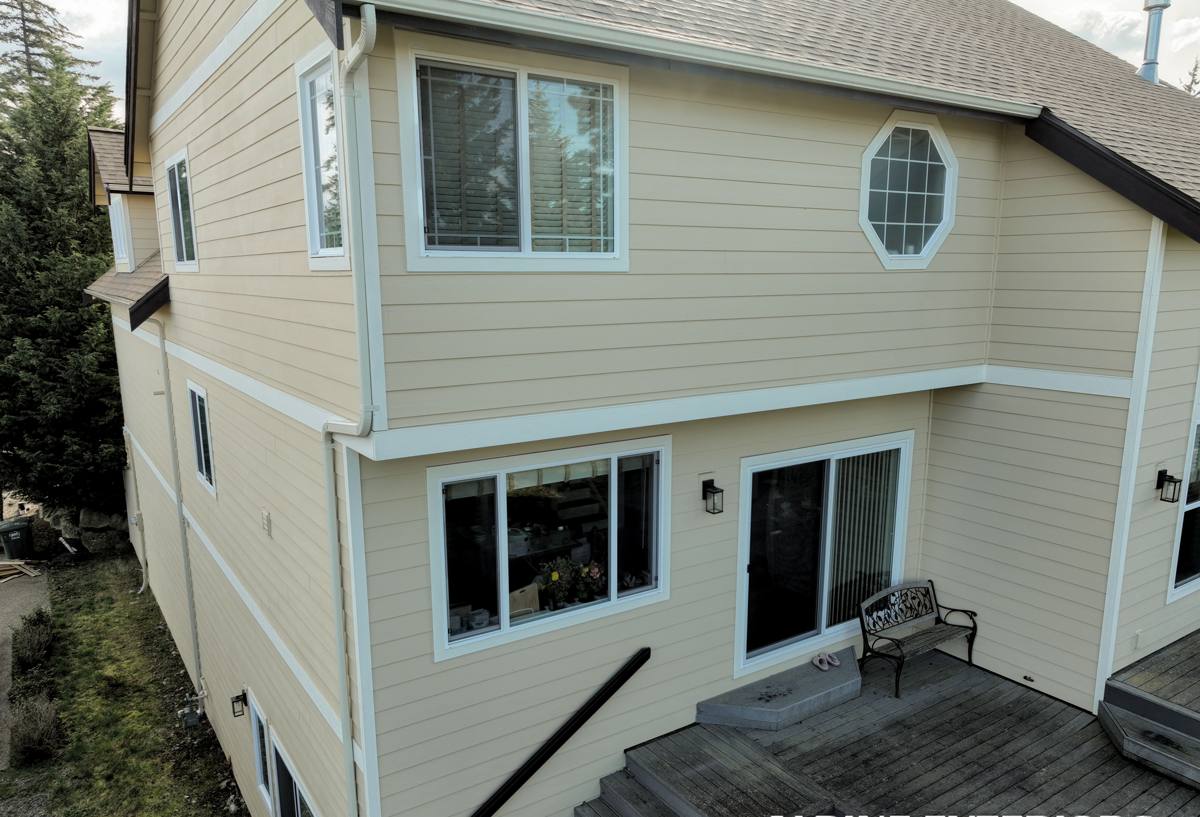
Signs a Repair Won't Cut It Anymore
Not every tired deck needs full replacement. But there are a few signs that patching individual boards is just delaying a bigger job:
- Soft or spongy spots in the decking that shift when you walk on them, especially near the house or stair landing
- Rust staining bleeding out around fastener heads or metal connectors
- Visible gaps or movement where the deck ledger meets the house siding or sheathing
- Persistent moss or dark staining on the underside of boards that comes back within weeks of cleaning
- Railing posts that flex more than they used to, which usually means the post base or blocking has gone soft
- A deck more than 15-20 years old built with hardware or flashing details that were standard at the time but wouldn't pass inspection today
If you're seeing two or more of these, it's worth having someone open up a board or two and look at the framing underneath before deciding whether to repair or replace.
What a Correct Deck Replacement Involves Here
Framing and Fasteners for Salt Air
The framing is what determines whether a deck lasts eight years or twenty-five. In a marine-air environment, we treat fastener and connector selection as non-negotiable rather than an upgrade option — stainless steel or heavy hot-dip galvanized hardware throughout, not the lighter coated hardware that's fine in drier inland areas but corrodes visibly within a few seasons this close to salt water. Joist hangers, post bases, and structural screws all get the same treatment, because a deck is only as strong as its weakest connector.
Ledger Flashing and House Connection
Most deck failures that end up as insurance claims start at the ledger — the board that attaches the deck to the house. If that connection isn't properly flashed to shed water away from the house sheathing, moisture works its way behind the siding and rots the framing from a spot you can't see until it's serious. Correct ledger flashing, proper standoff spacing, and through-bolted (not just lag-screwed) connections are standard on every replacement we do, regardless of what was there before.
Decking Material Choices
There's no single right decking material for every Point Roberts home — it depends on budget, how much upkeep you want to do, and how the deck gets used. Here's how the common options compare for this climate specifically:
| Material | Moisture & Moss Resistance Here | Upkeep | Relative Cost |
|---|---|---|---|
| Pressure-treated wood | Good if sealed regularly; end grain and fastener holes are vulnerable points | Annual cleaning and re-sealing recommended in this climate | Lowest upfront |
| Cedar | Naturally moisture-resistant but still needs sealing to resist moss and graying | Regular cleaning and periodic finish renewal | Mid-range |
| Capped composite | Very good — the cap layer resists moisture absorption and moss gets a much harder surface to hold onto | Occasional washing, no sealing or staining | Higher upfront |
| PVC decking | Excellent moisture resistance since there's no wood fiber to absorb water | Lowest — mainly just periodic washing | Highest upfront |
We'll walk you through the real trade-offs for your situation rather than pushing whatever has the best margin. If a wood deck fits your budget and you're willing to keep up with sealing, that's a legitimate choice — we just want you to know what the maintenance commitment actually looks like in this climate before you decide.
Drainage and Moss Management
Beyond the decking itself, the framing layout and any under-deck drainage detailing matter a lot here. Proper board spacing, joist spacing that avoids standing water pockets, and where applicable, an under-deck drainage system all reduce how long moisture sits against wood surfaces. Less standing moisture means less moss, and less moss means less time spent power-washing every spring.
Our Process, Start to Finish
We keep the process straightforward because homeowners have enough to think about without a mystery timeline:
- Site visit and assessment — we look at the existing deck, check framing condition where accessible, and talk through what you actually want from the new one.
- Written scope and estimate — clear on materials, hardware, timeline, and what's included, so there's nothing to guess at later.
- Permitting — we handle the Whatcom County permit process for the project rather than leaving that on you.
- Demo and framing — old decking and, where needed, old framing come out; new framing goes in built to the standard described above.
- Decking, railing, and finish work — installed to manufacturer spec for whichever material you've chosen, since improper installation is one of the fastest ways to void a decking product's warranty.
- Final walkthrough — we go over the finished deck with you, including what maintenance it does and doesn't need going forward.
Why a Crew That Already Works Point Roberts Matters
Point Roberts is a U.S. exclave — the only land route in and out crosses through Canada. That's not a small detail when you're hiring a contractor. A crew that doesn't regularly work there has to plan every trip around a border crossing, which affects how reliably they can show up, how they schedule material deliveries, and how they price the job once that friction gets factored in. A crew that already works Point Roberts on a regular basis has that logistics question solved before your project starts — trucks, tools, and materials move on a routine we've already worked out, not one we're improvising for a single job.
There's a second, quieter benefit: familiarity with what actually holds up out there. A crew that's replaced decks in Point Roberts before has already seen which hardware corrodes too fast, which framing details lead to callbacks, and which decking installs cleanest in this specific combination of salt air and rain. That's not something you can fully substitute with a general spec sheet — it comes from having done the work in this exact location.
Permits and Whatcom County Requirements
Deck replacement in Point Roberts falls under Whatcom County's building permit process, and depending on the scope — height, attachment to the house, size — a permit and inspection are typically required rather than optional. Setback requirements and any applicable shoreline considerations for waterfront or near-waterfront properties can also come into play given the peninsula's geography. We handle this as part of the project rather than treating it as the homeowner's problem to sort out, but it's worth knowing upfront that a legitimate deck replacement here isn't a weekend cash job — it's a permitted project with an inspection at the end.
Keeping a New Deck in Good Shape
Whatever material you choose, a little routine care goes a long way in this climate. A basic seasonal checklist:
- Sweep debris off the deck regularly — trapped leaves and needles hold moisture and feed moss growth
- Wash the deck surface at least once a year to interrupt moss before it establishes
- Check and re-seal wood decking on the schedule the product calls for — don't wait until it looks gray and dry
- Look underneath the deck once a year for signs of moisture staining, rust, or soft framing
- Keep gutters and downspouts near the deck clear so runoff isn't dumping extra water onto or under it
- Address any loose railing, soft boards, or popped fasteners as soon as you notice them rather than waiting for the next problem to show up alongside it
Getting Started
If your Point Roberts deck is showing its age, or you just want an honest read on whether repair or full replacement makes more sense, we're happy to take a look. We offer free, no-pressure estimates — use the form below to get one scheduled.