 Blaine Siding
 Sandy Point's Coastal Climate Is Hard on Asphalt Shingles
Sandy Point sits right up against the water in northern Whatcom County, and that location shapes what a roof has to survive out here. Salt-laden air moves off the Strait and settles on everything, including roofing metal, fasteners, and the granule surface of an asphalt shingle. Over years, that salt exposure speeds up corrosion on exposed nails, flashing, and vent components in a way that homes further inland simply don't deal with as fast.
Add in driving rain that comes sideways during winter storms, not just straight down, and you've got wind-driven moisture testing every seam, lap, and flashing detail on the roof rather than just the open field of shingles. Then there's moss. Western Whatcom County's wet season runs long, and shaded, north-facing slopes in a place like Sandy Point can stay damp for months at a stretch. Moss and algae take hold in that dampness, and once established they hold moisture against the shingle surface and work their way under tabs and around fasteners.
None of this means asphalt shingle roofing is a poor choice for a Sandy Point home — it's still one of the most cost-effective, proven roofing systems available, and a correctly installed and maintained shingle roof handles this climate fine. But "correctly installed" and "correctly maintained" carry more weight here than they do in a drier part of the state, and that's the standard we build to.
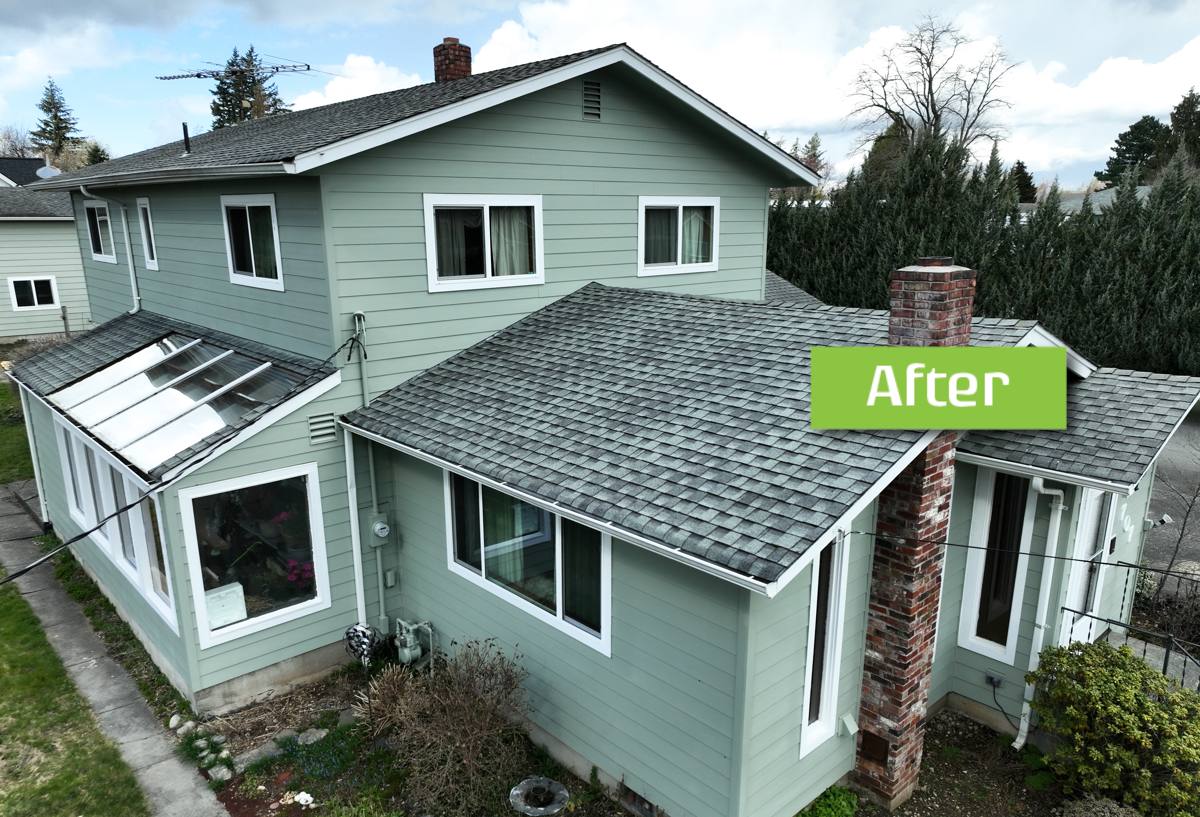
What a Correctly Installed Asphalt Shingle Roof Includes
A shingle roof is a system, not just a layer of shingles nailed to plywood. Every component underneath and around the shingles matters as much as the shingles themselves, especially in a wind-and-rain climate like this one.
Underlayment and Ice-and-Water Barrier
The underlayment is the roof's backup plan — the layer that keeps water out if wind ever drives rain up under a shingle tab or a shingle is damaged. We use synthetic underlayment across the field for its tear resistance and consistent water shedding, and we run self-adhering ice-and-water barrier at the eaves, valleys, and any roof-to-wall transitions, which are the spots most likely to see standing or backed-up water during a heavy winter storm.
Flashing Details
Flashing around chimneys, skylights, sidewalls, and valleys is where most shingle roof leaks actually originate — not in the open field of shingles. Step flashing at sidewalls, properly lapped valley metal, and counterflashing that's tucked correctly rather than just caulked over are what keep water managed at these transition points for the life of the roof. Caulk is a maintenance item, not a substitute for correctly formed and lapped metal.
Ventilation
A balanced intake-and-exhaust ventilation system keeps the attic space close to outdoor temperature and lets moisture escape rather than condense on the underside of the roof deck. Poor ventilation shortens shingle life from underneath — trapped heat and moisture cook the shingles from below and can rot the deck, regardless of how good the shingles on top are. We check soffit intake and ridge or box-vent exhaust as part of every shingle roofing job, not as an afterthought.
Choosing Shingles That Hold Up Near the Water
Not every asphalt shingle product performs the same in a marine environment, and the differences matter more here than in a sheltered inland neighborhood. The table below lays out the practical trade-offs for the shingle classes we typically discuss with Sandy Point homeowners.
| Shingle Type | Wind Performance | Algae/Moss Resistance | Typical Lifespan |
|---|---|---|---|
| Standard 3-tab | Lower wind rating, more prone to lifting in gusts off the water | Standard granules only, no built-in resistance | Shorter end of the range |
| Architectural/laminate | Higher wind rating from the laminated, dimensional construction | Often available with algae-resistant granules | Mid-to-long range |
| Algae-resistant (AR) laminate | Same strong wind rating as standard laminate | Copper- or zinc-infused granules actively resist moss and algae growth | Long range, holds appearance longer |
For most Sandy Point homes we recommend algae-resistant laminate shingles specifically because of the moss pressure described above — the granule technology doesn't eliminate the need for maintenance, but it meaningfully slows how fast growth establishes on shaded slopes. We also pay attention to the manufacturer's wind warranty rating and confirm our nailing pattern and fastener count meet or exceed what that rating requires, since a shingle's published wind rating only holds if it's installed to spec.
Signs a Sandy Point Roof Needs Attention
Because of the salt air and moss pressure here, shingle roofs in this area can show wear in ways that are easy to miss from the ground. Worth checking for, or asking us to check for during an inspection:
- Granules collecting in gutters or at downspout outlets — a sign the shingle surface is wearing down
- Dark streaking or green-black growth on north-facing or shaded slopes
- Moss forming in mats, especially near valleys and along the lower courses
- Curling, cupping, or lifted shingle edges, particularly on wall-facing or ridge-adjacent courses exposed to wind
- Rusted or corroded exposed fasteners, flashing edges, or vent caps
- Soft spots or sagging when walked, which can point to deck moisture damage underneath
- Daylight or water staining visible in the attic around chimneys, vents, or valleys
Any one of these on its own isn't necessarily an emergency, but they're the early indicators we look for so a small repair doesn't turn into a deck replacement.
Our Asphalt Shingle Roofing Process
Whether the job is a full replacement or a targeted repair, we work through the same disciplined sequence on every Sandy Point roof:
- On-site inspection of the existing roof, decking, flashing, and ventilation to scope the actual condition, not just a drive-by estimate
- Full tear-off of old roofing material down to the deck, so we can verify what's underneath rather than layering over hidden problems
- Deck inspection and repair or replacement of any soft, rotted, or delaminated sheathing before anything new goes down
- Installation of ice-and-water barrier at eaves, valleys, and wall transitions, followed by synthetic underlayment across the field
- New flashing at all chimneys, skylights, sidewalls, and valleys — we don't reuse old flashing on a full replacement
- Shingle installation following the manufacturer's nailing pattern and exposure specs to preserve the wind and product warranty
- Ridge and intake ventilation check, with corrections made if the existing system is undersized or blocked
- Full site cleanup, including a magnetic nail sweep of the yard and driveway
- Final walkthrough so you can see the completed work and ask questions before we call the job done
Living With a Long Moss Season
Even a well-installed, algae-resistant shingle roof needs some seasonal attention in this part of Whatcom County, simply because the wet season runs long and shaded roof planes rarely get a chance to fully dry out between storms. A few habits go a long way toward protecting the investment:
- Keep gutters and valleys clear of needles and debris so water doesn't pool and feed moss growth
- Trim back overhanging branches to reduce shade and debris drop on north-facing slopes
- Have moss physically removed or treated before it mats thick enough to hold water against the shingles — soft washing rather than pressure washing protects the granule surface
- Schedule a roof check after the heaviest part of the storm season to catch any wind or debris damage early
We're glad to walk a homeowner through what a reasonable maintenance schedule looks like for their specific roof — pitch, shading, and tree cover all change how often these steps are actually needed.
What Affects the Cost of a Shingle Roof in Sandy Point
Every roof is different, so we don't quote sight unseen, but the factors below are the main drivers behind cost on most jobs in this area.
| Cost Factor | Why It Matters |
|---|---|
| Roof size and pitch | More square footage and steeper pitches take more material and more labor time |
| Number of layers to remove | Tearing off multiple existing layers adds labor and disposal cost versus a single layer |
| Deck condition | Rotted or delaminated sheathing found during tear-off requires replacement before shingles go on |
| Shingle class chosen | Algae-resistant laminate shingles cost more up front than standard 3-tab but hold up longer here |
| Roof complexity | Chimneys, skylights, valleys, and multiple roof planes all add flashing work and time |
| Access and site conditions | Steep sites, limited driveway access, or proximity to the water can affect staging and disposal logistics |
We'll go over these factors specifically for your roof during an on-site estimate, so you know exactly what's driving the number rather than getting a flat per-square rate that doesn't reflect your actual roof.
Why Hire a Crew That Already Works in Sandy Point
A shingle roof spec'd for a dry inland climate isn't automatically the right spec for a home exposed to salt air and wind off the water. Knowing which flashing details matter most in this specific setting, which shingle products actually resist the moss pressure here, and how much ventilation a Sandy Point attic really needs comes from working roofs in this exact area, not from a generic installation checklist. We're based in Blaine, we work throughout Whatcom County, and Sandy Point's coastal exposure is a condition we plan for on every job here, not an exception we're figuring out for the first time.
That local familiarity also means we can talk through realistic timelines around this area's weather windows, and we're not disappearing after the invoice is paid if a question comes up down the road.
Get a Free, No-Pressure Estimate
If you're dealing with moss buildup, a roof that's overdue for a look, or you're just planning ahead for a Sandy Point home, we're happy to take a look and give you a straight assessment — no pressure, no hard sell. Use the form below to request a free estimate and we'll get back to you to schedule a time that works.