 Blaine Siding
 Why Birch Point Decks Wear Out Faster Than Inland Decks
Birch Point sits close enough to the water that every deck out here is dealing with conditions a deck twenty miles inland never sees. Salt-laden air corrodes fasteners and hardware from the inside out, long before the wood itself looks bad. Driving rain off the Strait gets pushed sideways into railings, stair stringers, and the gaps between deck boards where it doesn't dry out quickly. And Whatcom County's long wet season — often stretching from fall through spring — gives moss and algae months to establish themselves on any horizontal surface that doesn't get regular sun or airflow.
None of that means a deck at Birch Point can't last. It means the deck has to be built and replaced with those specific stresses in mind, not with a generic approach that would work fine in a drier part of the state. A deck replacement here is really a chance to fix the things that let the original deck fail early — usually a combination of hidden moisture, the wrong hardware, or a design that didn't account for how much water actually hits a waterfront-facing structure.
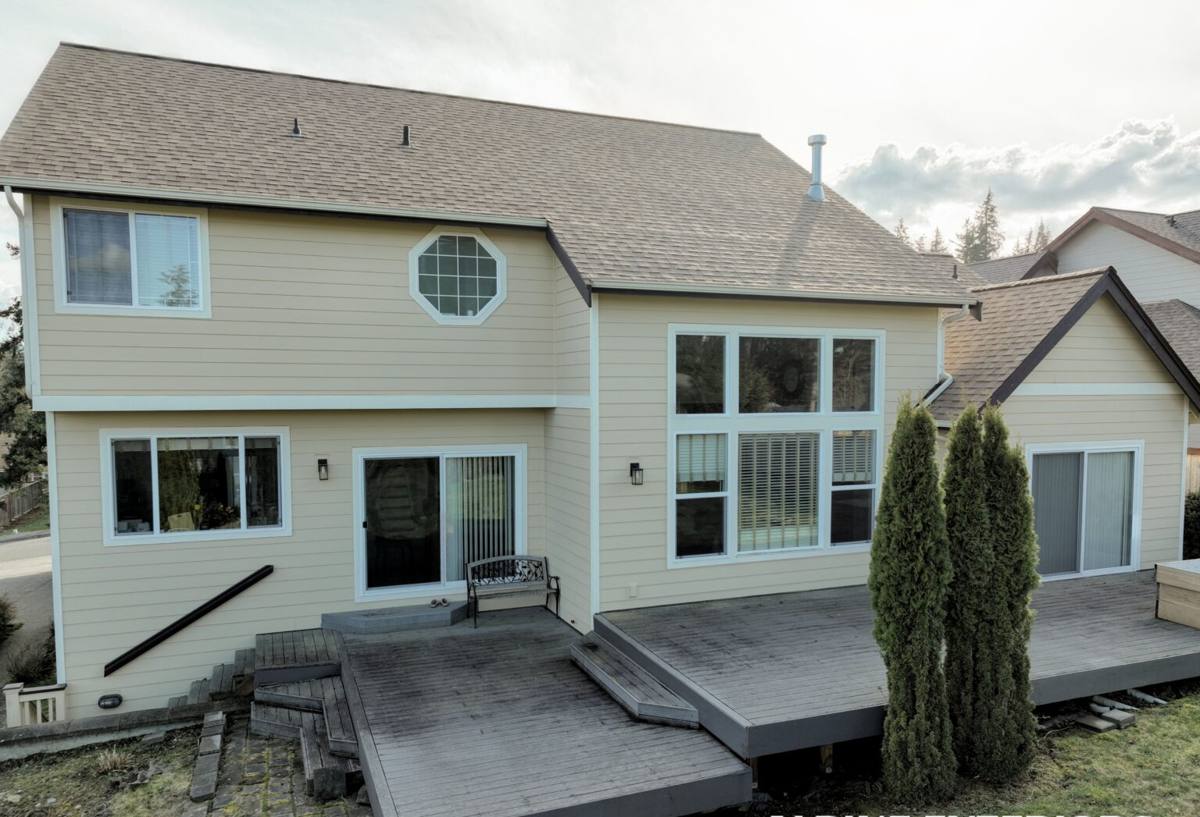
Signs a Deck Needs Replacement, Not Just Repair
Homeowners often call us wanting a quote on "a few boards" and end up needing a full replacement once we're underneath the deck. It's worth knowing the difference before you spend money on a repair that won't hold.
- Soft, spongy decking that gives when you press on it, especially near board ends or around fastener heads
- Rust streaks bleeding out from screws or nails — a sign the fastener is failing inside the board
- The ledger board (where the deck attaches to the house) shows gaps, dark staining, or movement when the deck is loaded
- Footings or posts that have shifted, settled unevenly, or show cracking at the base
- Persistent moss or black-green staining that comes back within weeks of cleaning, even after a pressure wash
- Railings that flex or wiggle more than a firm push should produce
- A musty smell coming from underneath the deck, which usually means moisture is trapped against the framing
One or two of these on their own might mean a repair. Several together, especially anything involving the ledger board or footings, almost always means the structure needs to come out and be rebuilt correctly.
What a Correct Deck Replacement Actually Involves
It Starts Below the Decking, Not With It
The boards you walk on are the last thing installed and the first thing homeowners judge, but the framing underneath is what determines whether the deck lasts 10 years or 30. A proper replacement means checking or rebuilding the ledger board connection with correct flashing so water can't get behind it, sizing joists and beams to current code for the actual span and load, and confirming footings are deep enough and sized right for our soil conditions.
Drainage Has to Be Designed In, Not Left to Chance
On a site that gets as much rain as Birch Point does, water management can't be an afterthought. That means proper gapping between boards for airflow and drying, ledger flashing that directs water away from the house framing, and grading or drainage matting under low decks so water doesn't pool against posts and footings. A deck that traps water against wood, even pressure-treated wood, is a deck that will need attention again sooner than it should.
Choosing Decking Material for a Salt-Air, Moss-Prone Site
There's no single "best" decking material — every option is a set of trade-offs, and the right choice depends on how much maintenance you want to do and how the deck is used. What we won't do is put a material on a Birch Point deck without being upfront about how it will actually perform in this climate.
| Material | Moisture & Moss Behavior | Maintenance | Typical Lifespan |
|---|---|---|---|
| Pressure-treated wood | Absorbs moisture; needs sealing to resist moss and staining | Annual cleaning and re-sealing recommended | 10–15 years with upkeep |
| Cedar | Naturally moderate rot resistance but still absorbs water; moss forms without upkeep | Regular cleaning, periodic oil or sealant | 15–20 years with upkeep |
| Composite decking | Doesn't absorb water like wood but can still grow surface moss/algae if shaded and damp | Occasional wash, no sealing or staining | 25–30 years |
| PVC/capped composite | Fully sealed surface, least hospitable to moss and algae buildup | Low — occasional wash | 25–30+ years |
For homes right at Birch Point, we lean toward recommending composite or capped composite decking on horizontal surfaces exposed to standing moisture, simply because it holds up to the moss cycle with far less ongoing work. That said, some homeowners want the look and feel of real wood and are willing to keep up with the maintenance — that's a legitimate choice too, as long as it's made with clear eyes about the upkeep involved.
Fasteners, Flashing, and Hardware — the Details Salt Air Punishes First
More decks fail because of bad hardware than bad decking. Standard galvanized fasteners and connectors can start corroding within a few years this close to the water. On every deck replacement, we use stainless steel or marine-grade coated fasteners and structural connectors rated for coastal exposure, and we flash the ledger board properly so water can't sit against the house rim joist. These aren't upgrades — for a Birch Point deck, they're the baseline for a job that's supposed to last.
Permits and Shoreline Considerations in Whatcom County
Deck replacement in Whatcom County typically requires a building permit, and that requirement doesn't go away just because the old deck was "grandfathered in." If a deck is close to the water or within a shoreline jurisdiction, there can be additional setback or shoreline review requirements layered on top of the standard building permit — the specifics depend on the parcel and its exact distance from the water, so this gets checked property by property rather than assumed. We handle the permit process as part of the job so homeowners aren't left figuring out county requirements on their own.
Our Process for a Birch Point Deck Replacement
- On-site assessment of the existing deck, including checking under the decking at the framing, ledger, and footings — not just a visual walk-around
- Honest recommendation on repair versus full replacement, with the reasoning explained
- Written estimate covering material options and what's driving the cost difference between them
- Permit handling through Whatcom County, including any shoreline review the property requires
- Demolition and disposal of the old deck
- Framing, flashing, and footing work brought up to current code
- Decking, railing, and stair installation with corrosion-resistant hardware throughout
- Final walkthrough before we consider the job done
Why a Crew That Already Works Birch Point Matters
A deck built for a dry inland yard and a deck built for a waterfront lot in Whatcom County are not the same project, even if they look identical from the street. A crew that regularly works Birch Point already knows which fasteners hold up here, how far water can be driven sideways by wind off the Strait, and what the moss cycle does to a deck that isn't detailed correctly. That experience shows up in decisions made before the first board goes down — decisions a crew unfamiliar with this shoreline might not think to make.
It also matters for permitting. A contractor who has already been through the Whatcom County process for shoreline-adjacent properties knows what documentation the county wants and doesn't waste time learning the process on your job.
Keeping a New Deck Looking Good in This Climate
A well-built deck still needs some seasonal attention here, especially through Blaine's wetter months.
- Sweep debris off the deck regularly so leaves and needles don't trap moisture against the boards
- Rinse or lightly scrub visible moss growth before it spreads, rather than waiting for it to build up
- Check that gaps between boards stay clear of debris so water and air can move through
- Inspect railings and stair connections once a year for movement or corrosion at the hardware
- For wood decks, plan on re-sealing on the schedule the product calls for — skipping a cycle is when moss and rot get a foothold
If you're dealing with a tired, soft, or moss-covered deck at Birch Point, we're happy to take a look and give you a straight answer on what it actually needs. Reach out using the form below for a free, no-pressure estimate.