 Blaine Siding
 Why Ferndale Homes Need Siding Built for This Climate
Ferndale sits close enough to the Strait of Georgia and Bellingham Bay that salt-laden air is a daily fact of life for the homes here, not an occasional coastal event. Add Whatcom County's long wet season, driving rain that comes in sideways off the water, and the shaded, damp conditions that let moss and algae take hold on north-facing walls for months at a time, and you have a climate that is genuinely hard on exterior siding. Products that hold up fine in a drier inland climate often struggle here: wood swells and rots at the edges, vinyl chalks and gaps at the seams, and lower-grade composite panels can absorb moisture at cut ends and delaminate over a few winters.
Fiber cement siding was engineered specifically for problems like this. It's dimensionally stable, doesn't feed mold or moss the way wood does, and — installed correctly — sheds the kind of sustained, wind-driven rain that Ferndale sees from fall through spring. That last part, "installed correctly," is the whole story. Fiber cement is a strong material, but its long-term performance depends almost entirely on installation details: clearances, flashing, fastening, and caulking. A great product installed carelessly will still trap moisture and fail early. That's the gap this page is really about.
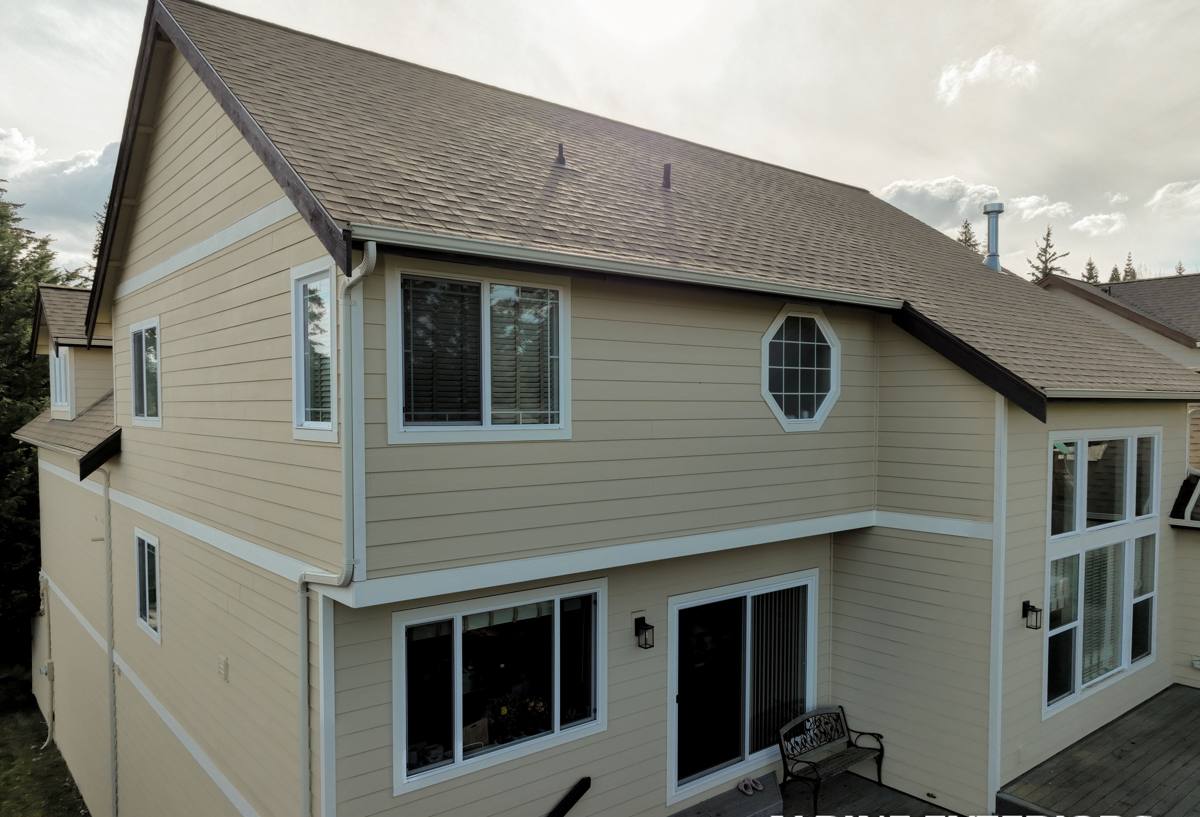
What a Correct Fiber Cement Job Actually Involves
Fiber cement isn't a material you can install the way you'd install vinyl or hang a panel and move on. It has specific requirements, and skipping any of them shortens the life of the siding regardless of how good the boards themselves are.
Clearances and Ground Contact
Fiber cement siding needs a minimum clearance from grade, roofing, decks, and paved surfaces — generally several inches, more in areas prone to standing water or heavy sprinkler overspray. In a wet climate like Whatcom County's, cutting that clearance close invites wicking at the bottom edge, which is one of the most common causes of premature siding failure we see when we're called in to look at older installations.
Weather-Resistive Barrier and Flashing
Behind every course of siding there needs to be a continuous, properly lapped weather-resistive barrier, with flashing integrated at every penetration — windows, doors, hose bibs, light fixtures, deck ledgers, and roof-to-wall intersections. Given how much rain Ferndale gets over a typical winter, any gap in this layer becomes a slow leak point, often invisible from the outside for years before it shows up as rot in the sheathing.
Fastening
Fiber cement requires corrosion-resistant fasteners, driven at the correct depth and spacing — not too deep (which cracks the board or blows out the fastening zone), not too shallow (which leaves the board loose and prone to rattling and wind damage). Near salt air, fastener corrosion resistance matters more than it would fifty miles inland; the wrong fastener can rust and streak the siding within a few seasons.
Cut Edges and Caulking
Every field-cut edge of a fiber cement board needs to be sealed — factory edges are protected, but a cut end left raw will absorb moisture over time. Joints, seams, and terminations need the right sealant, applied to manufacturer spec, not just enough caulk to make the seam look tidy. This is one of the most common shortcuts on rushed jobs, and it's also one of the hardest for a homeowner to catch during a walkthrough.
James Hardie Products and Why We Install Only Hardie
We install James Hardie fiber cement exclusively — we don't install LP SmartSide, vinyl, Cemplank, Allura, or unfinished wood siding. That's a deliberate standard, not a sales preference. Hardie's HardieZone system engineers its products for specific climate regions, its ColorPlus finish is factory-applied and baked on (rather than field-painted, which is where a lot of exterior finish failures start), and the company backs its products with a strong, transferable non-prorated warranty when installed by a certified installer. For a coastal Whatcom County home, that combination of engineered moisture resistance and a finish that isn't relying on a caulk gun and a paint crew to hold up is worth the standard.
| Product Line | Best Use | Notes for Ferndale Homes |
|---|---|---|
| HardiePlank lap siding | Primary wall cladding | Most common choice; wide color and texture range in ColorPlus finish |
| HardiePanel vertical siding | Accent walls, gables, modern facades | Clean lines, pairs well with board-and-batten detailing |
| HardieShingle siding | Accent areas, Craftsman and cottage styles | Staggered or straight-edge profiles for visual texture |
| HardieTrim boards | Corners, fascia, window and door trim | Matches siding durability so trim doesn't fail before the field siding does |
Our Process for a Ferndale Fiber Cement Install
The steps below are the same core process we follow on every fiber cement job in this area, adjusted for the specific exposure of each home — a wall that takes direct weather off the water gets more attention at flashing and clearance details than a sheltered, tree-covered elevation.
- On-site assessment. We look at existing siding condition, sheathing condition where accessible, moisture staining, moss and algae patterns, and the home's specific exposure to wind-driven rain and salt air.
- Tear-off and sheathing check. Old siding comes off and we inspect the sheathing underneath. Any soft, rotted, or water-damaged sheathing gets repaired before anything new goes up — covering damaged sheathing with new siding just hides a problem that will resurface.
- Weather-resistive barrier and flashing installation. New barrier goes on with correct lapping, and flashing is installed or upgraded at every penetration and transition.
- Siding installation to Hardie spec. Correct clearances, fastener type and spacing, and cut-edge sealing at every board.
- Trim, caulking, and detail work. Corners, trim boards, and all joints get finished to manufacturer specification — this is where a lot of the long-term weather performance actually comes from.
- Final walkthrough. We go over the finished job with the homeowner before considering it complete.
Why Local Experience in Whatcom County Matters
A crew that already works in and around Ferndale and Blaine has seen how this specific stretch of coastline behaves on real homes — which elevations take the worst of the wind-driven rain, how fast moss establishes on shaded north walls, and how salt air affects fastener and flashing choices over time. That's different from general siding experience in a drier or more sheltered part of the state. It also means we're not learning the local permitting process, weather patterns, or common older-home construction details on your project. Familiarity with the area translates directly into fewer surprises during tear-off and better decisions on flashing and clearance details that aren't always obvious from a spec sheet.
What Affects the Cost of a Fiber Cement Project
Every home is different, and we'd rather give you an accurate number after seeing the house than a broad estimate that doesn't hold up. That said, these are the main factors that drive cost up or down on a typical project:
| Factor | Why It Matters |
|---|---|
| Home size and wall complexity | More corners, gables, and dormers mean more cutting, trim, and labor time |
| Existing siding removal | Tear-off of old wood, vinyl, or damaged siding adds time versus a bare-wall install |
| Sheathing repair | Rot or moisture damage found during tear-off needs to be fixed before new siding goes on |
| Product line and profile | Lap siding, panel siding, and shingle siding differ in material and labor cost |
| Trim and accent detail | Board-and-batten accents, shingle sections, and custom trim add labor |
| Accessibility | Steep rooflines, tight lot lines, or multi-story walls affect staging and labor time |
Living With Fiber Cement: Maintenance That Actually Matters
One of the real advantages of fiber cement over wood is how little ongoing maintenance it needs — but "little" isn't "none," especially in a moss-prone, salt-air climate like this one. Here's what actually matters for keeping the siding, and the ColorPlus finish, performing the way it should:
- Rinse the siding annually, focusing on shaded, north-facing walls where moss and algae take hold first
- Keep gutters clear so overflow doesn't run down the siding face and accelerate moss and staining
- Trim back shrubs and trees that keep wall sections shaded and damp longer than they need to be
- Inspect caulking at trim and penetrations every couple of years and have any cracked or shrunk sealant redone
- Watch for chalking, fading, or peeling — with ColorPlus finish this should be rare, and it's worth a warranty call if it happens early
- Address any staining or rust streaking near fasteners promptly rather than letting it spread
Warranty and What It Actually Covers
James Hardie backs its siding products with a strong, transferable non-prorated limited warranty, and ColorPlus finishes carry their own finish warranty covering fading, chipping, and cracking under normal conditions. Warranty coverage on a fiber cement job depends heavily on correct installation — manufacturer warranties are tied to installation being done to spec, which is part of why the installation details covered above aren't optional extras. We install to manufacturer specification specifically so the warranty coverage you're paying for is actually intact if you ever need it.
Get a No-Pressure Estimate
If your Ferndale home's siding is showing moss staining, soft spots, or gaps at the seams, or you're planning ahead for a replacement, we're happy to take a look and walk you through what we see — no pressure, no obligation. Use the form below to request a free estimate.