 Blaine Siding
 Composite Decking in a Salt Air, High-Rain Climate
Peace Arch sits close enough to the water and to Semiahmoo Bay that homes here deal with a specific combination most inland Whatcom County properties don't: salt-laden air, long stretches of driving rain off the water, and a moss season that can run from early fall well into spring. A deck out here isn't just exposed to "Pacific Northwest weather" in the general sense — it's exposed to weather that pushes moisture sideways into fastener heads, board gaps, and ledger connections, and it does it for months at a time without much drying window in between storms.
That combination is exactly why composite decking has become the practical choice for a lot of homeowners in this area. Wood decks can be built well and last, but they need consistent maintenance to hold up against salt air corrosion on fasteners and moss growth in shaded, damp corners. Composite, installed correctly, gives you a surface that doesn't absorb water the way wood fibers do, doesn't need annual staining, and resists the kind of moss and algae growth that turns a deck slick and dangerous by December.
This page is about composite decking specifically — not siding, not general remodeling — and specifically for homes in the Peace Arch area. The install details, board selection, and maintenance advice below are shaped by what actually happens to decks in this microclimate, not generic decking advice written for a dry climate.
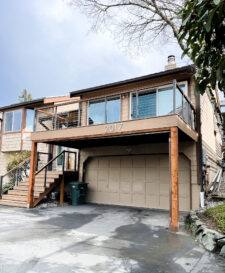
What Salt Air, Rain, and Moss Actually Do to a Deck
Salt air and hardware
Salt-laden air corrodes exposed metal faster than inland air does. On a deck, that means fastener heads, joist hangers, ledger bolts, and any exposed screws are the first things to show rust or pitting if the wrong grade of hardware was used. Once a fastener starts to corrode, it can weep rust stains into the decking boards around it and eventually lose holding strength.
Driving rain and water path
Rain that comes in sideways off the water doesn't just fall on the deck surface — it drives into board-to-board gaps, under railing posts, and against the house where the deck ledger attaches. If that water doesn't have a clear, engineered path to shed away from the structure, it sits. Sitting water is what rots ledger boards, softens joists, and eventually causes a deck to feel spongy or uneven.
Moss and the long shade season
Moss needs moisture and low light to establish, and Peace Arch gets a long stretch of both. On wood decking, moss can actually take root in the wood grain. On composite, moss and algae sit on the surface rather than in it, which matters — it's the difference between a problem you can pressure-wash off in twenty minutes and one you have to sand, treat, and reseal.
Composite vs. Wood vs. PVC for This Climate
There's no single "best" decking material for every home — it depends on budget, how much upkeep you want to do, and how exposed the deck is to weather. Here's how the three common options actually compare for a coastal Whatcom County property.
| Material | Moisture behavior | Maintenance | Typical lifespan here |
|---|---|---|---|
| Pressure-treated wood | Absorbs water; needs sealing to resist rot and moss | Annual cleaning, sealing/staining every 1-2 years | 10-15 years with upkeep |
| Capped composite | Cap layer sheds water; core resists rot | Periodic wash; no staining or sealing | 25-30+ years |
| Cellular PVC | Fully water-resistant, no wood fiber | Lowest upkeep; wash only | 25-30+ years |
We install capped composite for most Peace Arch homeowners because it strikes the right balance of cost, appearance, and performance in this climate. Uncapped or older-generation composite boards (all-in mixed wood-plastic with no protective cap) can absorb moisture at the surface over time and are more prone to staining and mold in a climate this wet — that's a maintenance and moisture-behavior trade-off, not a claim about any one brand being defective. We're upfront with clients about that difference before they choose a board.
What a Correct Composite Deck Installation Actually Involves
Composite boards are more forgiving than wood in some ways and less forgiving in others. A correct install in a wet, salty climate involves details that don't show up in a brochure:
The substructure comes first
Composite decking is only as good as what's underneath it. Joists need to be sized and spaced correctly for the specific composite product (composite typically needs tighter joist spacing than wood, especially on diagonal or picture-frame layouts), and every joist top should be protected with joist tape before boards go down. Joist tape isn't optional trim — it's a waterproof barrier that keeps rain from soaking into the top of the framing where fastener screws penetrate.
Ledger flashing and the house connection
Where the deck attaches to the house is the single highest-risk water entry point on the whole structure. Correct ledger flashing directs water away from the wall assembly instead of letting it channel behind the siding. In a driving-rain area like this, a poorly flashed ledger is often the reason a deck looks fine on top but has hidden rot underneath within a few years.
Fastener selection
Given the salt air, we use stainless steel or coated fasteners rated for coastal exposure rather than standard galvanized hardware. It costs a bit more up front and saves you from rust streaks and weakened connections down the road.
Gapping and drainage
Board spacing has to account for both composite's thermal expansion and the need for water to actually drain through rather than pool on the surface. Too tight, and boards can buckle in temperature swings or trap standing water; too wide, and the deck feels sloppy underfoot.
Hidden fastener systems
Most composite boards today are designed for hidden fastener clips rather than face-screwing. Done right, this gives a clean surface with no screw heads to corrode or catch water — but it requires the clips to be installed at the correct spacing and torque, which is where inexperienced crews often cut corners.
Our Process for a Peace Arch Composite Deck
- Site visit and assessment — we look at sun/shade exposure, existing drainage patterns, ledger condition if it's a replacement, and how exposed the site is to wind-driven rain off the water.
- Board and layout selection — we walk through capped composite options, color and grain choices, and railing systems that hold up to salt air.
- Structural check — footings, ledger, and joists are evaluated against current code and the load requirements of the composite product chosen.
- Install — framing and joist tape, ledger flashing, hidden fastener system, and finish trim, in that order, with attention to drainage the whole way through.
- Final walkthrough — we go over basic care with you before we consider the job done.
Choosing the Right Board for a Marine Climate
Not every composite board is built the same, and the right choice depends on how exposed your specific deck is. A deck that's mostly covered by a roofline and shielded from direct wind-driven rain has more flexibility in board choice than one that's fully open to the weather coming off the water. Things worth weighing:
- Full cap vs. partial cap — full-cap boards resist moisture and staining better on all sides, which matters most on open, exposed decks.
- Streaking and mold resistance — some board lines are formulated specifically to resist the kind of mildew growth common in shaded, damp Pacific Northwest yards.
- Color — darker boards absorb more heat and can show pollen/dust differently than lighter tones; this is a preference call, not a performance issue.
- Grain pattern and slip resistance — a textured, low-gloss finish matters more here than in a dry climate, since the deck surface is wet more often than not for parts of the year.
Cost factors to expect
| Factor | Why it moves the price |
|---|---|
| Deck size and shape | More linear footage of board and framing; complex shapes (curves, angles) add labor |
| Board tier | Full-cap, premium composite lines cost more per square foot than entry-level composite |
| Substructure condition | Replacing rotted ledger, joists, or footings adds cost beyond surface decking |
| Railing system | Composite or aluminum rail systems vary widely in price versus basic wood rail |
| Height and access | Elevated decks or difficult site access add labor time |
We give honest, itemized estimates rather than a flat per-square-foot number pulled from a national average — every Peace Arch lot and every existing structure is different, and the estimate should reflect your actual site.
Living With a Composite Deck in Peace Arch
Composite decking cuts maintenance dramatically compared to wood, but "low-maintenance" doesn't mean "no maintenance," especially in a climate that stays damp for so much of the year. A simple seasonal routine keeps a composite deck performing the way it's supposed to:
- Rinse or pressure-wash (low setting) at the start of moss season and again in spring to clear pollen, dirt, and any early moss growth before it sets in.
- Keep gutters and downspouts near the deck clear so water isn't dumping directly onto the deck surface or the ledger connection.
- Sweep standing debris out of board gaps — trapped leaves and needles hold moisture against the boards longer than open air does.
- Check railing posts and stair connections once a year for any looseness, which can be an early sign of a fastener or framing issue underneath.
- Avoid harsh solvents or pressure settings above what the manufacturer recommends — they can dull the cap layer's finish over time.
Why Hiring a Crew That Already Works Peace Arch Matters
A lot of what makes a composite deck last in this specific area isn't in the product spec sheet — it's in how the substructure is built to handle this climate's rain volume, how the ledger is flashed against a house that's already dealing with salt air exposure, and which fastener grades actually hold up here versus somewhere drier. A crew that already works Blaine and the Peace Arch area has seen what happens to decks built without those details, and builds accordingly from the start rather than learning it on your project.
Local knowledge also matters for permitting and code compliance — Whatcom County and city requirements around deck footings, guardrail height, and setback can differ from what a crew used to a different jurisdiction assumes. Getting that wrong costs time and money in corrections after the fact.
Get a Straightforward Estimate
If you're weighing composite decking for a home in the Peace Arch area, we're glad to come take a look, walk the site with you, and give you a clear, no-pressure estimate based on your actual deck — not a generic quote. Use the form below to get started.